
Wir verwenden Cookies

Diese Website nutzt Google Analytics, um die Nutzung zu analysieren und unser Angebot zu verbessern. Ihre Zustimmung ist freiwillig und kann jederzeit widerrufen werden.

DGI-zertifizierte ImplantologinÜber 95% Erfolgsrate13+ Jahre Erfahrung

Dental Prosthetics Munich - Crowns, Bridges & Dentures | Dentist Christina Dickel

A complete and healthy set of teeth is essential for quality of life. In our Munich practice, we offer modern dental prosthetic solutions that functionally and aesthetically replace damaged or missing teeth. From single crowns to complete denture solutions - each restoration is individually tailored to your needs.

What Is Dental Prosthetics?

Dental prosthetics — known in dentistry as prosthodontics — encompasses all measures to replace damaged or missing teeth. Whether a single tooth needs a crown or an edentulous jaw requires rehabilitation with a fixed implant-supported restoration, modern dental prosthetics reliably restore chewing function, speech and aesthetics.

Tooth loss has far-reaching consequences that go well beyond appearance. Without timely replacement, neighbouring teeth drift into the gap, the opposing tooth appears to "grow" out of the jaw (elongation), and the jawbone in the edentulous area gradually resorbs. Early treatment prevents this chain reaction.

We broadly distinguish two categories:

  • Fixed prosthetics: Crowns, bridges and implant-supported restorations — permanently cemented or screwed in place, they feel like your own teeth.
  • Removable prosthetics: Partial and full dentures — can be taken out for cleaning and offer flexible solutions for more extensive tooth loss.

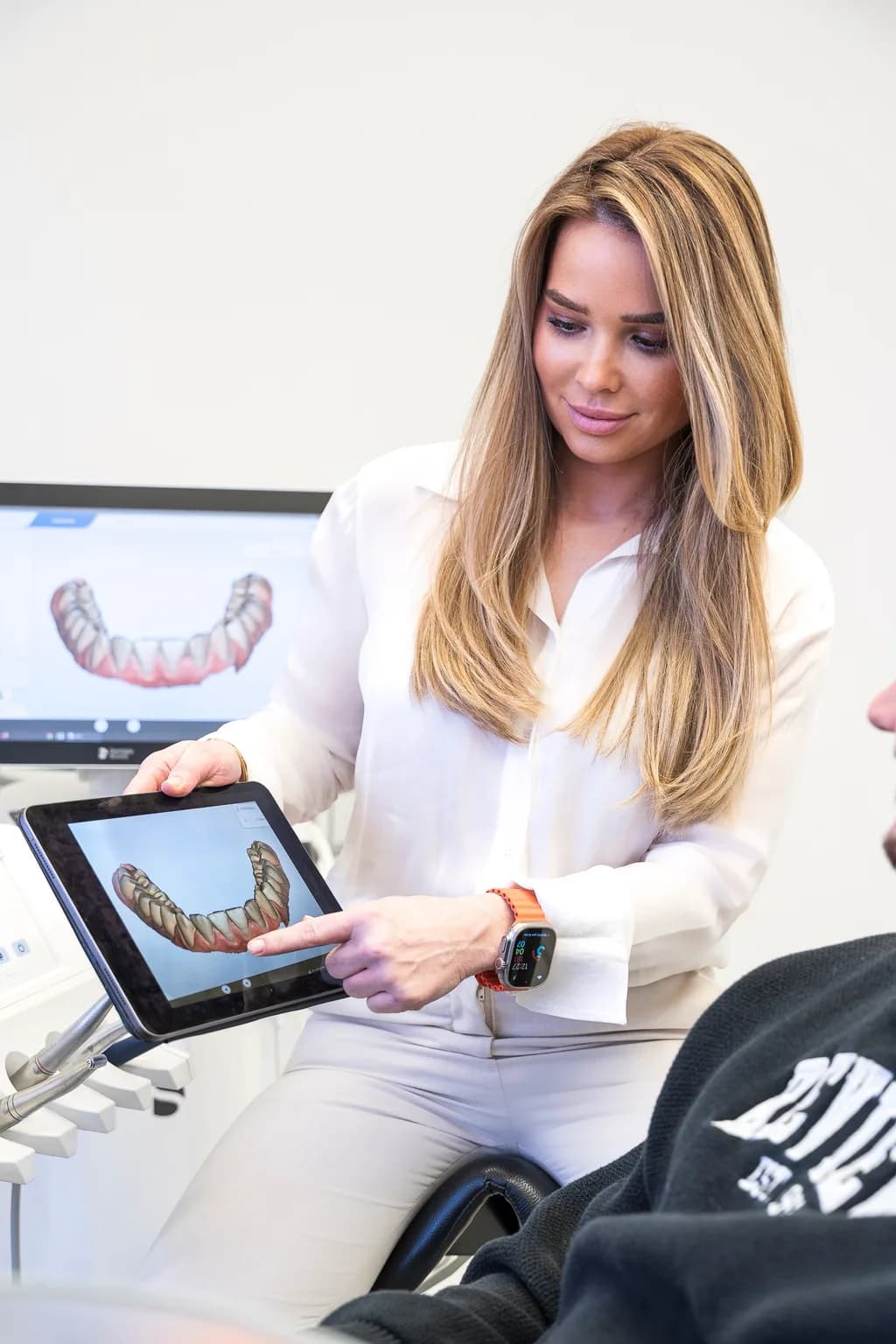
At our practice in Munich-Oberfoehring, we offer the full spectrum of modern dental prosthetic solutions. As a CEREC-certified practice, we use digital CAD/CAM technology for precise, aesthetically pleasing restorations — often in considerably less time than conventional methods.

Festsitzender und herausnehmbarer Zahnersatz im Vergleich
Die zwei Kategorien: Festsitzender Zahnersatz (Kronen, Brücken) und herausnehmbarer Zahnersatz (Prothesen).

Overview of Dental Prosthetic Options

Choosing the right type of dental prosthetic depends on the number of missing teeth, the condition of the remaining teeth, the jawbone and your personal preferences. Here is an overview of the main options:

TypeFixed?LongevityInsuranceSuitable for
Dental crown✓ Yes10–15 yearsFixed subsidySeverely damaged single tooth with preserved root
Dental bridge✓ Yes10–15 yearsFixed subsidy1–2 missing teeth with stable neighbouring teeth
Partial denture✗ Removable5–10 yearsFixed subsidyMultiple missing teeth with remaining natural teeth
Telescopic denture✗ Removable (secure fit)10–15 yearsFixed subsidyMany missing teeth, high comfort desired
Full denture✗ Removable5–8 yearsFixed subsidyEdentulous jaw
Implant + crown✓ Yes15–20+ yearsFixed subsidy*Single or multiple missing teeth, sufficient bone
All-on-4 / All-on-6✓ Yes (screw-retained)15–20+ yearsFixed subsidy*Edentulous jaw, desire for fixed teeth in a single day

* For implants, German statutory health insurance pays the fixed subsidy (Festzuschuss) for the prosthetic component (crown/bridge), not for the implant itself.

Sieben Zahnersatz-Arten im Vergleich: Krone, Brücke, Teilprothese, Teleskopprothese, Vollprothese, Implantat, All-on-4
Alle Zahnersatz-Arten auf einen Blick: Vom einzelnen Zahn bis zum zahnlosen Kiefer.

Fixed Dental Prosthetics

Fixed dental prosthetics are permanently attached to prepared teeth or implants — you care for them just like your own teeth. They offer the highest level of comfort and the most natural appearance.

Zahnkrone und Zahnbrücke im anatomischen Vergleich
Links: Krone als Schutzkappe für einen geschädigten Zahn. Rechts: Brücke mit Pfeilerzähnen und Brückenglied.

Dental Crowns — Protection for Damaged Teeth

A dental crown encases the entire visible tooth like a cap, restoring its shape, function and aesthetics. Crowns are used when a tooth has been so severely weakened by decay, fracture or following a root canal treatment that a filling is no longer sufficient.

At our practice, we prefer to work with all-ceramic and zirconia materials — metal-free, biocompatible and virtually indistinguishable from natural teeth. Thanks to our CEREC technology, we can fabricate and fit ceramic crowns in a single appointment in many cases.

Dental Bridges — Closing Gaps Reliably

A dental bridge replaces one or two missing teeth by anchoring to the neighbouring teeth (abutment teeth). These neighbouring teeth are crowned, and the bridge is cemented as a single, connected unit.

For patients who wish to preserve their neighbouring teeth, the Maryland bridge (adhesive bridge) offers a minimally invasive alternative: the replacement tooth is bonded to the backs of the neighbouring teeth using thin wings — with little or no preparation required.

Removable Dental Prosthetics

Removable dental prosthetics can be taken out for cleaning and at night. Modern solutions offer significantly more comfort and retention than those of just a few years ago.

Drei Prothesenarten: Teilprothese, Teleskopprothese und Vollprothese
Herausnehmbarer Zahnersatz: Von der Klammerprothese über die Teleskopprothese bis zur Totalprothese.

Partial Dentures — When Natural Teeth Remain

A partial denture replaces several missing teeth and is attached to the remaining natural teeth. The simplest version is the clasp-retained denture (cast metal framework), which uses metal clasps for retention.

A superior option both aesthetically and functionally is the telescopic denture: inner crowns (primary telescopes) are cemented onto the remaining teeth. The denture contains matching outer crowns (secondary telescopes) that slide precisely over the inner crowns through friction fit. The result: secure retention without visible clasps, yet removable for cleaning when needed. Telescopic dentures are among my preferred solutions for more extensive tooth loss.

Full Dentures — For the Edentulous Jaw

A full denture (complete denture) replaces all teeth in one jaw. It consists of a gum-coloured acrylic base with acrylic teeth attached, held in place by suction and anatomical fit.

In the upper jaw, suction retention generally works well. In the lower jaw, retention is often limited — stabilisation with two to four implants can greatly improve comfort and function.

Implant-Supported Dental Prosthetics

Dental implants are artificial tooth roots made of titanium or ceramic that are placed into the jawbone and integrate firmly during healing. They serve as the foundation for fixed dental prosthetics — without the need to prepare neighbouring teeth.

All-on-4-Konzept: Vier Implantate tragen eine festsitzende Brücke im zahnlosen Kiefer
All-on-4: Nur vier strategisch gesetzte Implantate ermöglichen festsitzende Zähne für den gesamten Kiefer.

Implant-Supported Single Crown and Bridge

A single implant with a screwed-on ceramic crown replaces a missing tooth without placing any load on the neighbouring teeth — the aesthetically and functionally best solution for single-tooth gaps. When several adjacent teeth are missing, an implant-supported bridge can be anchored on two or more implants.

All-on-4 and All-on-6 — Fixed Teeth in a Day

The All-on-4 concept enables the restoration of a fully edentulous jaw with just four strategically placed implants. The two posterior implants are tilted (approx. 45°) to provide sufficient anchorage even when bone volume is reduced — bone grafting is often unnecessary as a result.

With All-on-6, six implants are placed, distributing the load more evenly and providing even greater stability when bone is adequate. In both cases, you receive a provisional fixed restoration on the day of treatment — "fixed teeth in a day". The definitive ceramic restoration is fitted after the healing phase (3–6 months).

As a member of the DGI (German Society for Implantology), I regularly undertake continuing education in the latest implant techniques. At our practice, we plan every implant case digitally using 3D imaging (CBCT) for maximum precision and safety.

Crown or Bridge? A Decision Guide

Many patients ask themselves: "Crown or bridge?" The answer depends on the specific situation:

  • Tooth still present but severely damaged? → A crown protects and preserves the tooth.
  • One tooth missing, neighbouring teeth already crowned or heavily filled? → A bridge makes sense, as the neighbouring teeth need crowns anyway.
  • One tooth missing, neighbouring teeth healthy and intact? → An implant with a crown is the best choice, as the healthy neighbouring teeth need not be prepared.
  • A front tooth missing and a conservative solution desired? → A Maryland bridge can replace the tooth without significant preparation of the neighbouring teeth.

During the consultation, I openly discuss all options with their advantages and disadvantages — so that you can make a well-informed decision.

Costs and Fixed Subsidy (Festzuschuss) 2026

The cost of dental prosthetics consists of the dentist's fee, laboratory costs and material costs. As a patient with German statutory health insurance (gesetzliche Krankenversicherung), you are entitled to a fixed subsidy (Festzuschuss) from your health insurer — a set amount determined by the dental findings, not by the type of restoration you choose.

How the Fixed Subsidy Works

Since 2005, German statutory health insurance has paid a defined fixed subsidy for every dental prosthetic diagnosis. This covers 60% of the cost of the so-called Regelversorgung (the standard solution deemed medically adequate). As of 1 January 2026, the fixed subsidies were increased by approximately 4.78%.

If you choose a higher-quality restoration (e.g. all-ceramic instead of metal-ceramic), the fixed subsidy remains the same — you pay the difference as your out-of-pocket contribution.

Reducing Your Out-of-Pocket Costs with the Bonus Booklet

With a consistently maintained bonus booklet (Bonusheft) — a record of regular dental check-ups — you can significantly increase your fixed subsidy:

  • 5 years of uninterrupted preventive care: fixed subsidy rises to 70% of the Regelversorgung
  • 10 years of uninterrupted preventive care: fixed subsidy rises to 75% of the Regelversorgung

In practical terms: for a crown whose Regelversorgung costs around EUR 300, you would receive EUR 180 in subsidy without the bonus booklet. With 10 years of documented check-ups, you would receive EUR 225 — a saving of EUR 45 simply through regular dental visits.

Hardship Provisions and Financing

Patients on a low income can apply for the hardship provision (Härtefallregelung) — the insurer then covers up to 100% of the Regelversorgung. Please speak to us; we are happy to assist you with the application.

For higher-quality restorations, we offer the option of instalment payments to spread the cost over several months. Before treatment begins, you always receive a detailed treatment and cost plan (Heil- und Kostenplan) that transparently itemises all costs — including the anticipated fixed subsidy from your insurer.

The Dental Prosthetic Treatment Process

The path to your new dental prosthetic follows a well-established process — regardless of the type of restoration chosen:

  1. Examination and consultation: Thorough assessment with radiographic diagnostics, discussion of all options — your wishes and concerns are the focus.
  2. Treatment and cost plan: You receive a detailed plan showing all costs, the anticipated fixed subsidy and your out-of-pocket contribution. You submit this to your health insurer for approval.
  3. Preparation: Depending on the restoration, teeth are prepared (trimmed), implants are placed or impressions are taken. Digital impressions with our CEREC scanner are possible in many cases.
  4. Try-in: For more extensive prosthetics, we check the fit, occlusion (bite) and aesthetics in a try-in appointment.
  5. Fitting: The finished prosthetic is precisely adjusted and permanently secured. You receive care instructions and a follow-up appointment.

Timeframe: A single crown can be completed in one appointment thanks to CEREC. Bridges and dentures typically require 2–4 appointments over 2–4 weeks. Implant-supported restorations require a healing phase of 3–6 months.

Behandlungsablauf Zahnersatz in 5 Schritten
Der Weg zu Ihrem Zahnersatz: Von der Befundaufnahme über den Heil- und Kostenplan bis zur Eingliederung.

Materials Compared

The material influences the aesthetics, durability, biocompatibility and cost of your dental prosthetic. Here are the main options:

  • All-ceramic (lithium disilicate): Highest aesthetics thanks to natural translucency. Ideal for the visible front-tooth region. Metal-free and highly biocompatible.
  • Zirconia: Extremely durable yet tooth-coloured. Perfect for posterior teeth and bridges that must withstand high chewing forces. Metal-free.
  • Metal-ceramic (PFM): A metal framework with a ceramic veneer. Well-proven, stable and more affordable than all-ceramic. The dark metal margin may become visible at the gum line.
  • Acrylic (PMMA/composite): Used mainly for denture teeth and provisional restorations. Cost-effective but less durable than ceramic.

At our practice, I preferably recommend metal-free materials — all-ceramic and zirconia. They are biocompatible, aesthetically superior and can be digitally fabricated with precision using our CEREC technology.

Zahnersatz-Materialien im Vergleich: Vollkeramik, Zirkon, Metallkeramik und Kunststoff
Materialien für Zahnersatz: Unterschiede in Ästhetik, Belastbarkeit und Biokompatibilität.

Dental Prosthetics for Nervous Patients

Dental anxiety is no reason to forgo necessary dental prosthetic treatment. At our practice, we offer several ways to make treatment as comfortable as possible:

  • Sedation (twilight sedation): You are in a relaxed, sleep-like state and are barely aware of the treatment. Ideal for more extensive prosthetic procedures or implant placements.
  • Nitrous oxide sedation: A gentle, easily controlled calming effect through inhalation — you remain conscious but significantly more relaxed. The effect wears off quickly after treatment.
  • Compassionate care: We take our time, explain each step in advance and work at your pace. You are welcome to arrange a no-obligation initial consultation to get to know us and the practice.

Learn more: Dental treatment for nervous patients

Care and Longevity

The lifespan of your dental prosthetic depends largely on proper care:

  • Fixed prosthetics (crowns, bridges): Care for them like natural teeth — brush twice daily, use dental floss or interdental brushes for the gaps. Beneath bridge pontics, I recommend special Superfloss. Longevity: 10–15 years and beyond.
  • Removable prosthetics (dentures): Clean daily with a dedicated denture brush and denture cleanser. Store overnight in water or a cleaning solution. Take particular care of any remaining natural teeth. Longevity: 5–15 years depending on type.
  • Implant-supported prosthetics: Care for them like natural teeth, with special attention to the junction between implant and gum. Regular professional implant cleaning is recommended. Longevity: 15–20+ years.

Regular preventive care and check-up appointments every 6 months are crucial for the long-term success of any dental prosthetic.

Why Choose Dr Dickel's Practice for Your Dental Prosthetics?

At our practice in Munich-Oberfoehring, we combine specialist expertise, modern technology and personal care:

  • Broad specialist expertise: Member of the DGI (implantology), DGZMK (dental, oral and maxillofacial medicine) and DGAZ (aesthetic dentistry) — three professional societies that cover the full spectrum of dental prosthetics.
  • CEREC-certified: Digital CAD/CAM fabrication of ceramic crowns and inlays — in many cases in a single appointment.
  • Telescopic denture expertise: We produce high-quality telescopic dentures for optimal retention and natural aesthetics.
  • All-on-4 and All-on-6: Fixed implant-supported restorations for edentulous jaws — planned with 3D imaging (CBCT) for maximum safety.
  • Nervous patients welcome: Sedation and nitrous oxide for a relaxed treatment experience.

Book your personal consultation — we take the time to answer your questions and work with you to find the ideal solution for your dental situation.

Zahnarztpraxis Dr. Dickel in München-Oberföhring — modernes Behandlungszimmer für Zahnersatz
Unsere Praxis: Moderne CEREC-Ausstattung für präzisen Zahnersatz in angenehmer Atmosphäre.

Kosten im Überblick

Dental crown (all-ceramic)

Fixed subsidy + out-of-pocket

The fixed subsidy covers 60–75% of the Regelversorgung (standard treatment). The out-of-pocket share depends on the material chosen.

Dental bridge (3-unit)

Fixed subsidy + out-of-pocket

For a bridge, you receive a fixed subsidy for each tooth involved. Ceramic increases the out-of-pocket share.

Partial denture / telescopic denture

Fixed subsidy + out-of-pocket

Telescopic dentures are a higher-quality option and correspondingly more expensive than simple clasp-retained dentures.

Full denture

Fixed subsidy + out-of-pocket

The Regelversorgung (acrylic denture) is largely covered by the fixed subsidy.

Implant + crown

Fixed subsidy* + out-of-pocket

The fixed subsidy applies only to the prosthetic component (crown), not to the implant itself.

All-on-4 / All-on-6

Fixed subsidy* + out-of-pocket

Comprehensive implant-supported restoration. Fixed subsidy covers the prosthetic portion.

The fixed subsidies (Festzuschüsse) were increased by approximately 4.78% as of 1 January 2026. The exact amount is based on the individual diagnosis in accordance with KZBV guidelines.

With a complete bonus booklet (Bonusheft), the fixed subsidy rises to 70% (5 years) or 75% (10 years) of the Regelversorgung. For patients on a low income, the hardship provision (Härtefallregelung) provides up to 100% reimbursement of the Regelversorgung.

We offer instalment payments to spread your out-of-pocket contribution over several months. Before treatment begins, you always receive a detailed treatment and cost plan (Heil- und Kostenplan) with a transparent breakdown of all costs.

Risiken und Sicherheit

Dental prosthetics is a well-established and safe field of treatment. As with any medical procedure, however, complications can occur; we minimise these through careful planning and aftercare.

Adjustment difficulties

Common (temporary)

A normal adjustment period of 1–2 weeks. Occlusion and fit corrections during follow-up appointments.

Sensitivity of prepared teeth

Occasional

Usually temporary. Desensitising measures and adapted cementation technique.

Secondary caries at the crown margin

Rare with good care

Precise crown-margin design, regular check-ups and consistent oral hygiene.

Denture pressure sores

Occasional after fitting

Targeted adjustment of the denture base. Typically resolved after 1–2 adjustments.

Abutment tooth overload with bridges

Rare

Careful planning of bridge statics, regular monitoring of abutment teeth.

Material intolerance

Very rare

We preferably use metal-free, biocompatible materials (all-ceramic, zirconia).

At our practice, we minimise risks through digital planning (CEREC, CBCT), careful material selection, thorough aftercare and regular continuing education in all areas of prosthodontics and implantology.

Häufige Fragen

Fixed prosthetics (crowns, bridges, implant-supported restorations) are permanently cemented or screwed in place and feel like your own teeth. Removable prosthetics (partial and full dentures) can be taken out for cleaning and at night. Fixed prosthetics generally offer greater comfort and chewing force but tend to be more involved and costly.
That depends on the number of missing teeth, the condition of those that remain, the jawbone and your personal wishes. For a single missing tooth, an implant or bridge is ideal. For multiple missing teeth, partial dentures or implant-supported solutions are options. For edentulous jaws, All-on-4 concepts or full dentures deliver the best outcomes. During the consultation, we work with you to find the optimal solution.
The process comprises five steps: examination with consultation, preparation of the treatment and cost plan, preparation (tooth trimming or implant placement), try-in and finally the definitive fitting. Depending on the type of prosthetic, treatment ranges from a single appointment (CEREC crown) to several months (implant-supported restoration with a healing phase).
Costs vary considerably depending on the type, material and scope of the restoration. As a patient with German statutory health insurance, you receive a fixed subsidy (Festzuschuss), which was increased by approximately 4.78% in 2026. You can raise the subsidy to up to 75% of the Regelversorgung (standard treatment) by maintaining a complete bonus booklet (Bonusheft). Before treatment begins, you receive a transparent treatment and cost plan showing all costs and your anticipated out-of-pocket contribution.
The Festzuschuss is a set amount that German statutory health insurance pays for every dental prosthetic diagnosis. It covers 60% of the Regelversorgung (the standard treatment deemed medically adequate). With a bonus booklet, it rises to 70% (5 years) or 75% (10 years). As of 1 January 2026, all fixed subsidies were raised by approximately 4.78%. The exact amount depends on the individual diagnosis and is shown in the treatment and cost plan.
Three ways: (1) Maintain your bonus booklet (Bonusheft) without gaps — 5 years = 70%, 10 years = 75% fixed subsidy. (2) Apply for the hardship provision (Härtefallregelung) if you are on a low income — up to 100% of the Regelversorgung. (3) Arrange instalment payments to spread your out-of-pocket costs over several months. We are happy to advise you on all available options.
Longevity depends on the type and how well it is maintained: crowns and bridges last 10–15 years with good care, telescopic dentures likewise 10–15 years, simple partial dentures 5–10 years, full dentures 5–8 years. Implant-supported prosthetics can last 15–20 years and beyond. Regular check-ups and professional dental cleanings significantly extend the lifespan.
Treatment is carried out under local anaesthetic — you feel no pain. For nervous patients, we additionally offer sedation (twilight sedation) and nitrous oxide. After treatment, slight sensitivity may occur, which can be easily managed with simple painkillers and usually subsides within a few days.
If the damaged tooth still has a viable root, a crown is the right choice. If a tooth is completely missing and the neighbouring teeth already have fillings or crowns, a bridge is sensible. If the neighbouring teeth are healthy, an implant is often the better option, as no healthy tooth structure needs to be sacrificed.
A telescopic denture is a high-quality removable prosthetic with an exceptionally secure fit. Inner crowns are cemented onto the remaining teeth, and the removable section features matching outer crowns that slot precisely into place. The principle resembles a telescope — hence the name. Telescopic dentures offer excellent retention without visible clasps and can be extended later if needed.
All-on-4 is an implant concept in which an edentulous jaw is restored using just four implants. The posterior implants are placed at an angle to maximise bone utilisation — a separate bone graft is often unnecessary. On the day of treatment, you receive a provisional fixed restoration. The definitive ceramic bridge is fitted after 3–6 months.
For the visible zone, I recommend all-ceramic (lithium disilicate) for its natural aesthetics and translucency. For posterior teeth and bridges, zirconia is ideal — extremely durable yet tooth-coloured. Both materials are metal-free and biocompatible. The choice depends on the position in the mouth, the load and your aesthetic preferences.
With fixed prosthetics (crowns, bridges, implants), you can eat virtually everything just as you would with natural teeth. With removable prosthetics, a short adjustment period is normal. Telescopic dentures offer chewing force close to that of fixed prosthetics. In general, you should avoid extremely hard foods (cracking nuts, biting ice) to protect your dental work.
Yes, we offer sedation (twilight sedation) and nitrous oxide sedation to make dental prosthetic treatments as comfortable as possible for nervous patients. Sedation is a well-established option, particularly for more extensive procedures such as implant placements or denture fittings. Arrange a no-obligation initial consultation — we work at your pace.
Care for fixed prosthetics as you would natural teeth: brush twice daily, use dental floss or interdental brushes. Beneath bridges, I recommend Superfloss. Clean removable prosthetics daily with a denture brush and cleanser and store them overnight in water. Regular professional dental cleanings every 6 months are important for every type of dental prosthetic.

Qualifikationen und Zertifikate

DGI — German Society for Implantology

Membership

DGZMK — German Society for Dental, Oral and Maxillofacial Medicine

Membership

DGAZ — German Society for Aesthetic Dentistry

Membership

CEREC Certification — Digital CAD/CAM dental prosthetic fabrication

Certified

2012

State Examination in Dentistry

University

Bereit für Ihr strahlendes Lächeln?

Vereinbaren Sie jetzt Ihr kostenloses Beratungsgespräch. Wir freuen uns auf Sie.

Verwandte Leistungen

Ready for your
Dental Prosthetics?

Schedule your consultation appointment today and let our expertise convince you. We look forward to helping you achieve a healthy and radiant smile.

Treatment Overview:

Treatment Duration:
Sessions:
Investment:
Specialist: Dentist Dickel

Contact & Directions

Dental Practice Christina Dickel
Oberföhringer Straße 183a, 81925 München

Opening Hours

Mon:08:00-19:00
Tue:08:00-19:00
Wed:08:00-19:00
Thu:08:00-19:00
Fri:08:00-13:00
13+
Years Experience
4.9
★★★★★ Rating
100%
Satisfaction

Overview of Dental Prosthetic Options

Choosing the right type of dental prosthetic depends on the number of missing teeth, the condition of the remaining teeth, the jawbone and your personal preferences. Here is an overview of the main options:

TypeFixed?LongevityInsuranceSuitable for
Dental crown✓ Yes10–15 yearsFixed subsidySeverely damaged single tooth with preserved root
Dental bridge✓ Yes10–15 yearsFixed subsidy1–2 missing teeth with stable neighbouring teeth
Partial denture✗ Removable5–10 yearsFixed subsidyMultiple missing teeth with remaining natural teeth
Telescopic denture✗ Removable (secure fit)10–15 yearsFixed subsidyMany missing teeth, high comfort desired
Full denture✗ Removable5–8 yearsFixed subsidyEdentulous jaw
Implant + crown✓ Yes15–20+ yearsFixed subsidy*Single or multiple missing teeth, sufficient bone
All-on-4 / All-on-6✓ Yes (screw-retained)15–20+ yearsFixed subsidy*Edentulous jaw, desire for fixed teeth in a single day

* For implants, German statutory health insurance pays the fixed subsidy (Festzuschuss) for the prosthetic component (crown/bridge), not for the implant itself.

Fixed Dental Prosthetics

Fixed dental prosthetics are permanently attached to prepared teeth or implants — you care for them just like your own teeth. They offer the highest level of comfort and the most natural appearance.

Dental Crowns — Protection for Damaged Teeth

A dental crown encases the entire visible tooth like a cap, restoring its shape, function and aesthetics. Crowns are used when a tooth has been so severely weakened by decay, fracture or following a root canal treatment that a filling is no longer sufficient.

At our practice, we prefer to work with all-ceramic and zirconia materials — metal-free, biocompatible and virtually indistinguishable from natural teeth. Thanks to our CEREC technology, we can fabricate and fit ceramic crowns in a single appointment in many cases.

Dental Bridges — Closing Gaps Reliably

A dental bridge replaces one or two missing teeth by anchoring to the neighbouring teeth (abutment teeth). These neighbouring teeth are crowned, and the bridge is cemented as a single, connected unit.

For patients who wish to preserve their neighbouring teeth, the Maryland bridge (adhesive bridge) offers a minimally invasive alternative: the replacement tooth is bonded to the backs of the neighbouring teeth using thin wings — with little or no preparation required.

Removable Dental Prosthetics

Removable dental prosthetics can be taken out for cleaning and at night. Modern solutions offer significantly more comfort and retention than those of just a few years ago.

Partial Dentures — When Natural Teeth Remain

A partial denture replaces several missing teeth and is attached to the remaining natural teeth. The simplest version is the clasp-retained denture (cast metal framework), which uses metal clasps for retention.

A superior option both aesthetically and functionally is the telescopic denture: inner crowns (primary telescopes) are cemented onto the remaining teeth. The denture contains matching outer crowns (secondary telescopes) that slide precisely over the inner crowns through friction fit. The result: secure retention without visible clasps, yet removable for cleaning when needed. Telescopic dentures are among my preferred solutions for more extensive tooth loss.

Full Dentures — For the Edentulous Jaw

A full denture (complete denture) replaces all teeth in one jaw. It consists of a gum-coloured acrylic base with acrylic teeth attached, held in place by suction and anatomical fit.

In the upper jaw, suction retention generally works well. In the lower jaw, retention is often limited — stabilisation with two to four implants can greatly improve comfort and function.

Implant-Supported Dental Prosthetics

Dental implants are artificial tooth roots made of titanium or ceramic that are placed into the jawbone and integrate firmly during healing. They serve as the foundation for fixed dental prosthetics — without the need to prepare neighbouring teeth.

Implant-Supported Single Crown and Bridge

A single implant with a screwed-on ceramic crown replaces a missing tooth without placing any load on the neighbouring teeth — the aesthetically and functionally best solution for single-tooth gaps. When several adjacent teeth are missing, an implant-supported bridge can be anchored on two or more implants.

All-on-4 and All-on-6 — Fixed Teeth in a Day

The All-on-4 concept enables the restoration of a fully edentulous jaw with just four strategically placed implants. The two posterior implants are tilted (approx. 45°) to provide sufficient anchorage even when bone volume is reduced — bone grafting is often unnecessary as a result.

With All-on-6, six implants are placed, distributing the load more evenly and providing even greater stability when bone is adequate. In both cases, you receive a provisional fixed restoration on the day of treatment — "fixed teeth in a day". The definitive ceramic restoration is fitted after the healing phase (3–6 months).

As a member of the DGI (German Society for Implantology), I regularly undertake continuing education in the latest implant techniques. At our practice, we plan every implant case digitally using 3D imaging (CBCT) for maximum precision and safety.

Crown or Bridge? A Decision Guide

Many patients ask themselves: "Crown or bridge?" The answer depends on the specific situation:

During the consultation, I openly discuss all options with their advantages and disadvantages — so that you can make a well-informed decision.

Costs and Fixed Subsidy (Festzuschuss) 2026

The cost of dental prosthetics consists of the dentist's fee, laboratory costs and material costs. As a patient with German statutory health insurance (gesetzliche Krankenversicherung), you are entitled to a fixed subsidy (Festzuschuss) from your health insurer — a set amount determined by the dental findings, not by the type of restoration you choose.

How the Fixed Subsidy Works

Since 2005, German statutory health insurance has paid a defined fixed subsidy for every dental prosthetic diagnosis. This covers 60% of the cost of the so-called Regelversorgung (the standard solution deemed medically adequate). As of 1 January 2026, the fixed subsidies were increased by approximately 4.78%.

If you choose a higher-quality restoration (e.g. all-ceramic instead of metal-ceramic), the fixed subsidy remains the same — you pay the difference as your out-of-pocket contribution.

Reducing Your Out-of-Pocket Costs with the Bonus Booklet

With a consistently maintained bonus booklet (Bonusheft) — a record of regular dental check-ups — you can significantly increase your fixed subsidy:

  • 5 years of uninterrupted preventive care: fixed subsidy rises to 70% of the Regelversorgung
  • 10 years of uninterrupted preventive care: fixed subsidy rises to 75% of the Regelversorgung

In practical terms: for a crown whose Regelversorgung costs around EUR 300, you would receive EUR 180 in subsidy without the bonus booklet. With 10 years of documented check-ups, you would receive EUR 225 — a saving of EUR 45 simply through regular dental visits.

Hardship Provisions and Financing

Patients on a low income can apply for the hardship provision (Härtefallregelung) — the insurer then covers up to 100% of the Regelversorgung. Please speak to us; we are happy to assist you with the application.

For higher-quality restorations, we offer the option of instalment payments to spread the cost over several months. Before treatment begins, you always receive a detailed treatment and cost plan (Heil- und Kostenplan) that transparently itemises all costs — including the anticipated fixed subsidy from your insurer.

The Dental Prosthetic Treatment Process

The path to your new dental prosthetic follows a well-established process — regardless of the type of restoration chosen:

  1. Examination and consultation: Thorough assessment with radiographic diagnostics, discussion of all options — your wishes and concerns are the focus.
  2. Treatment and cost plan: You receive a detailed plan showing all costs, the anticipated fixed subsidy and your out-of-pocket contribution. You submit this to your health insurer for approval.
  3. Preparation: Depending on the restoration, teeth are prepared (trimmed), implants are placed or impressions are taken. Digital impressions with our CEREC scanner are possible in many cases.
  4. Try-in: For more extensive prosthetics, we check the fit, occlusion (bite) and aesthetics in a try-in appointment.
  5. Fitting: The finished prosthetic is precisely adjusted and permanently secured. You receive care instructions and a follow-up appointment.

Timeframe: A single crown can be completed in one appointment thanks to CEREC. Bridges and dentures typically require 2–4 appointments over 2–4 weeks. Implant-supported restorations require a healing phase of 3–6 months.

Materials Compared

The material influences the aesthetics, durability, biocompatibility and cost of your dental prosthetic. Here are the main options:

At our practice, I preferably recommend metal-free materials — all-ceramic and zirconia. They are biocompatible, aesthetically superior and can be digitally fabricated with precision using our CEREC technology.

Dental Prosthetics for Nervous Patients

Dental anxiety is no reason to forgo necessary dental prosthetic treatment. At our practice, we offer several ways to make treatment as comfortable as possible:

Learn more: Dental treatment for nervous patients

Care and Longevity

The lifespan of your dental prosthetic depends largely on proper care:

Regular preventive care and check-up appointments every 6 months are crucial for the long-term success of any dental prosthetic.

Why Choose Dr Dickel's Practice for Your Dental Prosthetics?

At our practice in Munich-Oberfoehring, we combine specialist expertise, modern technology and personal care:

Book your personal consultation — we take the time to answer your questions and work with you to find the ideal solution for your dental situation.

What is the difference between fixed and removable dental prosthetics?
Fixed prosthetics (crowns, bridges, implant-supported restorations) are permanently cemented or screwed in place and feel like your own teeth. Removable prosthetics (partial and full dentures) can be taken out for cleaning and at night. Fixed prosthetics generally offer greater comfort and chewing force but tend to be more involved and costly.
Which type of dental prosthetic is right for me?
That depends on the number of missing teeth, the condition of those that remain, the jawbone and your personal wishes. For a single missing tooth, an implant or bridge is ideal. For multiple missing teeth, partial dentures or implant-supported solutions are options. For edentulous jaws, All-on-4 concepts or full dentures deliver the best outcomes. During the consultation, we work with you to find the optimal solution.
How does a dental prosthetic treatment work?
The process comprises five steps: examination with consultation, preparation of the treatment and cost plan, preparation (tooth trimming or implant placement), try-in and finally the definitive fitting. Depending on the type of prosthetic, treatment ranges from a single appointment (CEREC crown) to several months (implant-supported restoration with a healing phase).
How much does dental prosthetic treatment cost in Munich?
Costs vary considerably depending on the type, material and scope of the restoration. As a patient with German statutory health insurance, you receive a fixed subsidy (Festzuschuss), which was increased by approximately 4.78% in 2026. You can raise the subsidy to up to 75% of the Regelversorgung (standard treatment) by maintaining a complete bonus booklet (Bonusheft). Before treatment begins, you receive a transparent treatment and cost plan showing all costs and your anticipated out-of-pocket contribution.
What is the Festzuschuss (fixed subsidy) and how much is it in 2026?
The Festzuschuss is a set amount that German statutory health insurance pays for every dental prosthetic diagnosis. It covers 60% of the Regelversorgung (the standard treatment deemed medically adequate). With a bonus booklet, it rises to 70% (5 years) or 75% (10 years). As of 1 January 2026, all fixed subsidies were raised by approximately 4.78%. The exact amount depends on the individual diagnosis and is shown in the treatment and cost plan.
How can I reduce my out-of-pocket costs for dental prosthetics?
Three ways: (1) Maintain your bonus booklet (Bonusheft) without gaps — 5 years = 70%, 10 years = 75% fixed subsidy. (2) Apply for the hardship provision (Härtefallregelung) if you are on a low income — up to 100% of the Regelversorgung. (3) Arrange instalment payments to spread your out-of-pocket costs over several months. We are happy to advise you on all available options.
How long does dental prosthetic work last?
Longevity depends on the type and how well it is maintained: crowns and bridges last 10–15 years with good care, telescopic dentures likewise 10–15 years, simple partial dentures 5–10 years, full dentures 5–8 years. Implant-supported prosthetics can last 15–20 years and beyond. Regular check-ups and professional dental cleanings significantly extend the lifespan.
Is dental prosthetic treatment painful?
Treatment is carried out under local anaesthetic — you feel no pain. For nervous patients, we additionally offer sedation (twilight sedation) and nitrous oxide. After treatment, slight sensitivity may occur, which can be easily managed with simple painkillers and usually subsides within a few days.
Crown or bridge — which is better?
If the damaged tooth still has a viable root, a crown is the right choice. If a tooth is completely missing and the neighbouring teeth already have fillings or crowns, a bridge is sensible. If the neighbouring teeth are healthy, an implant is often the better option, as no healthy tooth structure needs to be sacrificed.
What is a telescopic denture?
A telescopic denture is a high-quality removable prosthetic with an exceptionally secure fit. Inner crowns are cemented onto the remaining teeth, and the removable section features matching outer crowns that slot precisely into place. The principle resembles a telescope — hence the name. Telescopic dentures offer excellent retention without visible clasps and can be extended later if needed.
What is All-on-4?
All-on-4 is an implant concept in which an edentulous jaw is restored using just four implants. The posterior implants are placed at an angle to maximise bone utilisation — a separate bone graft is often unnecessary. On the day of treatment, you receive a provisional fixed restoration. The definitive ceramic bridge is fitted after 3–6 months.
Which material is best for dental prosthetics?
For the visible zone, I recommend all-ceramic (lithium disilicate) for its natural aesthetics and translucency. For posterior teeth and bridges, zirconia is ideal — extremely durable yet tooth-coloured. Both materials are metal-free and biocompatible. The choice depends on the position in the mouth, the load and your aesthetic preferences.
Can I eat normally with dental prosthetics?
With fixed prosthetics (crowns, bridges, implants), you can eat virtually everything just as you would with natural teeth. With removable prosthetics, a short adjustment period is normal. Telescopic dentures offer chewing force close to that of fixed prosthetics. In general, you should avoid extremely hard foods (cracking nuts, biting ice) to protect your dental work.
Is dental prosthetic treatment available for nervous patients?
Yes, we offer sedation (twilight sedation) and nitrous oxide sedation to make dental prosthetic treatments as comfortable as possible for nervous patients. Sedation is a well-established option, particularly for more extensive procedures such as implant placements or denture fittings. Arrange a no-obligation initial consultation — we work at your pace.
How do I care for my dental prosthetics properly?
Care for fixed prosthetics as you would natural teeth: brush twice daily, use dental floss or interdental brushes. Beneath bridges, I recommend Superfloss. Clean removable prosthetics daily with a denture brush and cleanser and store them overnight in water. Regular professional dental cleanings every 6 months are important for every type of dental prosthetic.