
Dental Implants: Procedure & Durability 2026 — for patients in Munich
Verfasst von Dr. Christina Dickel · Zuletzt geprüft: 04/24/2026
Das Wichtigste in Kürze
- A dental implant is an artificial tooth root made of titanium or zirconia that integrates firmly into the jawbone and anatomically replaces a lost tooth.
- Treatment duration: a total of 3 to 9 months from the initial consultation to the final crown — depending on healing time and whether bone grafting is necessary.
- Pain: implant placement is performed under local anesthesia and is completely pain-free. After the procedure, expect mild swelling and pressure sensations for 2 to 5 days, usually well controlled with ibuprofen 400 mg.
- Durability: scientifically documented at around 95 percent after 10 years and roughly 90 percent after 20 years — prerequisites are being a non-smoker and practicing good oral hygiene.
- Advantage over a bridge: adjacent teeth are not ground down. Advantage over a denture: chewing forces are transmitted into the bone as with a natural tooth, preventing bone loss.
- Contraindications: active periodontitis (must be pre-treated), heavy smoking, uncontrolled diabetes, bisphosphonate therapy, and age under 18 (jaw is still growing).
- Bone grafting when: bone height is below 6 mm or width is below 5 mm — frequently in the upper posterior region after prolonged tooth loss.
- Check-up interval: semi-annual professional dental cleaning plus annual X-ray monitoring of the implant to detect peri-implantitis early.
What is a dental implant?
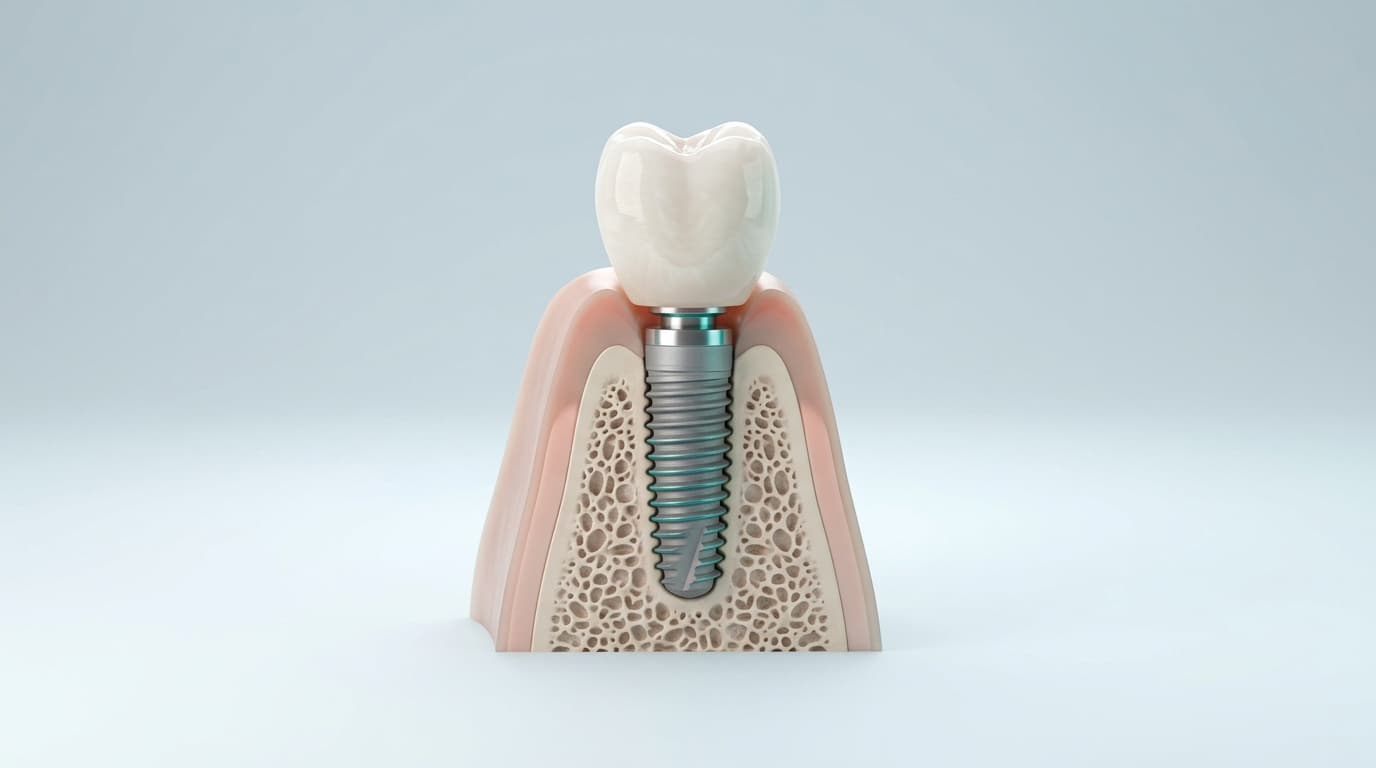
A dental implant is an artificial tooth root that is inserted into the jawbone, where it provides permanent support for a replacement tooth. Unlike a bridge, which uses healthy adjacent teeth as abutments, and a removable denture, which rests on the gums, an implant anatomically and functionally replaces the tooth root.
A complete implant consists of three components:
- Implant body — the actual artificial root, usually made of titanium, less often of zirconia. It is screwed into the jawbone and, over the course of 2 to 6 months, fuses firmly with the bone. This process is called osseointegration and is decisive for long-term stability.
- Abutment — the connecting piece between the implant body and the crown; it is placed on the implant after healing and extends through the gum.
- Suprastructure — the visible restoration: a single crown, an implant-supported bridge, or a fixed denture on several implants.
The decisive biological advantage over a bridge or conventional denture: the implant transmits chewing forces into the jawbone like a natural tooth root, thereby preventing the bone loss that regularly sets in after tooth loss. With a bridge, the two adjacent teeth must also be ground down — with an implant, the surrounding tooth substance remains untouched.
In modern dentistry, given sufficient bone volume and healthy periodontium, the implant is considered the first choice for replacing individual teeth.
When does an implant make sense — and when not?
An implant is always the dentally highest-quality solution when a natural tooth can no longer be preserved and there are no medical reasons against it. We make this decision based on a clinical examination, a 3D CBCT (DVT) scan to evaluate the available bone, and your overall health.
Typical indications:
- Single-tooth gap in the anterior or posterior region — the implant replaces a single tooth without grinding down adjacent teeth.
- Bounded gap (a gap between two teeth) — an alternative to the bridge, especially when the adjacent teeth are healthy and uncut.
- Free-end situation (missing molars at the end of the jaw) — here, a conventional bridge has no rear abutment, and the implant is the treatment of choice.
- Edentulous jaw — 4 to 6 implants carry a fixed bridge (All-on-4 concept) or a removable but securely anchored denture.
Contraindications to be clarified before implantation:
- Active periodontitis — must be successfully pre-treated; otherwise, inflammatory bone loss (peri-implantitis) threatens the implant too.
- Heavy smoking — significantly increases the healing risk and long-term failure rate.
- Uncontrolled diabetes mellitus — delayed wound healing and increased risk of infection.
- Ongoing bisphosphonate therapy (e.g., for osteoporosis or tumors) — risk of jaw necrosis; coordination with an internist required.
- Patients under 18 years — the jaw is still growing; the implant would remain in place while adjacent teeth continue to shift.
Compared to a bridge, the implant spares the adjacent teeth (a bridge requires grinding down the abutment teeth). Compared to a removable denture, it prevents bone loss and restores more chewing power.
Types of dental implants: material and system
Choosing the right implant depends on the material, the system manufacturer, and the treatment protocol. For the vast majority of patients, titanium in the two-piece standard protocol is the safest and best-documented choice.
Material: titanium or zirconia?
- Titanium, by far the most widely used implant material, is the gold standard. Titanium has a unique property: its surface fuses biologically with the bone (osseointegration). There is more than 30 years of scientific documentation with robust long-term data. Allergies to pure titanium are extremely rare.
- Zirconia (ceramic implant) is metal-free, white, and therefore aesthetically advantageous with thin gums in the anterior region. Disadvantages: long-term data do not yet reach as far back as for titanium, and in some systems the prosthetic restoration is less flexible. An option for patients with a metal-free preference or documented titanium intolerance.
System manufacturers. Established manufacturers with a long tradition and a solid research database include Straumann (Switzerland), Nobel Biocare (Sweden/USA), and Camlog (Germany). All three systems offer decades of available spare parts and prosthetic components — an important aspect if a crown needs to be replaced in 15 years.
One-piece or two-piece?
- Two-piece implants (standard): implant body and abutment are separate. The body heals covered under the gum, and the abutment is attached only after healing. Advantage: protected healing, flexible prosthetics.
- One-piece implants: body and abutment are one piece. Used less often, mostly in special situations with limited bone volume.
Immediate implant vs. standard protocol. With an immediate implant, the implant body is placed into the fresh alveolus directly after tooth extraction — possible under ideal conditions (absence of inflammation, stable bone volume). The standard protocol provides 2 to 3 months of healing of the extraction wound before implantation. The choice depends on the specific clinical findings; we decide this together after CBCT evaluation.
Implant treatment procedure — step by step
From the initial consultation to the final crown, implant treatment typically takes 3 to 9 months. The timeframe depends mainly on whether bone grafting is necessary and in which jaw the implant is placed (the lower jaw heals faster than the upper jaw).
- Consultation and 3D CBCT (DVT) diagnostics (30 to 45 minutes): Detailed discussion of your situation, clinical examination, cone beam computed tomography (CBCT / DVT) for precise measurement of bone height, bone width, and proximity to anatomical structures (inferior alveolar nerve canal in the lower jaw, maxillary sinus in the upper jaw). Followed by informed consent, material choice, and treatment and cost plan (HKP).
- Bone grafting if required (optional, 3 to 6 months of waiting): If bone volume is insufficient, augmentation is performed first (sinus lift, bone block, graft material). After augmentation, the bone needs 3 to 6 months to mature into a load-bearing base. Details in the bone-grafting section.
- Implantation (30 to 60 minutes per implant): Under local anesthesia — on request also with twilight sedation or general anesthesia — the gum is opened, the bone bed is prepared step by step using drills of defined sizes, and the implant body is screwed in. Finally, sutures are placed. The procedure itself is completely pain-free.
- Healing / osseointegration (3 to 6 months): During this phase, the implant fuses stably with the bone. In the lower jaw, this usually takes 2 to 3 months; in the upper jaw, 3 to 6 months due to the softer bone structure. A temporary restoration protects the gap during this time.
- Exposure and abutment placement (15 minutes): After successful healing, the gum over the implant is opened and the abutment is screwed on. A minor procedure under local anesthesia. Afterwards, 1 to 2 weeks for gum margin shaping.
- Impression and crown (2 appointments over 2 to 3 weeks): Digital scan or conventional impression, laboratory fabrication of the crown, try-in, and definitive screwing or cementing. Externally, the implant crown is indistinguishable from a crown on a natural tooth.
Summing up: a simple case without bone grafting takes around 3 to 4 months; a complex case with augmentation, 6 to 9 months. We plan every step transparently and hand you a written schedule after the initial consultation.
Pain and risks — what patients can really expect
Pain during implantation: The procedure itself is performed under local anesthesia and is completely pain-free for the patient. Many patients report afterwards that the implantation was considerably less stressful than a wisdom tooth extraction. On request, we also offer nitrous oxide, twilight sedation (intravenous sedation), or treatment under general anesthesia in cooperation with an anesthesiologist.
After the procedure: For 2 to 5 days, mild swelling and a pressure sensation in the surgical area are to be expected. Usually, ibuprofen 400 mg as per the package insert is sufficient for pain control. Cooling with a cold pack (10 minutes cooling, 10 minutes break) during the first 24 hours significantly reduces swelling. Soft food and avoiding physical exertion, nicotine, and alcohol for 3 to 5 days accelerates healing.
Risks in factual percentages:
- Wound infection: rare. Usually well managed with hygiene instructions and antibiotics if necessary.
- Nerve injury in the lower jaw (inferior alveolar nerve): very rare when planned with 3D CBCT. The consequence would be a temporary numbness of the lower lip; permanent damage is very rare.
- Maxillary sinus perforation in the upper posterior region: also largely avoidable with CBCT-based planning. Small perforations usually heal without consequences.
- Peri-implantitis (inflammatory bone loss around the implant) — the most important long-term risk: on average about 22% of patients in studies (range 14–30%, Derks & Tomasi 2015), significantly higher in smokers and with inadequate oral hygiene. Usually treatable when detected early.
Success rate. In non-smokers with a healthy periodontium and regular aftercare, the 10-year survival rate exceeds 95 percent. Smoking roughly doubles the risk of loss (meta-analysis, Chrcanovic et al. 2015).
You should come back to see us if, after 5 days, pain increases, fever develops, a purulent taste arises, or the implant feels loose.
Bone grafting — when is it necessary and how does it work?
An implant needs sufficient bone volume to sit firmly. The minimum requirements are:
- Vertical bone height: more than 6 mm
- Buccolingual bone width (from the cheek to the tongue side): more than 5 mm
If these values fall short, bone grafting (augmentation) is necessary. A typical situation: a tooth was extracted many years ago without the gap being restored — the jawbone has resorbed over time (atrophy after tooth loss).
The main augmentation procedures:
- External sinus lift — in the upper posterior region, when the maxillary sinus extends deep down. The sinus membrane is lifted through a lateral bone access, and the resulting space is filled with bone replacement material.
- Internal sinus lift — minimally invasive through the implant bed, when only small height gains (up to about 3 mm) are needed. Often performed together with the implantation.
- Autologous bone transplantation — harvesting a small bone block from the patient's own jaw (usually retromolar behind the wisdom teeth or from the chin region). Considered the "gold standard" because the material heals in optimally.
- Xenogeneic material such as Bio-Oss — derived from animal bone, biocompatible, serves as a scaffold into which the patient's own bone grows.
- Synthetic bone replacement materials — made of hydroxyapatite or tricalcium phosphate, animal- and human-free.
Healing time: After augmentation, usually 3 to 6 months must pass before the implant can be placed. In some favorable situations (simultaneous augmentation), both can be combined in one session — we decide this based on the CBCT findings.
Risks of bone grafting: perforation of the sinus membrane during a sinus lift (usually without consequences, rarely maxillary sinusitis), delayed healing, rejection of the material (rare). In well-planned procedures, success rates are clearly above 90 percent.
Durability and care — how long does an implant last?
Dental implants are among the most durable restorations in modern dentistry. Scientifically documented survival rates:
- After 10 years: approximately 95 percent
- After 20 years: around 90 percent
These figures apply to non-smokers with a stable periodontium and consistent aftercare. Smoking, untreated periodontitis, and inadequate oral hygiene significantly shorten the lifespan.
Factors for long-term success:
- Oral hygiene — brushing twice a day with a soft brush and fluoride toothpaste. At the implant margin, interdental brushes in the appropriate size are essential. Floss alone is often insufficient at an implant because the shape is different from a natural tooth.
- Semi-annual professional dental cleaning (PZR) — special instruments (plastic or titanium scalers) clean the implant neck without scratching the surface.
- Annual X-ray monitoring of the implant for the early detection of bone loss (peri-implantitis).
- Not smoking — the single factor with the greatest influence on long-term prognosis.
- Stable periodontal situation on adjacent teeth — gum disease also undermines bone around the implant.
Warning signs of incipient peri-implantitis:
- bleeding at the implant margin when brushing or probing,
- gum recession at the implant (exposed implant neck),
- pressure sensation, tension, or mild pain when chewing,
- sensation of loosening — this is already an advanced warning sign that requires an immediate check-up.
Anyone who notices these signs early and presents promptly generally has good chances of preserving the implant through conservative therapy (cleaning, rinsing, if necessary antibiotic therapy, regenerative procedures).
Fallbeispiel
Typical course of treatment (example): single implant in the lower jaw
Fictional example for illustration – not a real patient case.
Starting point. A patient has been missing his lower first molar (36) for years. He chews mainly on the other side.
Diagnostics. A 3D X-ray (CBCT) shows the height and width of the bone and the distance to the mandibular nerve. If there is enough bone, no bone augmentation is needed; otherwise it is built up beforehand or at the same time.
Typical course of treatment.
- Implant placement under local anaesthesia.
- Healing phase, in the lower jaw usually around three months.
- Uncovering and impression or digital scan.
- Fitting of the implant crown.
What to expect. After healing, chewing on both sides is possible again. Thorough cleaning and regular check-ups are important for the implant to last – above all to prevent peri-implantitis.
Häufige Fragen
How long does a dental implant last?
The scientifically documented survival rate is approximately 95 percent after 10 years and around 90 percent after 20 years — prerequisites are not smoking, good oral hygiene, and regular check-ups. Many implants last a lifetime. Decisive factors for reaching the upper durability range are: daily cleaning with interdental brushes at the implant neck, semi-annual professional dental cleaning, and annual X-ray monitoring for the early detection of peri-implantitis. Smoking significantly shortens the lifespan and roughly doubles the risk of loss (meta-analysis, Chrcanovic et al. 2015). Patients with a history of periodontitis are also at increased risk — here, particularly close-knit aftercare is important.
Does placing an implant hurt?
No. The procedure itself is performed under local anesthesia and is completely pain-free. Many patients report afterwards that implantation was far less stressful than expected — often less than a wisdom tooth extraction. On request, we additionally offer nitrous oxide, twilight sedation, or treatment under general anesthesia. After the procedure, mild swelling and a pressure sensation occur for 2 to 5 days, which can generally be managed well with ibuprofen 400 mg and cooling. Severe pain, fever, or a purulent taste are not normal side effects — in such cases, please contact the practice directly.
How long does the entire implant treatment take?
From consultation to final crown, treatment typically takes 3 to 9 months. The sequence: initial consultation with CBCT (1 day), bone grafting if necessary with 3 to 6 months of waiting time, implantation (1 appointment, 30 to 60 minutes), healing phase (2 to 3 months in the lower jaw, 3 to 6 months in the upper jaw), exposure with abutment (1 short appointment), impression and crown (2 appointments over 2 to 3 weeks). Without bone grafting, total duration is about 3 to 4 months; with augmentation, 6 to 9 months. During the healing phase, we restore the gap with a temporary if needed.
When is bone grafting necessary?
Bone grafting (augmentation) becomes necessary when the bone volume is not sufficient for a stable implant. As a rule of thumb: vertical height below 6 mm or width below 5 mm at the implant site. A typical situation is tooth loss that remained untreated for many years — the jawbone resorbs as a result. Procedures include external or internal sinus lift in the upper posterior region, an autologous bone block from the patient's own jaw, or filling with bone replacement material (Bio-Oss, synthetic). The healing time before implantation is 3 to 6 months. In some cases, augmentation and implantation can be combined in one session. Whether grafting is necessary is decided based on the 3D CBCT scan.
Implant or bridge — which is better?
Both restorations have their place. The implant has two decisive advantages: it spares the adjacent teeth (no need to grind them down) and transmits chewing forces into the jawbone — the natural bone loss after tooth loss is prevented. A bridge is faster (2 to 3 weeks instead of months) and requires grinding down the two healthy adjacent teeth. A bridge is preferable when the adjacent teeth need crowning anyway or when bone volume is insufficient for an implant and no augmentation is desired. In young patients with healthy adjacent teeth, the implant is dentally the better solution. More on this in our blog article on the direct comparison.
Am I too old for an implant?
There is no fixed upper age limit. Successfully placed implants in patients in their 70s and 80s are clinical routine. What matters is not calendar years but overall health, bone quality, intake of bisphosphonates (e.g., for osteoporosis — caution is advised here, and coordination with an internist is necessary), and the ability to maintain oral hygiene. Downward: under 18 years, implants are generally not placed because the jaw is still growing and the implant would remain fixed while natural teeth continue to shift. In patients beyond age 80, we decide individually based on CBCT findings and general condition.
Can you get an implant with periodontitis or diabetes?
For both conditions, the rule is: not in untreated form, but after successful pre-treatment, very much possible. Active periodontitis must first be systematically treated (professional cleaning, pocket therapy, surgical measures if needed) before an implant is placed — otherwise, inflammatory bone loss (peri-implantitis) also threatens the implant. After successful periodontitis therapy and stable aftercare, implants are entirely possible but require particularly close monitoring. With diabetes mellitus, the HbA1c value is decisive: if blood sugar is well controlled (HbA1c below about 7 percent), the success rate barely differs from that in non-diabetics. Uncontrolled diabetes is a contraindication. Coordination with the family doctor or diabetologist is recommended.
What are the risks with dental implants?
The main risks at a glance: wound infection rare, nerve injury in the lower jaw very rare with 3D CBCT planning (usually only temporary numbness), maxillary sinus perforation in the upper jaw (largely avoidable through CBCT), implant loss during primary healing in the first 3 to 6 months is rare. The most important long-term risk is peri-implantitis — inflammatory bone loss around the implant with an average frequency of about 22% (Derks & Tomasi 2015), significantly elevated in smokers and with inadequate oral hygiene. Detected early through regular check-ups, peri-implantitis is usually well treatable. Overall, the 10-year success rate exceeds 95 percent — dental implants are among the safest restorations in dentistry.
Weiterführende Themen
Verwandte Ratgeber
Artikel aus dem Blog
Behandlung in unserer Praxis
Quellen & Literatur
- Howe MS et al. — Long-term (10-year) dental implant survival: systematic review (J Dent 2019)(abgerufen am 1.10.2026)
- Chappuis V et al. — Long-term outcomes of dental implants: 20-year prospective case series (Clin Implant Dent Relat Res 2013)(abgerufen am 1.10.2026)
- Jepsen S et al. — Primary prevention of peri-implantitis, consensus report incl. Derks & Tomasi meta-analysis (J Clin Periodontol 2015)(abgerufen am 1.10.2026)
- Chrcanovic BR et al. — Smoking and dental implants: systematic review and meta-analysis (J Dent 2015)(abgerufen am 1.10.2026)
- German Society for Implantology (DGI) — guidelines and patient information(abgerufen am 24.4.2026)
- ottonova guide — dental implant (patient information)(abgerufen am 24.4.2026)