
Contents
A dentist for anxious patients in Munich-Oberföhring: you set the pace
If you have put off a dental appointment for a long time, you don't need a lecture. You need a plan that feels safe. That is how we work at our practice in Munich-Oberföhring: you meet us first without any treatment, you keep control at all times with an agreed stop signal, and if talking and patience are not enough, there are three levels of sedation — nitrous oxide, twilight sedation and general anaesthesia with a specialist anaesthetist on our dedicated anaesthesia days.
Dental anxiety is common. Studies from Germany suggest that roughly one adult in ten is anxious enough to postpone or avoid dental treatment altogether. Many people know what follows: nothing hurts for a long time, then suddenly a lot does — and walking into a practice gets even harder.
Dr. Christina Dickel and her team treat anxious patients from Oberföhring, Bogenhausen, Johanneskirchen, Englschalking and across Munich. Below you will find what we do differently, which sedation suits whom, how a day under general anaesthesia works, and when German statutory insurance covers anaesthesia.

Your first visit: getting to know each other, no treatment
The first appointment is a conversation, not a treatment. It is calm, planned with more time than a routine check-up, and you decide how far it goes:
- Arriving: Feel free to mention your anxiety when you book. The whole team will know, and you won't have to explain it again at reception.
- Listening before examining: We ask what frightens you and what you have experienced. Some people fear the injection, others lying back, gagging, or being asked why they stayed away so long. We don't ask that question.
- Only a look if you want one: If it feels right, we take a look at your teeth, possibly with an X-ray. If not, we simply talk. Both are fine.
- Agreeing a stop signal: We agree on a hand signal. Raise your hand and we stop immediately — no questions, no discussion.
- A plan at your pace: You leave with a proposal: what treatment is needed, in which order, and with which kind of sedation, if any. Acute pain comes first, everything else step by step.
If you are in pain right now, we will of course treat you straight away — as briefly and gently as possible, with the detailed planning afterwards.

What does a dentist for anxious patients do differently?
The instruments are the same as in any dental practice. What differs is how we use them:
- Explain first, then act: Before anything happens, we tell you what comes next, how it will feel and how long it takes. Surprises are the worst part of treatment for anxious people.
- Handing over without losing control: The stop signal applies in every session. Breaks are planned, not an exception.
- Short appointments at the start: Many anxious patients build trust through small, low-discomfort steps such as a professional cleaning or a small filling before larger treatments follow.
- Thorough local anaesthesia: We wait until the anaesthetic has fully taken effect and check before we begin. If you still feel something, we top it up.
- Sedation as an option, not a default: Not every anxious patient needs nitrous oxide or anaesthesia. We recommend the mildest method that gets you comfortably through treatment.
- Fewer appointments where it makes sense: Under twilight sedation or general anaesthesia, several treatment steps can be combined in one session.
Nitrous oxide, twilight sedation or general anaesthesia: which level suits you?
The right method depends on two questions: how strong is your anxiety, and how extensive is the treatment? We make the final recommendation after the first visit and, for twilight sedation and general anaesthesia, after your consultation with the anaesthetist.

Nitrous oxide: relaxed and awake
You breathe a mixture of nitrous oxide and oxygen through a small nasal mask. Within a few minutes you feel calmer, but you stay responsive and can tell us how you are doing at any time. Afterwards you breathe pure oxygen for a few minutes and the effect wears off quickly. Nitrous oxide does not replace local anaesthesia, but it makes it much easier to tolerate.
Suits: mild to moderate anxiety, fear of injections, a strong gag reflex, shorter treatments, children.
Twilight sedation: deeply relaxed, little memory
With twilight sedation (intravenous sedation) you receive a calming medication through a vein. You drift into a drowsy state, breathe on your own and respond when spoken to, but afterwards you will remember little of the treatment. At our practice the sedation is given by a specialist anaesthetist who monitors you throughout.
Suits: moderate to severe anxiety, longer sessions, several treatments in one appointment.
General anaesthesia: asleep for the whole treatment
On our anaesthesia days a specialist anaesthetist with full equipment is in the practice. You sleep through the entire treatment while heart, circulation, breathing and oxygen levels are monitored continuously. Dr. Christina Dickel treats you herself during this time — including extensive work such as multiple extractions, implants or a full restoration.
Suits: severe dental phobia, extensive treatment needs, a gag reflex too strong for other methods, patients with disabilities.
The three levels side by side
| Nitrous oxide | Twilight sedation | General anaesthesia | |
|---|---|---|---|
| Consciousness | Awake and relaxed | Drowsy, responsive | Asleep |
| Memory of treatment | Yes | Little to none | None |
| Local anaesthesia | Yes, in addition | Yes, in addition | Added depending on procedure |
| Administered by | Dentist | Specialist anaesthetist | Specialist anaesthetist |
| Fasting required | No, just a light meal beforehand | Yes | Yes |
| Driving afterwards | Usually yes, after a short rest | No, not for 24 hours | No, not for 24 hours |
| Companion needed | No | Yes | Yes |
| German statutory insurance | Private service | Usually a private service | Covered only for specific indications |
Fear of injections, gagging, noise: solutions for specific triggers
"Fear of the dentist" is often a fear of one particular thing. For the most common triggers there are practical solutions:
Fear of injections
Before the injection we numb the gum with a topical gel, so the needle itself is barely noticeable. We inject slowly, because it is the pressure of the fluid that can be unpleasant, not the needle. If you still cannot face the injection, we give it under nitrous oxide or twilight sedation — most patients hardly notice it then. Under general anaesthesia you are not awake for it at all.
A strong gag reflex
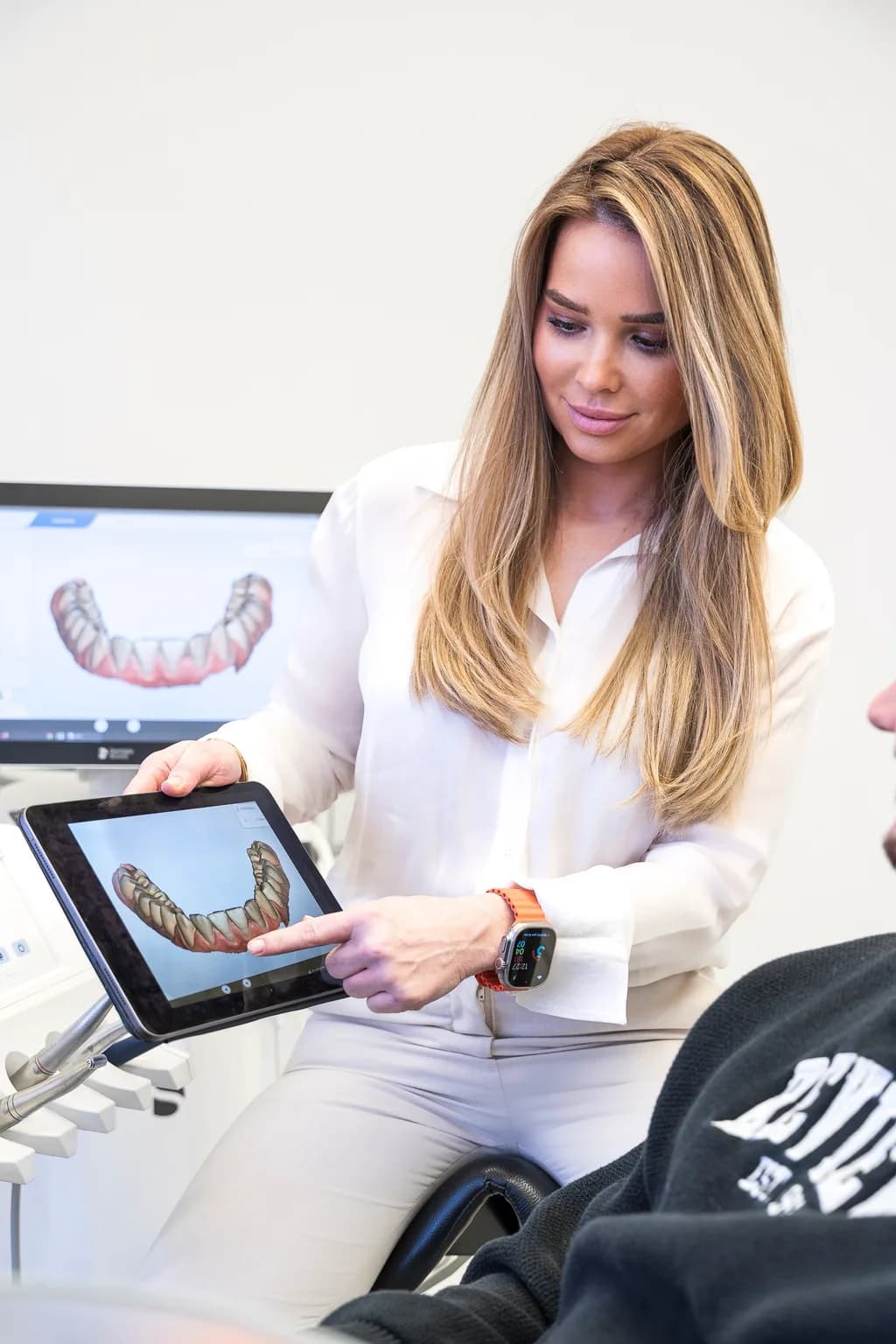
A strong gag reflex is not oversensitivity; it is a reflex you cannot simply switch off. What helps: sitting more upright, breathing through your nose, short working phases with breaks, and little water in the mouth. Where possible we replace impression paste with a digital intraoral scan. Nitrous oxide noticeably reduces gagging for many patients. If none of this is enough, treatment under twilight sedation or general anaesthesia is the safe route.
The drill, the smell, lying back
If music helps you, bring headphones. We announce loud instruments before they start and adjust the chair so you don't have to lie flat if that feels confining. Many of these triggers lose their power once they are announced and you know you can stop at any time.
Back at the dentist after years away: no judgement
Many of our patients have not seen a dentist for five, ten or more years. Often it is no longer the original fear that keeps them away but embarrassment about the state of their teeth. It becomes a cycle: the longer the gap, the higher the hurdle.
We have seen this many times and it does not shock us. What matters is what happens now:
- An honest assessment without judgement: We tell you plainly what we see, what is urgent and what can wait.
- Pain first: Inflammation and acute problems are treated first, so you get relief quickly.
- Manageable stages: We split the rest of the treatment into steps you can handle — or combine it into one session under general anaesthesia.
- Saving teeth before replacing them: Even after a long break, more teeth can often be saved than patients fear. Where teeth are missing, we advise on dental prosthetics and implants.
What a treatment day under general anaesthesia looks like
General anaesthesia at the dentist can be planned and prepared for well. The process is the same as for an outpatient operation:
- Consultation and consent: A few days beforehand you discuss your medical history, medication and any previous anaesthesia with the anaesthetist. He decides whether outpatient anaesthesia in the practice is safe for you and gives you binding instructions.
- Fasting: As a rule you may not eat anything in the six hours before anaesthesia. Until when clear drinks are allowed and which of your medications you take that morning is set by the anaesthetist in the consultation. Follow these instructions exactly — your safety depends on them.
- Arriving with a companion: Wear comfortable clothes, no nail polish or jewellery. An adult companion ideally brings you and must collect you afterwards.
- Falling asleep: Through a line in your arm you fall asleep within a short time. From here on you notice nothing.
- Treatment: Dr. Christina Dickel carries out in one session what would otherwise take several appointments — fillings, root canal treatment, extractions, implants, or crowns that can be made in the practice with CEREC.
- Waking up: You wake up in our recovery area and stay until the anaesthetist discharges you.
- The first 24 hours: No driving, no operating machinery, no important decisions or signatures, no alcohol. Ideally someone stays with you at home for the first few hours.
More detail on process, risks and recovery (in German): Narkose bei der Zahn-OP.

When does German statutory health insurance cover general anaesthesia?
Statutory health insurance (GKV) covers general anaesthesia for dental treatment only when it is medically necessary. Under the rules of the National Association of Statutory Health Insurance Dentists (KZBV), this applies to:
- Children under 12 whose treatment is not possible under local anaesthesia because they cannot cooperate
- People with intellectual disabilities or severe movement disorders who cannot cooperate sufficiently
- Patients with a diagnosed dental treatment phobia for whom necessary treatment cannot be carried out under local anaesthesia
- Patients who cannot receive local anaesthetics or sedatives because of an illness or allergy
- Extensive surgical procedures that cannot reasonably be done under local anaesthesia
Important for anxious patients: the diagnosis of dental phobia is not made by the dentist but only by a psychiatrist, a psychotherapist or a suitably qualified physician. In addition, insurance only covers anaesthesia for treatments that are themselves covered, such as extractions or standard fillings.
Nitrous oxide and twilight sedation are generally private services under statutory insurance. Private and supplementary insurance plans reimburse sedation depending on the policy. We clarify which rules apply to you before treatment with an individual treatment and cost plan that you can submit to your insurer.
Anxiety in children and teenagers
Many adults with dental anxiety trace it back to an experience in childhood. That is why we are especially careful with young patients: short appointments, showing and explaining everything first, never forcing anything. For smaller treatments nitrous oxide often helps. If a child under 12 needs larger treatment that has not been possible despite several attempts, general anaesthesia can be the gentler route — and is then covered by statutory insurance.
More on treating children: Children's dentistry
Further reading: sedation and dental anxiety in detail
- Dental anxiety guide: anxiety or phobia, causes, self-help, therapy, children
- Dental anxiety test: how anxious are you? Five questions from the scientific MDAS scale
- Nitrous oxide sedation: effect, process, who it suits
- Twilight sedation: intravenous sedation with a specialist anaesthetist
- General anaesthesia at the dentist: anaesthesia days, safety, preparation
- Angst vorm Zahnarzt überwinden (in German): what you can do yourself
- Narkose bei der Zahn-OP (in German): process, risks and recovery
Our practice in Oberföhring — for anxious patients from all over Munich
Our practice is at Oberföhringer Straße 183a in north-east Munich, easy to reach from Bogenhausen, Johanneskirchen, Englschalking, Daglfing and Unterföhring. Many anxious patients also come from other parts of the city because they are looking for a practice that offers all three levels of sedation under one roof.
- A first visit without treatment
- A stop signal in every session
- Nitrous oxide, twilight sedation and general anaesthesia with a specialist anaesthetist
- A recovery area in the practice
- CEREC: ceramic restorations in one session, including under sedation
You can book by phone or online. If phoning is hard for you, a short message saying "anxious patient" is enough — we will get back to you and talk everything through calmly.

Risks and safety
All three sedation procedures are among the safest methods in modern medicine. As with any medical procedure, side effects may occur, but they are usually mild and temporary.
Nausea after sedation/anaesthesia
Occasional (10–30% with general anaesthesia)
Prophylactic medication, arriving on an empty stomach, standing up slowly.
Fatigue and drowsiness
Common after twilight sedation/general anaesthesia
Normal reaction, subsides within a few hours. Companion needed for the journey home.
Sore throat after intubation
Occasional with general anaesthesia
Mild and temporary (1–2 days). Lozenges and warm drinks help.
Local irritation (nitrous oxide)
Rare
Adjustment of the nasal mask, dose reduction.
Paradoxical reaction (agitation instead of relaxation)
Very rare
Immediate adjustment of medication, possible switch to a different sedation method.
Allergic reaction to medication
Very rare
Thorough medical history taken before treatment, emergency equipment available in the practice.
At our practice, we minimise risks through individual health checks before every sedation, continuous monitoring by trained staff or the specialist anaesthetist, and a protected recovery area in the practice.
Qualifications and certificates
DGI — German Society for Implantology
Membership
DGZMK — German Society for Dental, Oral and Maxillofacial Medicine
Membership
DGÄZ — German Society for Aesthetic Dentistry
Membership
CEREC Certification — Digital CAD/CAM dental restoration
Certified
2012
State examination in dentistry
University
Frequently asked questions
Ready to take your first step?
Book an appointment for a personal consultation at our practice in Munich Oberföhring.