
Inhaltsverzeichnis
What are dental implants?
A dental implant is a small screw made of titanium or ceramic that is inserted into the jawbone as an artificial tooth root. An abutment and a custom-made crown are attached on top — the result looks and feels just like a natural tooth.
Unlike a bridge, no healthy adjacent teeth need to be ground down for an implant. The jawbone continues to be stimulated and does not deteriorate — a decisive advantage over removable dentures.

Titanium or ceramic — which material?
In our practice we work with premium implant systems in both titanium and ceramic. Titanium implants have been clinically proven for over 40 years with success rates above 95%. Ceramic implants (zirconia) offer a metal-free alternative — particularly suitable for patients with metal sensitivities or high aesthetic demands in the front tooth area.
Implants vs. bridge vs. denture
Each solution has its merits. The decision depends on your individual situation — the number of missing teeth, available bone, budget, and personal preference. During the consultation I will present all options to you honestly.
- Implant: Independent, preserves adjacent teeth, maintains bone. More involved, higher initial investment.
- Bridge: Faster to complete, well-established method. Requires grinding down healthy adjacent teeth.
- Denture: Cost-effective, no surgical procedure. Can slip, accelerates bone loss.
Who is suitable for implants?
In principle, implants are an option for most adults — from a single missing tooth to complete edentulism. The prerequisites are sufficient jawbone and healthy gums.
Suitable for:
- One or more missing teeth
- Complete tooth loss (full-arch restoration with All-on-4/6)
- Loose denture that needs to be stabilised
- Patients who do not want a bridge (preserving tooth structure)
Limitations (not automatically an exclusion):
- Insufficient jawbone — often solvable through bone grafting
- Active periodontitis — must be treated first (→ Periodontitis treatment)
- Heavy smoking — increases the risk, not an absolute exclusion
- Certain systemic conditions — individual assessment required
Saving the tooth before implantation: Before a tooth is extracted and replaced with an implant, we always check first whether a root canal treatment can save the tooth. Keeping your natural tooth is always the best solution.
Even if you are unsure whether implants are right for you: come in for a consultation. Together we will find the best solution for your situation.
Types of implant solutions
Depending on your starting situation, there are different implant concepts. Here is an overview of the most common solutions we offer in our practice:

Single-tooth implant
The most common solution: one implant replaces exactly one missing tooth. Adjacent teeth remain untouched. Particularly worthwhile in the visible area where aesthetics matter.
Duration: 3–6 months total | Cost: approx. 1,800–3,500 EUR (incl. crown)
Implant-supported bridge
For 2–4 adjacent missing teeth: two implants support a bridge. Fewer implants required than with individual restorations, yet still fixed and stable.
Duration: 4–6 months | Cost: approx. 3,500–7,000 EUR
All-on-4 / All-on-6 full-arch restoration
For complete tooth loss or severely compromised remaining dentition: 4–6 strategically placed implants support a complete, fixed arch. Bone grafting is often not necessary because the posterior implants are placed at an angle.
Duration: Provisional often on the same day, final restoration after 3–6 months | Cost: approx. 12,000–25,000 EUR per jaw
Immediate implants
In suitable cases, an implant can be placed immediately after tooth extraction — in the same appointment. This significantly shortens the overall treatment time. Prerequisites: sufficient bone and no infection present.
Duration: Immediate placement, final crown after 3 months | Cost: comparable to a single-tooth implant
Mini implants
Smaller implants (diameter under 3 mm) for stabilising an existing denture. Simpler procedure, faster healing, but not suitable for every situation.
Duration: Often immediately loadable | Cost: approx. 800–1,500 EUR per implant
Treatment process step by step
An implant procedure is a predictable, routine intervention. Here you will find out exactly what happens at each stage:

1. Initial consultation and medical history
At the first appointment we talk in detail about your wishes and expectations. I examine your teeth and gums and discuss whether implants make sense for you. Duration: approx. 30–45 minutes.
2. 3D diagnostics (CBCT)
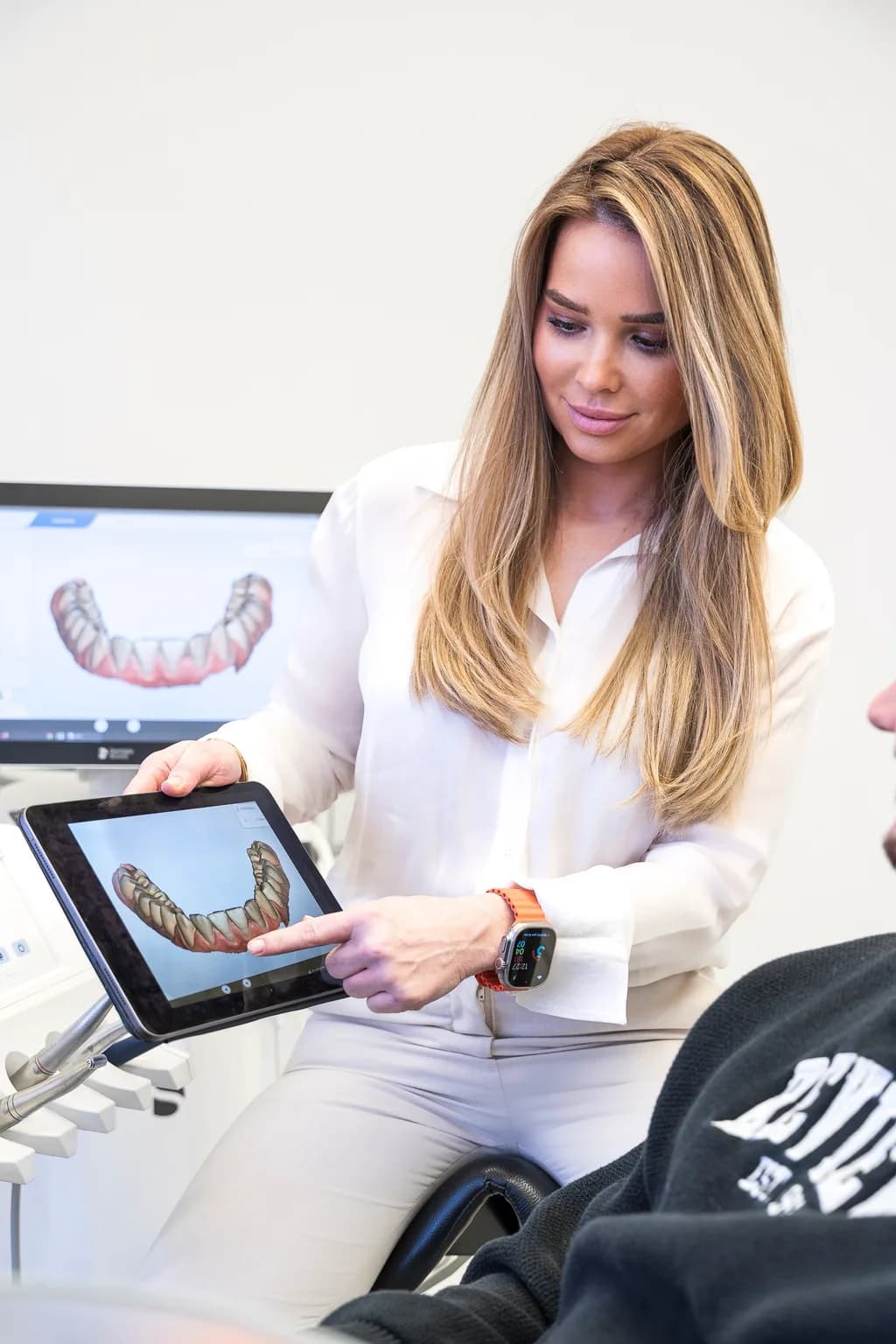
With our digital cone beam computed tomography (CBCT) we create a three-dimensional image of your jaw. This allows us to see exactly how much bone is present, where nerves and blood vessels run, and enables us to plan the implant to the millimetre.
3. Digital implant planning
On the computer I plan the position, angle and depth of each implant. For complex cases we produce a surgical guide — this increases precision and significantly reduces operating time.
4. Bone grafting if required
If there is insufficient bone, we build it up. The most common method in the posterior upper jaw is a sinus lift. In the lower jaw we use bone substitute material or the patient's own bone. The graft heals for 3–6 months before the implant is placed.
5. Implant placement
The actual procedure takes 30–60 minutes per implant under local anaesthesia. You will feel pressure but no pain. We also offer IV sedation on request. After the procedure you will receive a provisional so you can smile straight away.
6. Healing phase (osseointegration)
Over the following 3–6 months the implant fuses firmly with the jawbone — a natural process called osseointegration. During this time you will wear a provisional. Regular check-ups ensure that everything is progressing as planned.
7. Uncovering and impressions
After healing the implant is uncovered and a healing abutment is placed. After 2–3 weeks we take a digital impression for your final crown.
8. Final restoration
Your custom crown, bridge or prosthesis is fitted. We check the fit, bite and aesthetics together until everything is perfect. From this point on you have firm, beautiful teeth again.
Aftercare and maintenance
The lifespan of your implant depends significantly on proper care. Here is your roadmap:
The first 24 hours:
- Apply a cool pack to the cheek from the outside (20 min. on, 20 min. off)
- Soft foods only, nothing hot, no alcohol
- Do not smoke (at least 2 weeks)
- Pain relief as needed (ibuprofen 400–600 mg)
First week:
- Brush teeth normally, avoiding the surgical area
- Use mouth rinse as prescribed
- No sport, no strenuous physical activity
Long term:
- Daily cleaning with interdental brushes or floss around the implant
- Professional cleaning every 3–6 months
- Annual check-up X-ray
- Come to the practice immediately if you experience any discomfort

Costs and financing
Implants are an investment in your quality of life. Here you will find a transparent overview of costs:

Risks and complications — an honest perspective
Implant procedures are among the safest interventions in dentistry. Nevertheless, I want to speak openly with you about possible risks — because informed patients make better decisions.
Frequently asked questions about dental implants
Here you will find answers to the questions patients ask me most often:
Your dentist: Dr. Christina Dickel
As a specialist in implantology I combine thorough academic training with many years of clinical experience. Every implant is planned individually using state-of-the-art 3D technology to guarantee you the best possible result.
For me, implantology is more than just tooth replacement — it is about giving people back a piece of quality of life. Firm chewing, carefree smiling, a natural appearance.
Kosten im Überblick
| Leistung | Preisrahmen | Hinweis |
|---|---|---|
| Single-tooth implant (incl. crown) | 1,800 - 3,500 EUR | Most common solution for a single missing tooth |
| Implant-supported bridge | 3,500 - 7,000 EUR | 2 implants with bridge for 2–4 missing teeth |
| All-on-4 full-arch restoration | 12,000 - 25,000 EUR | Per jaw, fixed restoration for complete tooth loss |
| Mini implants | 800 - 1,500 EUR | Per implant, for denture stabilisation |
| Bone grafting / sinus lift | 500 - 3,000 EUR | If required, in addition to implant costs |
Single-tooth implant (incl. crown)
1,800 - 3,500 EUR
Most common solution for a single missing tooth
Implant-supported bridge
3,500 - 7,000 EUR
2 implants with bridge for 2–4 missing teeth
All-on-4 full-arch restoration
12,000 - 25,000 EUR
Per jaw, fixed restoration for complete tooth loss
Mini implants
800 - 1,500 EUR
Per implant, for denture stabilisation
Bone grafting / sinus lift
500 - 3,000 EUR
If required, in addition to implant costs
Statutory insurance patients receive the fixed subsidy regardless of the chosen restoration. Private insurers cover 50–100% of total costs including the implant, depending on the policy. We will prepare a detailed treatment and cost plan for submission to your insurance provider.
We offer instalment payment options so the costs do not all arise at once. Talk to us — we will find a solution that fits your budget.
Risiken und Sicherheit
Dental implants are among the most thoroughly researched and safest procedures in dentistry. The long-term success rate is above 95%. As with any surgical procedure, there are risks that I would like to discuss openly with you:
Swelling and pressure sensation
Common (normal)
Apply cool pack; resolves within 3–5 days
Temporary numbness
Occasional
Through 3D planning, nerves are precisely located and protected
Infection
Rare (<2%)
Sterile operating conditions, prophylactic antibiotic if indicated
Implant loss (failed osseointegration)
Rare (2–5%)
A second attempt after healing is usually successful
Peri-implantitis (inflammation around the implant)
Rare with proper care
Regular professional cleaning and check-ups, early treatment
In our practice we minimise risks through digital 3D implant planning, guided surgery with surgical stents, sterile operating protocols and close post-operative monitoring. Every procedure is planned individually — no off-the-shelf solution.
Qualifikationen und Zertifikate
2014
Curriculum Implantologie
Deutsche Gesellschaft für Implantologie (DGI)
2015
Curriculum Ästhetische Zahnheilkunde
Deutsche Gesellschaft für Ästhetische Zahnheilkunde (DGÄZ)
2019
Curriculum Funktionsdiagnostik
Dr. Seeher, München Nymphenburg
2012
Staatsexamen Zahnmedizin
Heinrich-Heine-Universität Düsseldorf
Häufige Fragen
Ready to take your first step?
Book an appointment for a personal consultation at our practice in Munich Oberföhring.