
Contents
What Are Veneers?
Veneers are ultra-thin ceramic shells that are permanently bonded to the front surface of your teeth — comparable to a custom-made contact lens for your tooth. At just 0.3 to 0.7 millimetres thick, they correct the colour, shape and position of your front teeth without the need for extensive grinding.
Unlike a dental crown, which covers the entire tooth, a veneer covers only the visible front surface. This means significantly more healthy tooth structure is preserved. The ceramic is bonded directly to the tooth enamel using a special adhesive technique — a bond that, when applied correctly, is extraordinarily strong and long-lasting.
In our practice in München we work with high-quality ceramics (lithium disilicate and feldspathic ceramic) that mimic natural tooth enamel almost perfectly in terms of translucency and surface texture. The result: veneers that are indistinguishable from real teeth, even up close.

When Are Veneers the Right Choice?
Veneers are a versatile solution for a range of aesthetic concerns in the front-tooth region. I recommend them particularly for:
- Stubborn discolouration: When professional whitening does not achieve the desired result — for example with tetracycline staining or non-vital teeth.
- Gaps between teeth (diastema): Small to medium gaps between the front teeth can be elegantly closed with veneers.
- Minor misalignment: Crooked or rotated teeth can be visually straightened — without years of orthodontic treatment.
- Chipped or worn edges: Veneers restore the natural tooth shape while simultaneously protecting against further loss of substance.
- Irregular tooth shapes: Teeth that are too small, too pointed or asymmetrical receive a harmonious, natural form.
During the initial consultation I analyse your individual situation and discuss honestly whether veneers are the best path to your ideal smile — or whether another solution would make more sense.
Types of Veneers Compared
Not all veneers are the same. Depending on the starting situation, aesthetic requirements and budget, there are different types of veneers that we offer in our practice in München. Here is an honest comparison:

Ceramic Veneers — The Classic
Ceramic veneers are the gold standard of aesthetic dentistry. They are made from high-strength ceramic (lithium disilicate or feldspathic ceramic) and are individually fabricated for you in a dental laboratory.
- Thickness: 0.5–0.7 mm
- Preparation: Minimal removal of tooth enamel required (approx. 0.3–0.5 mm)
- Longevity: 15–20 years with good care
- Aesthetics: Excellent — natural translucency like real tooth enamel
- Cost: From 1,000 EUR per tooth
Ceramic veneers are my first choice when maximum aesthetics and longevity are required. The preparation is minimal but not reversible — a point I always address openly in consultations.
No-Prep Veneers — Without Grinding
No-prep veneers are the most conservative option: ultra-thin ceramic shells (0.2–0.3 mm) bonded directly to the tooth enamel with no or minimal preparation. The key advantage: the procedure is potentially reversible.
- Thickness: 0.2–0.3 mm
- Preparation: None or minimal
- Longevity: 10–15 years
- Aesthetics: Very good, but teeth may appear slightly more voluminous
- Cost: From 1,500 EUR per tooth
No-prep veneers are particularly suitable for patients who do not want to sacrifice any tooth structure. They are ideal for small gaps, minor discolouration or where a natural increase in tooth size is desired. They are not suitable if the teeth already protrude forward — the result would appear too bulky.
Composite Veneers — The Quick Alternative
Composite veneers are built up directly at the dental chair using high-quality composite resin — in a single appointment, without a dental technician. This makes them the fastest and most cost-effective veneer option.
- Thickness: Variable
- Preparation: None or minimal
- Longevity: 5–8 years
- Aesthetics: Good, but not as translucent as ceramic
- Cost: From 400 EUR per tooth
I recommend composite veneers as an entry-level solution or for individual teeth — for example to repair a chipped edge. For a complete smile makeover involving multiple teeth, I advise ceramic veneers, as composite stains more quickly and is not as durable.
Full-Ceramic Veneers — Premium Aesthetics
Full-ceramic veneers made from feldspathic ceramic are the premium option: completely metal-free, with the highest translucency and the most natural aesthetics of all veneer types. They are layered by hand in a meticulous process and are barely distinguishable from natural tooth enamel.
These veneers are my recommendation for the most demanding aesthetic requirements — particularly in the upper front-tooth region, where light and transparency are decisive. Their fabrication requires an experienced dental technician and slightly more time, but delivers results at the very highest level.
Veneers vs. Lumineers — The Complete Comparison
The question "veneers or Lumineers?" comes up very frequently in my practice in München. Many patients have heard of Lumineers and wonder whether they are the better choice. Here I explain the differences:
What are Lumineers? Lumineers are a brand name by DenMat (USA) for particularly thin veneers (0.2–0.3 mm). They are placed with no or minimal tooth preparation — similar to no-prep veneers from other manufacturers. The term "Lumineers" is often used as a synonym for no-prep veneers, but is strictly speaking a specific product.

Comparison: Conventional Veneers vs. Lumineers
Here are the key differences at a glance:
- Thickness: Conventional veneers 0.5–0.7 mm vs. Lumineers 0.2–0.3 mm
- Preparation: Veneers: minimal enamel reduction required. Lumineers: as a rule no preparation
- Reversibility: Veneers: no (tooth structure has been removed). Lumineers: conditional (can theoretically be removed)
- Aesthetics: Veneers: the most natural appearance, as they sit flush with the gumline. Lumineers: can appear slightly more voluminous
- Longevity: Veneers: 15–20 years. Lumineers: 10–15 years
- Cost: Comparable; Lumineers tend to be slightly more expensive
My Recommendation as Your Dentist
There is no "better" or "worse" — it depends on your individual starting situation:
I recommend Lumineers/no-prep for:
- Small teeth that should appear slightly larger
- Minor discolouration or gaps between teeth
- Patients who do not want to sacrifice any tooth structure
I recommend conventional ceramic veneers for:
- Teeth that already protrude slightly forward (to avoid excessive volume)
- More pronounced discolouration that needs to be masked
- Maximum aesthetic perfection in the visible zone
- Larger shape corrections
During the consultation I will show you both options on screen using Digital Smile Design — so you can see in advance what result to expect.
Who Are Veneers Suitable For?
Veneers are an excellent solution for many aesthetic concerns — but not the right choice for every patient and every situation. In our practice in München we take the time for an honest assessment:
Ideal candidates for veneers:
- Discolouration that does not respond adequately to whitening
- Gaps between the front teeth (diastema)
- Minor tooth misalignment that allows for a visual correction
- Chipped, worn or uneven incisors
- Asymmetrical or undersized tooth shapes
- The desire for a harmonious, naturally white smile
Limitations and contraindications:
- Severe bruxism (teeth grinding): Without an accompanying night guard there is an increased risk of fracture. We discuss protective measures.
- Insufficient tooth structure: With severely decayed or already extensively filled teeth, a dental crown is often the better choice.
- Active decay or periodontitis: These must be treated first before veneers can be placed.
- Severe misalignment: With significant jaw misalignment I first recommend treatment with aligners — veneers can then handle the fine-tuning afterwards.
Alternatives I discuss openly: Not everyone needs veneers. Sometimes professional whitening is sufficient, sometimes a dental crown is more appropriate, and with misalignment, aligners can correct the underlying cause rather than merely changing the appearance. In the initial consultation we discuss all options honestly — including the more affordable ones.
Treatment Process Step by Step
A veneer treatment in our practice in München follows a tried-and-tested, clearly structured process. You will know exactly what is happening at every stage — no surprises.

1. Initial Consultation and Analysis (30–45 Minutes)
At the first appointment I take my time to understand your wishes. We discuss what bothers you about your smile and what you have in mind. I examine your teeth, gums and bite, photograph your current situation and explain honestly which options are suitable for you — veneers, whitening, crowns or a combination.
2. Digital Smile Design — Planning Your Smile on Screen
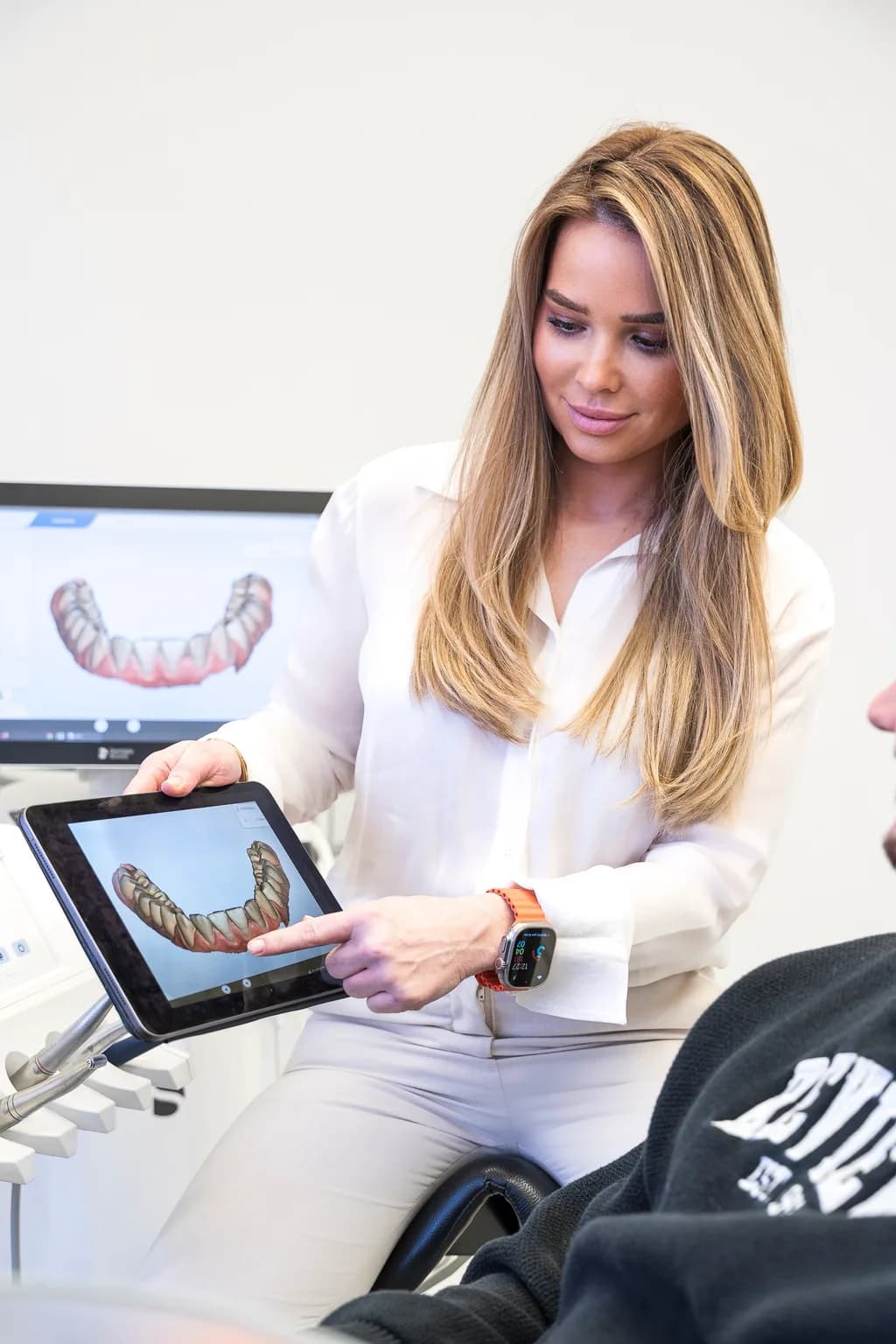
Using Digital Smile Design I create a digital simulation of your future smile. Based on photos and videos of your face and teeth, I design the optimal tooth shape, size and colour on the computer. You see the result on screen beforehand and can have a say — before anything happens to your teeth.
3. Mock-Up — Try Before You Commit
Based on the digital design we create a mock-up: provisional veneers made from composite resin that are placed directly onto your teeth. You experience your new smile live — in the mirror, in photos, in conversation. Is everything right? Then we move forward. Would you like to change something? No problem, we adjust.
4. Preparation and Impression
For conventional ceramic veneers I remove an ultra-thin layer of tooth enamel (0.3–0.5 mm) under local anaesthesia. With no-prep veneers this step is omitted. I then take a digital impression — no uncomfortable impression tray, but a precise 3D scan. The data goes directly to our dental laboratory. You receive an aesthetic temporary restoration while your finished veneers are being made.
5. Placement of the Finished Veneers
After 1–2 weeks of laboratory time your veneers are ready. In a careful appointment I try each veneer individually and check colour, shape and fit. Only when both you and I are satisfied are the veneers permanently bonded to your teeth using modern adhesive technique. The entire process is painless and takes 1–2 hours depending on the number of veneers.
Overall timeframe: 2–3 appointments over 2–3 weeks. With composite veneers the treatment can often be completed in a single session.
Digital Smile Design — Plan Your Smile in Advance
Digital Smile Design (DSD) is an innovative planning technology that I use as a certified DSD practitioner in my practice in München. Rather than working by feel, we plan your new smile digitally — to the millimetre and visible to you in advance.
How Digital Smile Design works:
- Step 1: We take high-resolution photos and videos of your face — from the front, in profile, while smiling and speaking.
- Step 2: On the computer I analyse proportions, symmetry, the gumline and the relationship between teeth, lips and face.
- Step 3: I design your new smile digitally and overlay it onto your current photos — you see the planned result realistically placed in your own face.
- Step 4: We discuss the design together. Would you like the teeth slightly wider? A touch less white? We adjust until it is perfect.
Why DSD makes the difference: You are not buying a pig in a poke. You see your result before treatment begins. And the digital design serves as a precise template for our dental laboratory — no interpretation, no surprises. Communication between the practice and the laboratory is pin-point accurate.
In my experience DSD is the single most important step for satisfied veneer patients. The result is right because it was planned together beforehand.

Results with Veneers
To give you a realistic impression of what veneers can achieve, I describe here typical treatment cases from our practice in München:
Case 1: Discoloured Front Teeth
A patient with persistently stained upper incisors over many years — whitening had only limited success. With 4 ceramic veneers in a natural shade (Shade A2) she received a uniformly bright, naturally looking smile. The treatment involved 3 appointments over 2 weeks.
Case 2: Gap (Diastema) Closed
A patient with a visible gap between the upper central incisors. With 2 ceramic veneers the gap was closed and the teeth proportionally adjusted — the result looks as though the gap had never existed. No preparation required (no-prep veneers).
Case 3: Chipped Incisors Restored
After a sporting accident both upper central incisors had chipped at the corners. Using composite veneers we were able to restore the natural tooth shape in a single session — quickly, painlessly and with a convincing aesthetic outcome.
Case 4: Complete Smile Makeover
A patient wanted a complete transformation of her smile — irregular tooth shapes, minor misalignment, yellowish discolouration. With 8 ceramic veneers on the upper jaw and prior Digital Smile Design we created a harmonious, radiantly natural smile. The patient described the result as "life-changing".
We are continuously expanding this gallery with real patient results. Feel free to ask us for additional examples during your consultation — we will show you comparable cases from our practice.
Longevity and Care
Veneers are robust — but not indestructible. With the right care you can significantly extend the lifespan of your veneers. Here is your care plan:
Longevity by veneer type:
- Ceramic veneers: 15–20 years, often longer
- No-prep veneers: 10–15 years
- Composite veneers: 5–8 years (can be refreshed)
Daily care:
- Brush teeth twice daily with a soft to medium toothbrush
- Use dental floss or interdental brushes daily
- Avoid highly abrasive toothpastes (steer clear of whitening toothpastes with a high RDA value)
- Prefer alcohol-free mouthwash
What you should avoid:
- Biting nuts, ice cubes or hard objects directly with the front teeth
- Opening bottles with your teeth (it sounds obvious, but it happens)
- Nail biting or holding pens between your teeth
- If you grind your teeth: always wear a night guard (we can make one for you)
Professional aftercare:
- Professional dental cleaning every 6 months — particularly important at the veneer margins
- Annual check of the veneers for fit and condition
- If a veneer loosens or cracks, come to the practice immediately — in most cases the veneer can simply be re-bonded
With this routine your ceramic veneers will easily last 15 years, and often considerably longer. Many of my patients have been wearing their veneers for over a decade without any issues.

Costs and Financing
Transparent cost information is important to me — you should know exactly what to expect before treatment begins. Here you will find an overview of veneer costs in our practice in München:

Advantages and Possible Disadvantages — An Honest Assessment
I want to give you an honest assessment — veneers are an excellent treatment, but like any dental procedure they have both advantages and disadvantages. An informed decision is the best decision.
The advantages of veneers:
- Natural aesthetics at the highest level
- Minimal loss of tooth structure (compared to crowns)
- Durable and colour-stable (ceramic does not stain)
- Versatile: correct colour, shape and position in one step
- Fast treatment: a new smile in 2–3 weeks
Frequently Asked Questions About Veneers
Here you will find answers to the questions that patients in München ask me most frequently about veneers. If your question is not listed — please call us or book an initial consultation.
Your Dentist: Dr. Christina Dickel
Aesthetic dentistry is my passion. As a dentist specialising in aesthetic dental medicine and a certified Digital Smile Design practitioner, I combine clinical precision with an eye for natural beauty. Every veneer I place is planned individually — because a beautiful smile is always a personal smile.
For me, veneers are more than thin ceramic shells — they are the key to a smile that makes my patients feel truly comfortable again. Giving back that joy in life is what motivates me every day.
Veneers in München
Our practice for aesthetic dentistry is centrally located in München-Oberföhring — easily accessible from all parts of München. Whether ceramic veneers, no-prep veneers or a complete smile makeover: we advise you personally, plan digitally and realise your ideal smile with the highest precision.
Book your no-obligation initial consultation — I look forward to welcoming you to our practice.

Kosten im Überblick
| Leistung | Preisrahmen | Hinweis |
|---|---|---|
| Ceramic Veneers | from 1,000 EUR per tooth | Classic solution with the highest aesthetics and longevity (15–20 years) |
| No-Prep Veneers | from 1,500 EUR per tooth | No grinding, reversible, ultra-thin (10–15 years) |
| Composite Veneers | from 400 EUR per tooth | Cost-effective alternative in one appointment (5–8 years) |
| Digital Smile Design (planning) | 200 - 500 EUR | Digital pre-planning and simulation of your new smile |
| Complete Smile Makeover (6–10 veneers) | 6,000 - 15,000 EUR | Full coverage of the front-tooth region with ceramic veneers |
Ceramic Veneers
from 1,000 EUR per tooth
Classic solution with the highest aesthetics and longevity (15–20 years)
No-Prep Veneers
from 1,500 EUR per tooth
No grinding, reversible, ultra-thin (10–15 years)
Composite Veneers
from 400 EUR per tooth
Cost-effective alternative in one appointment (5–8 years)
Digital Smile Design (planning)
200 - 500 EUR
Digital pre-planning and simulation of your new smile
Complete Smile Makeover (6–10 veneers)
6,000 - 15,000 EUR
Full coverage of the front-tooth region with ceramic veneers
As veneers are classified as an aesthetic treatment, statutory health insurance (GKV) does not cover the costs. Private health insurance (PKV) reimburses a proportion of the treatment costs depending on the policy and contract — particularly where a medical indication exists (e.g. restoration following an accident). We will prepare a detailed treatment and cost plan for submission to your insurer.
We want your ideal smile to be within reach regardless of budget. That is why we offer instalment payment — simply mention it during the consultation. Together we will find a solution that suits your financial situation.
Risks and safety
Veneers are one of the most established and safe treatments in aesthetic dentistry. As with any dental procedure, however, there are aspects I want to discuss openly with you:
Tooth sensitivity after preparation
Common (temporary)
Subsides after 1–2 weeks; desensitising toothpaste helps
Irreversibility with conventional veneers
Important to know
No-prep veneers as a reversible alternative are discussed during consultation
Veneer may come loose
Rare (<3%)
Can usually be re-bonded without difficulty
Veneer may fracture or chip
Rare
Repair or replacement possible; night guard as prevention
Colour mismatch with adjacent teeth
Avoidable
Professional shade selection and prior mock-up trial
Not suitable for severe bruxism
Contraindication
Night guard as an accompanying protective measure
In our practice we minimise risks through Digital Smile Design planning, a mock-up test prior to the final treatment, collaboration with an experienced dental laboratory and modern adhesive technique in line with the latest scientific standards. Every veneer is planned individually and reviewed together with you before final placement.
Qualifications and certificates
2015
Curriculum Ästhetische Zahnheilkunde
Deutsche Gesellschaft für Ästhetische Zahnheilkunde (DGÄZ)
Digital Smile Design Certification
2012
State Examination in Dentistry
Heinrich-Heine-Universität Düsseldorf
Frequently asked questions
Ready to take your first step?
Book an appointment for a personal consultation at our practice in Munich Oberföhring.