
Tooth Replacement: Options, Costs & Comparison 2026
Verfasst von Dr. Christina Dickel · Zuletzt geprüft: 04/23/2026
Das Wichtigste in Kürze
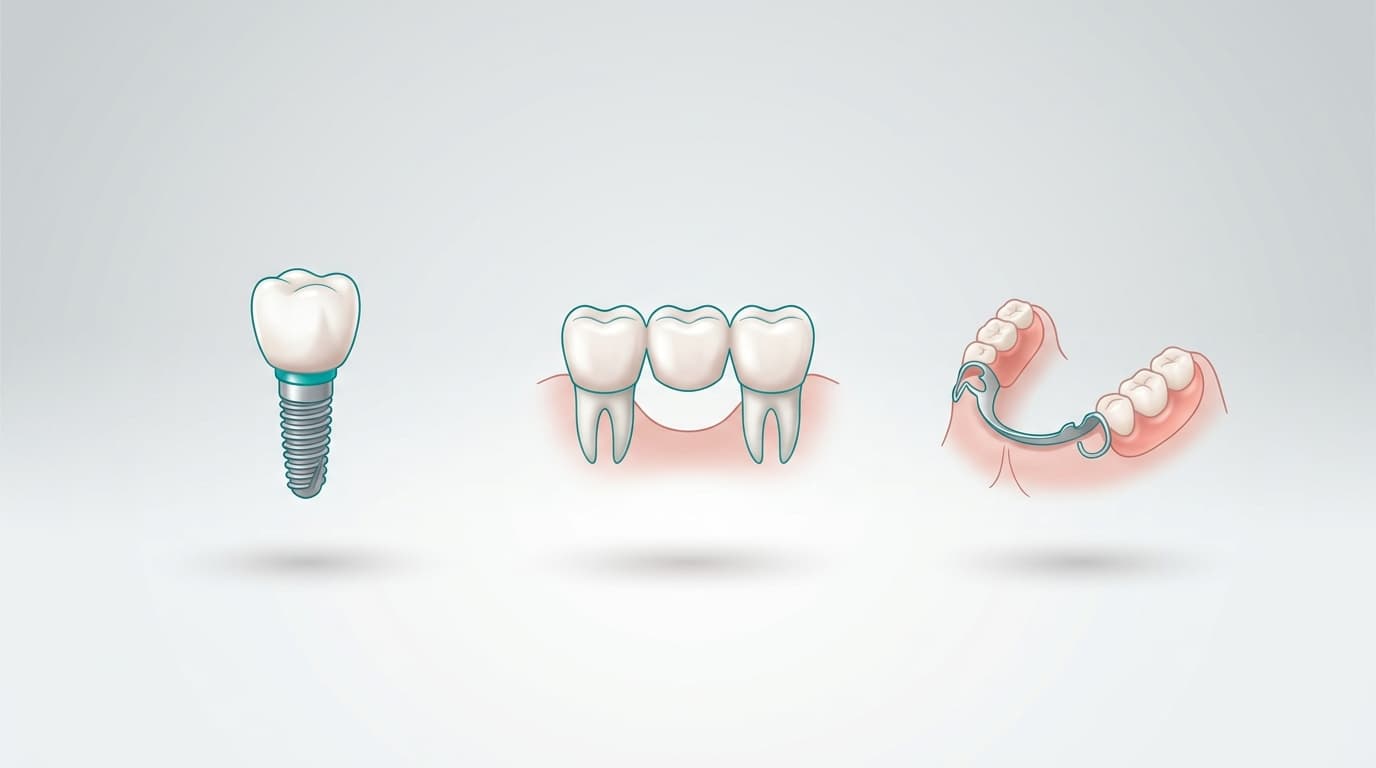
- Four categories: fixed (crown, bridge), implant-supported, removable (partial denture, full denture), combined (telescopic or attachment denture).
- The fixed subsidy (Festzuschuss) from the statutory health insurance is finding-based and applies to all variants — regardless of whether you choose standard, equivalent, or alternative care.
- Implants offer the highest wearing comfort and the best bone preservation, but are generally a private service with an individual out-of-pocket cost.
- A bridge requires two restorable adjacent teeth that must be prepared — otherwise, the standard care subsidy does not apply.
- Dentures are the most affordable solution but less comfortable; without the stimulation of the root, the jawbone resorbs under the denture base over the years (atrophy).
- The right decision depends on four factors: remaining dentition, available bone, budget, and life situation (age, ability to maintain hygiene, expectations).
What are dental prosthetics — and when are they necessary?
Dental prosthetics (tooth replacement) refer to the restoration of missing or severely damaged teeth. In dentistry, we strictly distinguish between tooth preservation (filling, inlay, root canal treatment) and tooth replacement (crown, bridge, implant, denture). A tooth replacement is used when a tooth can no longer be saved or is already lost — whether due to tooth decay, periodontitis, root fractures, trauma, or age-related tooth loss.
The indication for a tooth replacement depends on the initial finding. We roughly distinguish three clinical situations:
- Single-tooth restoration: A single tooth is so severely damaged that a filling or inlay is no longer sufficient. This is a classic indication for a dental crown. Alternatively: extraction and a single implant.
- Partially edentulous dentition: One or more teeth are missing, but the remaining teeth can still bear a load. Options: bridge (if abutment teeth are healthy), implants (if sufficient bone is available), partial denture (if non-preparable teeth are missing).
- Edentulous jaw: All teeth in the upper or lower jaw are lost. Options: full denture, implant-supported denture (All-on-4/All-on-6), or combined tooth replacement on remaining root stumps (overdenture).
The consequences of an untreated lost tooth are often underestimated. A single missing molar leads to the drifting of adjacent teeth within 6–18 months, the supraeruption of the opposing tooth (which "grows" into the gap), resulting in incorrect loading and occlusal disorders. At the same time, the jawbone in the area of the gap breaks down — without the natural chewing stimulation from the tooth root, the height of the jaw ridge decreases by 11 to 22% within the first six months alone (Tan et al. 2012). A later planned implant becomes more complex and expensive (bone grafting, sinus lift).
In addition, missing or poorly fitting dentures impair chewing function — which in the long run can lead to unilateral chewing, temporomandibular joint (TMJ) disorders, digestive problems, and even social withdrawal. Therefore, early prosthetic planning — ideally within 3 months after tooth loss — is clearly superior both medically and economically.
In this guide, we show what options modern dentistry offers in 2026, what they cost, how the statutory health insurance is involved, and which solution fits which life situation. In the section "Comparison: Fixed vs. Removable," you will find a concrete decision table, and in the "Decision Guide" section, a structured question-and-decision tree.
The 4 Categories of Tooth Replacement at a Glance
Tooth replacement can be divided into four broad categories. The distinction is not just academic — it determines the price, procedure, care, and billing with the health insurance.
- Fixed tooth replacement (on natural teeth):
- Dental crown — replaces the clinical crown of a single tooth. Placed after significant loss of tooth structure or a root canal treatment. Materials: porcelain-fused-to-metal (PFM), all-ceramic (lithium disilicate, zirconia), gold crown.
- Dental bridge — closes a gap by preparing at least two adjacent teeth to act as abutments. Variants: conventional bridge (abutment crowns), resin-bonded bridge / Maryland bridge (minimally invasive), cantilever bridge (anchored on one side — only for small gaps in the anterior region).
- Implant-supported tooth replacement:
- Single implant with crown — an artificial titanium or ceramic root plus an implant crown. Replaces a single tooth without loading adjacent teeth.
- Implant bridge — multiple implants support a bridge over multiple gaps, without preparing natural teeth.
- Implant-supported denture (All-on-4 / All-on-6 / Locator): 4–6 implants in the edentulous jaw support a removable or screw-retained denture.
- Removable tooth replacement:
- Partial denture — replaces missing teeth, held in place by clasps or attachments on remaining teeth. Variants: clasp denture (simple, visible clasps), cast partial denture (standard solution), precision attachment denture (clasp-free, highly esthetic).
- Full denture / Complete denture — replaces all teeth in a jaw. Stays in place in the upper jaw via a suction effect, and in the lower jaw only by positioning and possibly denture adhesive.
- Combined tooth replacement:
- Telescopic denture — primary crowns on remaining teeth/implants, covered by secondary crowns within a removable denture. Holds like a fixed prosthetic but can be removed for cleaning.
- Attachment or bar-retained denture — complex connecting elements between remaining teeth and the denture; often used in a partially dentate jaw with few remaining abutments.
The choice between these categories depends on four factors — which we go through structurally in the Decision Guide section: (1) how many teeth are missing, (2) the condition of the remaining teeth, (3) how much jawbone is available, and (4) your budget and life situation. Some patients can choose equally between a bridge and an implant — other situations clearly dictate the restoration (e.g., edentulous upper jaw with poor bone availability → implant-supported overdenture instead of All-on-4).
Dental Crown: Restoring a Severely Damaged Single Tooth
The dental crown is the basic restoration for a single tooth whose clinical crown (the visible part above the gums) is largely destroyed. Typical indications include:
- Extensive tooth decay that can no longer be treated with a filling
- After a root canal treatment, to protect the brittle tooth from fractures
- After fractures (sports injury, fall) where the root area is preserved
- As an abutment for a bridge (see next section)
- On an implant as an "implant crown"
Material variants at a glance:
- Porcelain-fused-to-metal (PFM) crown: standard care in the posterior region, full health insurance subsidy applies.
- All-ceramic crown (lithium disilicate, e.g., e.max): metal-free, highest esthetics, excellent biocompatibility.
- Zirconia crown: extremely fracture-resistant, ideal for the posterior region and patients who grind their teeth (bruxism).
- Gold crown: softest opposing bite, extremely durable, but visible.
- CEREC crown (chairside, same-day): all-ceramic, manufactured in a single visit; no temporaries, no second appointment.
The fixed subsidy for 2026 for a dental crown is determined per the finding-based statutory amount (60% base subsidy, 70% with a 5-year bonus booklet, 75% with a 10-year bonus booklet, 100% hardship provision). Your individual out-of-pocket cost depends on the material chosen and your bonus-booklet status — for an initial estimate, use our fixed-subsidy calculator.
Durability: All-ceramic crowns last an average of 12–15 years, PFM crowns 15–20 years, and gold crowns often 25+ years. A prerequisite is diligent home care (brushing 2× daily, flossing or using interdental brushes, regular professional dental cleanings).
Dental Bridge: Closing a Gap Using Your Own Adjacent Teeth
A dental bridge closes a gap between remaining teeth by anchoring onto at least two abutment teeth. It consists of two abutment crowns and one or more pontics (the artificial replacement tooth between the abutments). Important: A bridge requires that the adjacent teeth are worth preserving and can be prepared to bear the load.
The Three Bridge Variants
- Conventional bridge (preparation bridge): The two adjacent teeth are ground down entirely by about 1.5–2 mm and covered with crowns that support the pontic. Materials: PFM (standard care), all-ceramic, or zirconia.
- Resin-bonded bridge (Maryland bridge): Minimally invasive variant: Instead of prepared crowns, thin metal or ceramic wings are bonded to the back of the adjacent teeth. Only suitable for single missing anterior teeth (especially incisors) due to limited load-bearing capacity. Durability: 8–12 years. Advantage: Adjacent teeth remain almost completely intact.
- Implant-supported bridge: Two or more implants carry a bridge when adjacent teeth are missing or should remain untouched. Durability: 15–25 years. Details in the next section.
Indications and Contraindications
The conventional bridge is the standard care for a single gap in the posterior region — and it makes perfect sense when the adjacent teeth need a crown anyway (e.g., due to large old fillings or root canal treatments). It is not indicated when the adjacent teeth are healthy and free of decay — in that case, the preparation means irreversible damage to healthy tooth structure, making an implant the medically superior choice.
Durability and Care
A conventional PFM bridge lasts on average 10–15 years; all-ceramic bridges slightly less (10–12 years) due to a higher risk of fracture under load. Care is more demanding than with single crowns: The pontic must be cleaned with special superfloss threads or interdental brushes underneath the bridge body. Without this care, inflammation occurs on the gums under the pontic (similar to peri-implantitis) and tooth decay develops at the abutment margin.
Fixed Subsidy 2026
For a 3-unit bridge, the fixed subsidy is composed of the finding-based amounts for the gap plus the abutment crowns. The amount depends on your bonus booklet (60% base subsidy, 70% with a 5-year bonus, 75% with a 10-year bonus; 100% hardship). Your individual fixed subsidy and out-of-pocket cost are determined by our fixed-subsidy calculator based on your specific finding.
Dental Implant: The Artificial Root as a Premium Solution
A dental implant is an artificial tooth root that is inserted into the jawbone and, after a healing period of 3–6 months, serves as a support for a crown, bridge, or denture. Implants are the only restoration that comes functionally closest to a natural tooth: They preserve the jawbone, do not burden adjacent teeth, and with good care can last 20 years or longer.
Material: Titanium vs. Ceramic (Zirconia)
- Titanium implants: The standard for 50 years, excellently documented, survival rate after 10 years ~95%. Heals bioactively into the bone (osseointegration). Disadvantage: a dark shimmering metal edge can become visible if the gums are thin.
- Ceramic implants (zirconia): White, metal-free, highly biocompatible for allergy sufferers. Fewer long-term data; osseointegration is slightly slower.
Single Implant with Crown
A single implant with crown includes planning, surgery, the implant abutment, and the implant crown. The statutory health insurance (GKV) fixed subsidy is based on the standard-care bridge for the single gap; the surcharge for the implant is a private service. The individual cost structure is disclosed in the treatment and cost plan.
All-on-4 / All-on-6 in the Edentulous Jaw
In an edentulous upper or lower jaw, 4 (All-on-4) or 6 (All-on-6) implants are placed at strategic positions and provided with an immediate load-bearing bridge on the same day. The result: fixed teeth without a loose denture. Process and requirements are explained on our fixed teeth in one day page.
- All-on-4 per jaw: immediate restoration on the day of surgery; final restoration typically after 6 months.
- All-on-6 per jaw: more robust distribution of chewing forces, indicated when bone structure is good.
Prerequisites and Limitations
Implants require sufficient bone availability: at least 6 mm in width and 10 mm in height in the alveolar ridge. With prolonged tooth loss, bone grafting is often necessary (GBR, bone splitting, or a sinus lift in the posterior upper jaw). Heavy smokers, uncontrolled diabetics, patients undergoing bisphosphonate therapy, or those with severe periodontitis have limited eligibility for implants; an individual risk assessment is necessary here.
The success rate, with correct planning and good oral hygiene, is 95–97% over 10 years. Failures mostly result from peri-implantitis (inflammation around the implant) — therefore, professional aftercare with bi-annual implant prophylaxis is mandatory. Furthermore, future bone loss can be prevented by the regular loading of the implant.
Partial Denture: Removable Replacement for a Partially Edentulous Arch
A partial denture is a removable tooth replacement for patients with remaining natural teeth. It is used when a bridge is not possible (gaps are too large, too few abutment teeth, missing posterior teeth) or implants are out of the question (due to bone, budget, or medical reasons).
Clasp Denture (Simplest Variant)
The clasp denture is held in place by forged metal clasps around the remaining teeth. It is the simplest partial denture and is often indicated as an interim (temporary) denture. Disadvantages: The metal clasps are visible in the anterior region, and the stress on the anchor teeth can promote decay or tooth loosening in the long run.
Cast Partial Denture (Standard Solution)
The cast partial denture is the standard GKV care for a partially dentate jaw. It consists of a filigree metal framework (cobalt-chromium alloy or titanium) with integrated artificial teeth. It is held in place by cast clasps, which fit more precisely than wire clasps and distribute the load more evenly on the anchor teeth. With the finding-based fixed subsidy and your bonus-booklet status, an individual out-of-pocket cost applies — use the fixed-subsidy calculator for an estimate.
Precision Attachment Denture (Invisible)
With an attachment denture, the anchor teeth are fitted with crowns that contain a precision-machined connection mechanism (the "attachment"). The denture holds onto this hidden mechanic — no visible clasps, very high wearing comfort. Retention: precise and durable, with higher technical and laboratory effort.
Telescopic Denture (Premium Partial Denture)
The telescopic denture combines crowns and a removable denture: Primary crowns are permanently cemented onto the anchor teeth; precisely fitting secondary crowns sit within the denture. The principle: a telescopic effect like an extendable antenna. See the dedicated section further down.
Comparison of Everyday Retention
The question of retention is crucial for many patients. Ranking (poor → excellent): Clasp denture → Cast partial denture → Attachment denture → Telescopic denture → Implant-supported partial denture. The latter two are on par with fixed restorations regarding comfort and are also suitable for patients with high esthetic demands.
Full Denture (Complete Denture): Replacing All Teeth in the Jaw
A full denture (complete denture) replaces all the teeth in a jaw. It is indicated for patients whose remaining dentition can no longer bear a load — classically after years of periodontitis or advanced age-related tooth loss.
Retention in the Upper Jaw vs. Lower Jaw
The major difference between an upper and a lower full denture is the retention:
- Upper full denture: Stays in place through the suction effect. The denture covers the entire palate; negative pressure forms between the mucosa and the denture base, holding it to the bone. With a good jaw ridge and a precise impression, the retention is usually satisfactory.
- Lower full denture: No suction effect possible due to the movable tongue and the narrower alveolar ridge. Retention depends on jaw shape, saliva flow, and adaptation. Many patients resort to denture adhesives — but this is rarely a permanent solution. Recommendation: 2–4 mini implants (Locator) as anchor points.
Full-Denture Variants
- Standard full denture (acrylic teeth, acrylic base): the GKV standard-care variant co-financed by the fixed subsidy; we'll disclose the out-of-pocket cost transparently in the treatment and cost plan.
- Higher-quality full denture with customization, finer teeth, and a reinforced base as a private service.
- Overdenture on 2–4 implants: implant-supported retention and bone preservation as a private service beyond the fixed subsidy.
Loss of Fit and Relining
A problem with all full dentures: Chewing stimulation is absent under the denture base — the forces are transferred to the mucosa, not the bone. The jawbone resorbs (atrophy), and the denture becomes loose over the years. Regular relining (adding new acrylic underneath) extends the wearing time; a reline every 3–5 years is standard. After 8–12 years, a completely new denture is usually necessary.
Quality of Life
Many patients describe their first full denture as a significant adjustment — speech ("S" sounds), taste (palate coverage reduces taste perception), chewing comfort (considerably less chewing force than with natural teeth). After 4–6 weeks of adaptation, daily life is mostly manageable. Those who invest early in implant-supported solutions save long-term on relinings and enjoy a significantly higher quality of life.
Telescopic Denture & Combined Dental Prosthetics: Premium Solution
The telescopic denture is one of the esthetically and functionally highest-quality prosthetic solutions. It combines the advantages of fixed and removable prosthetics: retention like a crown, cleanability like a denture.
How does it work?
On the remaining teeth (or on implants), primary crowns are firmly cemented — these remain permanently on the abutments. Embedded into the removable denture are precisely fitting secondary crowns, which slide over the primary crowns. The principle: Just like a telescopic antenna, a friction grip is created — strong enough for full chewing function, but releasable by pulling.
Indications
- Partially edentulous jaw with 2–6 remaining teeth that can bear loads as abutments
- Patients who place high value on esthetics (no visible clasps)
- Situations where more teeth might potentially be lost in the future — the telescopic denture can be adapted to close gaps by adding artificial teeth
- Older patients for whom implants are too invasive
Billing and Effort
The statutory fixed subsidy consists of the finding-based amount (e.g., finding 3.1 or 3.2) plus the individual crown findings for the abutment teeth. The surcharge for the telescopic system is a private service. Your individual out-of-pocket cost is calculated in the treatment and cost plan.
The fabrication is complex: 4–6 appointments over 6–10 weeks are normal, including preparation, two impressions, try-in of the metal framework, and try-in of the teeth. An experienced master dental laboratory is indispensable.
Durability and Aftercare
Telescopic dentures last 15–25 years with good care. The telescopes wear down slightly in the first few years — the denture then sits a bit looser. Through a so-called activation (fine mechanical adjustment by the dental technician), the retention can be optimized again. Annual check-ups including cleaning of the primary crowns are mandatory.
Implant-Supported Denture: The Modern Alternative to a Full Denture
An implant-supported denture is the most modern solution for edentulous jaws. Instead of an unstable full denture, the prosthesis rests on 2–6 implants that securely anchor it. The result: significantly higher wearing comfort, stable chewing function, and preservation of the jawbone.
Variants
- Locator denture (2–4 implants): The denture remains removable, but clicks onto the implants via a push-button Locator. Ideal for the lower jaw (2 implants are often enough), also possible in the upper jaw (4 implants recommended).
- Bar-retained denture: A metal bar connects the implants; the denture snaps onto the bar. Better retention than Locator, more complex to clean.
- All-on-4 / All-on-6 (fixed screw-retained): An immediate load bridge is screwed onto 4–6 implants on the day of surgery. Not removable, feels like natural teeth.
Retention Comparison in Numbers
The holding force of a conventional lower full denture is typically only 1–5 Newtons — a simple tongue movement can dislodge it. A 2-implant Locator denture provides 20–40 Newtons; a 4-implant bar-retained denture 60–100 Newtons; a screw-retained All-on-4 bridge is practically unmovable (can bear loads up to approx. 200–500 Newtons, depending on the implant system).
When is the step worth it?
The surcharge compared to a simple full denture is noticeable, but pays off in the long run: No denture adhesives, no taste impairment from a palate plate, no relinings every 3 years, significantly better chewing efficiency than with a classic denture, and — crucially — the jawbone is preserved due to the implant stimulation.
Prerequisites
Bone availability must be sufficient: In the interforaminal lower jaw (between the chin nerves), 2 implants are often possible even with severe bone loss; in the upper jaw, a sinus lift is often required due to the maxillary sinus. Individual planning is done using a 3D CBCT scan.
Comparison: Fixed vs. Removable — the options at a glance
To make the choice easier, we have summarized the six most important options in a comparison table. The durability figures are practical guide values and depend heavily on care and the starting situation. For comparison, from systematic reviews: about 89% of conventional bridges are still in function after 10 years (Tan et al. 2004), and about 96% of implants (Howe et al. 2019). For your individual cost calculation, please use our fixed-subsidy calculator or a personal treatment and cost plan.
| Option | Comfort (1–5) | Durability | Maintenance effort | Bone preservation |
|---|---|---|---|---|
| Dental crown (all-ceramic, 1 tooth) | 5 / 5 | 12–15 years | Low (normal care) | Fully preserved (natural tooth) |
| Dental bridge, conventional (3-unit) | 5 / 5 | 10–15 years | Medium (superfloss under bridge) | Partial (gap resorbs) |
| Implant crown (1 tooth) | 5 / 5 | 20–25 years | Medium (implant prophylaxis) | Fully preserved (implant stimulation) |
| Telescopic denture (4 abutments) | 4 / 5 | 15–25 years | High (daily removal + cleaning) | Partial (abutment teeth) |
| Partial denture (cast framework) | 3 / 5 | 8–12 years | Medium (daily removal) | Low (tissue-borne) |
| Full denture (upper jaw) | 2–3 / 5 | 8–12 years (with relining) | High (adhesive, daily cleaning) | None (atrophy) |
How do you read the table? Comfort refers to subjective patient assessments (chewing feel, taste, speech behavior). Durability refers to the average time in situ before replacement is necessary. Bone preservation is the most important difference between implant-supported and tissue-borne solutions.
Practical interpretation: If you have a single tooth gap with healthy adjacent teeth, an implant offers the best overall package (comfort 5/5, high durability, bone preservation) — despite a higher initial investment. If you need to quickly restore a partially dentate jaw, a cast partial denture provides a solid, insurance-friendly solution. The telescopic denture is the "sweet spot" for patients who want comfort, avoid implants, and still have remaining abutment teeth.
Fixed-Subsidy System 2026: How Statutory Contributions Work
The statutory health insurance covers a finding-based fixed subsidy for any tooth replacement — regardless of which restoration you actually choose. The subsidy is based on the standard care for the respective finding. If you go beyond that (e.g., all-ceramic instead of PFM, implant instead of bridge), you pay the difference yourself.
Fixed-Subsidy Tiers and Bonus Booklet
- Base subsidy 60%: Every legally insured person receives the full fixed subsidy on standard care.
- +10% (70%) after 5 years: Uninterrupted annual check-ups in the bonus booklet.
- +15% (75%) after 10 years: Also uninterrupted.
- 100% (Hardship case): If your income is below the annually adjusted hardship threshold (Section 55 SGB V), the insurance covers the standard care entirely.
Standard, Comparable, Alternative Care
The fixed-subsidy system recognizes three types of care. Standard care (e.g., PFM crown in the visible area, cast partial denture) is co-financed by the fixed subsidy and usually results in a modest out-of-pocket cost if your bonus booklet is complete. A comparable restoration (e.g., all-ceramic crown instead of PFM) retains the fixed subsidy; the difference to the higher service is private. An alternative restoration (e.g., implant instead of bridge) also receives the fixed subsidy based on the standard-care bridge; the surcharge for the implant is a private service.
Individual Out-of-Pocket Cost
Your specific out-of-pocket cost depends on: (1) the chosen restoration, (2) your bonus-booklet status, (3) any hardship eligibility, (4) any supplemental dental insurance. Use our fixed-subsidy calculator for an initial estimate based on your finding and bonus-booklet status; for binding figures, we create an individualized treatment and cost plan (HKP) before each treatment.
With Supplemental Dental Insurance
A private supplemental dental insurance (e.g., with a "90% tooth replacement" tariff) generally reimburses a high share of the remaining out-of-pocket cost after the fixed subsidy — provided the waiting period has expired and the contract was signed before treatment began. A carefully chosen supplemental insurance often pays off within a few years for larger restorations.
Decision Guide: Which tooth replacement is right for you?
Choosing the right tooth replacement is a highly personal process. Answer the following four questions in order — depending on your answer, a typical recommendation will emerge. Important: This decision guide does not replace a professional dental consultation; however, it helps orient you toward realistic options before your first appointment.
- Question 1 — How many teeth are missing or need to be replaced?
- 1 tooth: Bridge (3-unit) or single implant with crown.
- 2–3 teeth, adjacent: 4- to 5-unit bridge, implant bridge, or small partial denture.
- 2–3 teeth, scattered: Partial denture (cast framework) or multiple single implants.
- Several (4+) teeth, remaining ones can bear loads: Partial denture, telescopic denture, or an implant strategy.
- All teeth in a jaw: Full denture, Locator denture on 2–4 implants, or fixed All-on-4/6.
- Question 2 — Are the adjacent teeth healthy?
- Yes, free of decay and without large fillings: Preparing healthy tooth structure argues against a bridge → prefer an implant or resin-bonded bridge.
- No — adjacent teeth have large fillings or need crowns anyway: A conventional bridge is medically and economically the right choice.
- No — adjacent teeth are missing or cannot bear loads: An implant solution is mandatory.
- Question 3 — Is there sufficient bone for implants?
- Yes (CBCT shows ≥ 6 mm width, ≥ 10 mm height): Implants are possible without additional measures.
- Tight only in the posterior upper jaw (maxillary sinus): Sinus lift necessary — doable as an additional service alongside the implant.
- No — severe bone loss in the lower jaw: Implants only possible with extensive bone grafting; Alternative: partial denture, telescopic denture, or 2-implant Locator denture.
- Question 4 — What budget is realistically available?
- Standard care (minimal out-of-pocket): PFM crown, conventional bridge, cast partial denture, acrylic full denture — statutory care with a low out-of-pocket cost when the bonus booklet is complete.
- Comparable care: All-ceramic crown, all-ceramic bridge, single implant, Locator denture on 2 implants — fixed subsidy plus private upgrade portion.
- Alternative / premium care: Telescopic denture, All-on-4, extensive implant bridge, metal-free full-mouth restoration — fixed subsidy based on the standard-care benchmark plus private upgrade portion.
Typical Combinations — Our Recommendations
- 1 missing tooth, adjacent teeth healthy, good bone, medium budget: Single implant with an all-ceramic crown — the best long-term solution.
- 1 missing tooth, adjacent teeth have large fillings, limited budget: Conventional 3-unit bridge (PFM or all-ceramic) — covered well by insurance.
- 4+ scattered missing teeth, medium budget: Cast partial denture (entry-level), with a later upgrade to a telescopic or implant solution.
- Edentulous lower jaw, standard budget: 2-implant Locator denture — a massive leap in quality of life compared to a full denture.
- Edentulous upper jaw, premium budget, desire for fixed teeth: All-on-6 with immediate loading.
Please note: The decision should always be based on current X-rays (for implant planning: CBCT) and a clinical examination. In our Munich practice, we offer free initial consultations including a treatment plan — there we can analyze your specific situation and go over your realistic options.
Tooth Replacement in Munich-Oberföhring: Our Practice Services
The dental practice of Dr. Christina Dickel in Munich-Oberföhring provides patients from Bogenhausen, Denning, Englschalking, and the entire northeast of Munich with the complete spectrum of prosthetic services. What sets us apart:
CEREC: All-Ceramic Crown in One Visit
With our CEREC chairside technology, we manufacture all-ceramic crowns in a single sitting: digital intraoral scan (no impression tray with silicone needed), computer-aided design, ceramic milling process, and glaze firing — all in about 90 minutes. No temporaries, no second appointment. Ideal for patients with little time or a sensitive gag reflex.
3D CBCT Planning for Implants
Our in-house Cone Beam Computed Tomography (CBCT) enables 3D planning of every implant: We view the bone structure, adjacent nerves (especially the inferior alveolar nerve in the lower jaw), the maxillary sinus, and the sinus floor profile before the procedure. This allows us to determine the implant position to an accuracy of 0.5 mm and operate using surgical guides. The risk of nerve lesions or sinus perforations → practically zero.
In-House Surgery — No Referrals
We perform implant placement, bone grafting, sinus lifts, and tooth extractions ourselves in our practice. You do not need a referral appointment to an oral surgeon; we manage your treatment from planning and surgery to the final prosthetic restoration all under one roof. This shortens the total treatment duration by 4–8 weeks and significantly improves communication between surgery and prosthetics.
Partnership with a Master Dental Laboratory
For bridges, telescopic, and implant-supported dentures, we collaborate with certified master dental laboratories in Munich. For complex cases, the master dental technicians are personally present during the try-in — result: precise fit, optimal esthetics, guaranteed "Made in Germany" quality without overseas labs.
Free Initial Consultation and Individual Treatment Plan (HKP)
- 45-minute initial consultation including examination, bitewing X-rays, and advice on all reasonable restoration options
- Transparent Treatment and Cost Plan (HKP) illustrating all bonus scenarios
- Upon request, a written comparison of alternatives (implant vs. bridge vs. partial denture) for your own decision-making
- Hardship case counseling and assistance with applications
Accessibility
- Address: Practice of Dr. Christina Dickel, Munich-Oberföhring
- Public transport: U-Bahn U4 Arabellapark, Tram 16/17, Bus 183/184
- Parking available directly at the building
- Appointments can be made online, by phone, or via email
If you are planning to get a tooth replacement or are unsure which option is right for you, feel free to schedule a free consultation. We take the time to analyze your situation and transparently present all realistic treatment options.
Fallbeispiel
Typical decision path (example): three missing molars
Fictional example for illustration – not a real patient case.
Starting point. A patient in his early sixties has lost three molars to periodontitis. The remaining teeth are stable after periodontal therapy. The 3D X-ray shows little bone below the maxillary sinus in the upper jaw and sufficient bone in the lower jaw.
Possible options.
- Implants with crowns – in the upper jaw with a sinus lift. Fixed and easy to clean, but surgically more demanding and taking several months.
- Removable partial denture with a metal framework (cast partial denture) – much less involved, but removable and with less chewing comfort; the jawbone under the denture is not loaded.
Fixed allowance. The health insurer pays the finding-based fixed allowance for the standard care – even if the patient chooses a different type of restoration such as implants. Statutory insurance covers the implants themselves only in narrowly defined exceptional cases.
How the decision is made. What matters is the available bone, the wish for fixed teeth, general health, the ability to clean and the budget. A treatment and cost plan for each option makes the out-of-pocket share comparable.
What to expect. Implant restorations usually take several months including healing time, longer with a sinus lift. Regular aftercare and good oral hygiene are decisive for long durability.
Häufige Fragen
What types of tooth replacement are there?
Implant or bridge — which is better?
What does tooth replacement cost in total?
What role does the fixed subsidy play?
How long does a dental bridge last?
Do implants cause teething-like pain? How long does healing take?
Is a telescopic denture a good idea?
What is the difference between a partial denture and an attachment denture?
How does a full denture stay in place in the upper jaw? In the lower jaw?
Can I finance tooth replacement?
What happens if I don't get a tooth replacement?
Which materials are biocompatible?
How often should I go for check-ups after getting tooth replacement?
Is tooth replacement a private out-of-pocket service?
How long does it take to make a tooth replacement?
Weiterführende Themen
Verwandte Ratgeber
Artikel aus dem Blog
Behandlung in unserer Praxis
Quellen & Literatur
- Tan K et al. — Survival and complication rates of fixed partial dentures after ≥ 5 years: systematic review (Clin Oral Implants Res 2004)(abgerufen am 1.10.2026)
- Howe MS et al. — Long-term (10-year) dental implant survival: systematic review and sensitivity meta-analysis (J Dent 2019)(abgerufen am 1.10.2026)
- Tan WL et al. — Post-extractional alveolar hard and soft tissue dimensional changes: systematic review (Clin Oral Implants Res 2012)(abgerufen am 1.10.2026)
- Federal Association of Statutory Health Insurance Dentists (KZBV) — Fixed Subsidy Catalog 2026 (Billing Guide for Fixed Subsidies)(abgerufen am 23.4.2026)
- German Dental Association (BZÄK) — Patient Guide to Tooth Replacement(abgerufen am 23.4.2026)
- IQWiG / Gesundheitsinformation.de — Crowns, Bridges, and Implants(abgerufen am 23.4.2026)
- AWMF Guideline S3 — Implant-Prosthetic Restoration of the Edentulous Maxilla(abgerufen am 23.4.2026)