
Dental Crown: Procedure, Costs & Everything Patients Need to Know in 2026
Verfasst von Dr. Christina Dickel · Zuletzt geprüft: 04/22/2026
Das Wichtigste in Kürze
- Procedure: Standard 2 appointments over 1 to 2 weeks (preparation + impression, then placement). With CEREC, same-day restoration is possible.
- Duration per appointment: Between 45 and 90 minutes depending on the initial situation and material.
- Pain: Preparation and placement are performed under local anesthesia and are painless; slight pressure sensitivity may linger for 1 to 3 days.
- Costs: Depend on material and bonus booklet — statutory care, private service, or upgrade with co-payment. Individual treatment and cost plan after examination.
- Longevity: 10 to 25 years depending on the material, provided consistent care and biannual check-ups.
- Warning signs: Pressure sensation when chewing, dark margin at the edge of the crown, bleeding gums around the crown, or recurring bad breath.
- In our practice in Munich-Oberföhring, we work with CEREC digital technology and all-ceramic materials (lithium disilicate, zirconia) — conventional metal-ceramic crowns only upon patient request.
What is a dental crown?
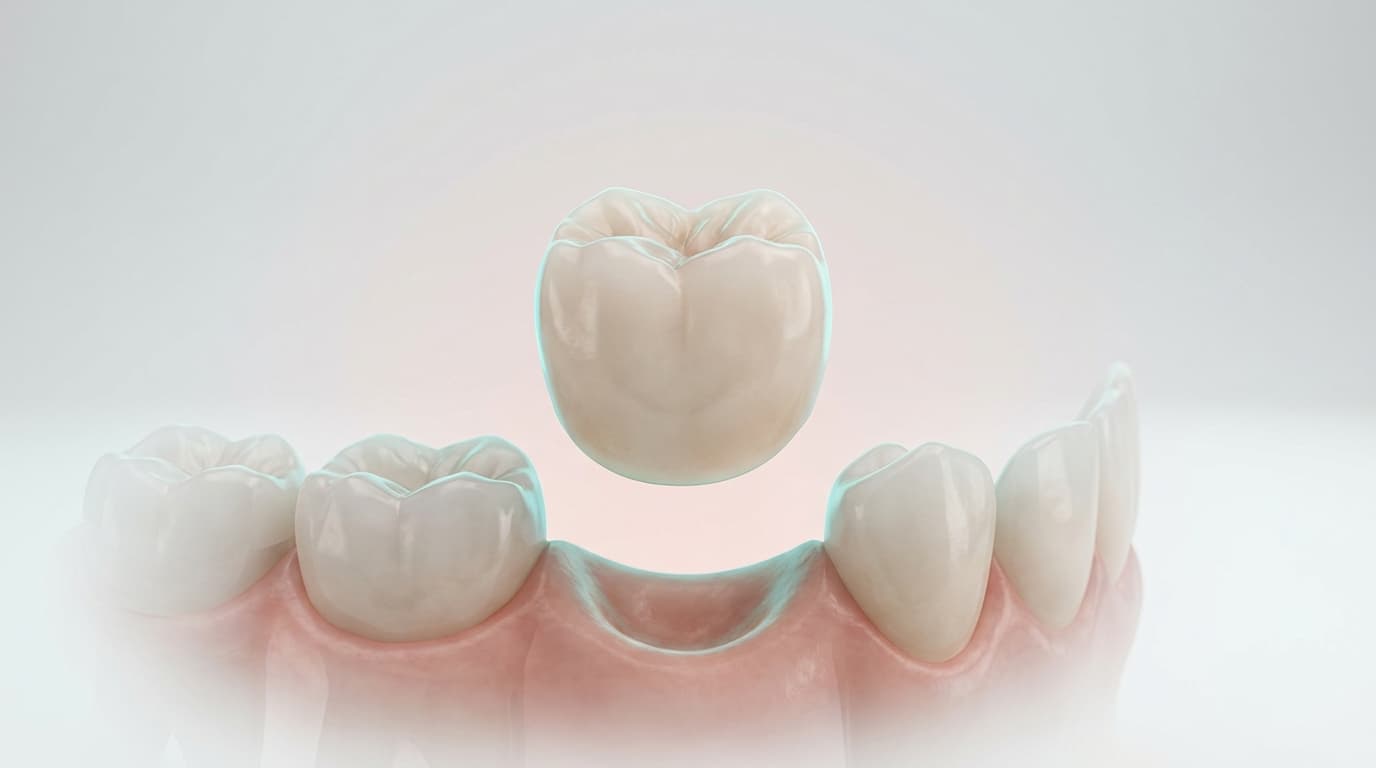
A dental crown is a custom-made restoration that completely caps the visible part of a severely damaged tooth, restoring the form, function, and aesthetics of the natural tooth. Unlike a filling, a crown does not just repair a small defect; it encloses the entire tooth like a cap, starting from the preparation margin.
In dentistry, a distinction is made between the anatomical crown (the natural part of the crown covered with enamel) and the prosthetic crown (the artificial cap). In everyday patient terms, "a crown" usually refers to the latter.
A crown is indicated when more than 50 to 70 percent of the tooth structure is destroyed—meaning a filling or an inlay would no longer provide enough stable protection. Typical triggers include deep tooth decay, tooth fractures, extensive old fillings, or restoration following a root canal treatment, where the devitalized tooth is at risk of fracturing without a crown.
Commonly used materials today range from all-ceramic (lithium disilicate, e.g., IPS e.max; or zirconia) to metal-ceramic (PFM) with veneering, up to full-cast crowns. The suitable material depends on the tooth (anterior or posterior), the bite situation, health insurance coverage, and aesthetic expectations. In our practice in Munich-Oberföhring, we use all-ceramic materials in over 90 percent of cases for reasons of biocompatibility and aesthetics.
When is a dental crown necessary?
A crown is always the treatment of choice when a direct filling or a lab-made inlay can no longer ensure the structural integrity of the tooth. We make this decision based on a clinical examination, bitewing x-rays, and—in more complex cases—a 3D CBCT scan.
The five most important clinical indications:
- Extensive tooth decay (caries) with a loss of tooth structure exceeding two cusps or more than 50 percent of the tooth's circumference.
- After a root canal treatment — endodontically treated teeth are more brittle and fracture significantly more often without a crown. International guidelines generally recommend a crown for endodontically treated posterior teeth.
- Tooth fracture or broken cusp — especially after a traumatic event or in cases of cracked tooth syndrome.
- Severe abrasion or erosion due to nighttime teeth grinding (bruxism), acid reflux, or eating disorders — here, the crown protects the remaining tooth structure from further degradation.
- Aesthetic correction of severely discolored, malformed, or asymmetrical teeth when bleaching and veneers are insufficient.
Not every large filling immediately requires a crown. As a rule of thumb: If there is less than 2 mm of healthy tooth structure remaining circumferentially after removing the decay, a crown is superior to an inlay. For root-canal-treated molars, we routinely recommend crowning within 4 to 6 weeks after completing the endodontic therapy to minimize the risk of fracture.
Types of dental crowns in comparison
The choice of material determines the aesthetics, longevity, and biocompatibility of your crown. Not every material is suitable for every tooth—for anterior teeth, translucency is key; for molars, fracture resistance is crucial.
| Material | Aesthetics | Longevity | Indication | Biocompatibility |
|---|---|---|---|---|
| All-ceramic (Lithium disilicate, e.max) | Very high — natural translucency | 15–20 years | Anterior and posterior teeth | Very high, metal-free |
| Zirconia crown | High — slightly opaque | 20–25 years | Posterior teeth, bruxism, bridges | Very high, metal-free |
| Metal-ceramic (PFM) | Medium — possible dark margin | 10–15 years | Standard care for posterior teeth | Medium — depends on alloy |
| Full-cast gold | Low (gold-colored) | 20+ years | Molars, bruxism | High (gold alloy) |
| Acrylic provisional | Medium | Weeks to months | Temporary solution | High |
In our practice in Munich-Oberföhring, we prefer monolithic all-ceramic (milled from a single block), which we generally fabricate in a single session using the CEREC system. We continue to provide metal-ceramic crowns if the fixed subsidy portion is to remain high and the patient opts for standard statutory health insurance care.
Dental crown procedure — step by step
The classic crowning procedure spans two treatment appointments spaced 7 to 14 days apart. With CEREC same-day restorations, the entire process is reduced to a single appointment lasting about 90 to 120 minutes.
- Appointment 1 — Examination, consultation, and treatment plan (30 minutes): Clinical exam, bitewing x-rays or CBCT, vitality test, material selection, explanation of the procedure, and creation of the treatment and cost plan (HKP), which is then submitted to your statutory health insurance.
- Appointment 2, Part A — Preparation (45–60 minutes): Following local anesthesia, the tooth is circumferentially reduced by approx. 1.0 to 1.5 mm (metal-ceramic) or 1.5 to 2.0 mm (all-ceramic). Before taking the impression, we place a retraction cord into the sulcus so the gums expose the preparation margin.
- Appointment 2, Part B — Impression or digital scan (10–20 minutes): Either conventionally with polyether or A-silicone impression material or—as is standard in our practice—digitally using an intraoral scanner. Bite registration and an impression of the opposing jaw are included.
- Provisional for 7–14 days (not needed with CEREC): We fabricate an acrylic temporary crown chairside to protect the prepared tooth from thermal stimuli, shifting of adjacent teeth, and bacterial contamination.
- Appointment 3 — Placement of the definitive crown (30–45 minutes): Try-in, checking the marginal fit, contact points, and occlusion (bite), cleaning, and adhesive cementation with composite resin cement (all-ceramic) or conventional cementation with glass ionomer cement (metal-ceramic). Finally, polishing the crown margin and fine-tuning the bite.
CEREC same-day restoration: With the digitally supported single-visit procedure, the temporary crown and second appointment are eliminated. After scanning, the CAD software designs the crown, a milling unit carves it from a ceramic block (approx. 15–20 minutes), followed by glazing/polishing and placement. Total duration: 90–120 minutes including breaks.
How long does a dental crown take in total?
The total duration depends primarily on whether you opt for the conventional two-step restoration or the CEREC same-day restoration—and whether the tooth requires root canal treatment beforehand.
- Standard procedure without root canal treatment: 1 to 2 weeks from the initial consultation to the placement of the final crown—two appointments of 60 to 90 minutes each.
- CEREC same-day restoration: 1 appointment, roughly 90 to 120 minutes. The crown leaves the practice permanently cemented on the same day.
- With prior root canal treatment: Total time 4 to 6 weeks. We typically wait 2 to 4 weeks after completing the endodontics to observe the healing response before placing a crown.
- With core buildup or post-and-core: An additional appointment of 30 to 45 minutes, though usually without extending the overall treatment timeline, as buildup and preparation are often combined in one session.
For patients from Bogenhausen, Oberföhring, and the entire northeastern Munich area, we recommend the CEREC same-day restoration for time-sensitive cases (business travelers, upcoming long-distance vacations, professional appearances). In our practice, we typically fabricate the all-ceramic crown in about 90 minutes—including preparation, scanning, design, milling, and placement.
Does getting a crown hurt?
The honest answer: The actual preparation of the tooth is completely painless under local anesthesia. What many patients find uncomfortable are the vibrations from the drill and keeping their mouth open for 45 to 60 minutes. Both can be easily mitigated with breaks, a relaxed posture, and, if desired, nitrous oxide sedation.
The placement of the final crown is usually done without anesthesia—it is a minimally invasive step involving a try-in and cementation. Many patients only notice a brief cool sensation when the cement cures.
After the anesthesia wears off (about 2 to 4 hours), slight pressure sensitivity may occur for 1 to 3 days because the tooth and surrounding periodontium are reacting to the preparation. Over-the-counter painkillers like 400 mg ibuprofen or 500 mg acetaminophen, taken according to the package insert, are sufficient here.
You should visit us again if:
- the pressure sensitivity does not subside after 5 days,
- a throbbing pain develops (indicating pulpal irritation),
- the bite feels altered or the crown feels "high",
- the gums at the crown margin remain swollen or bleeding.
For anxious patients, we offer twilight sleep (intravenous sedation) or treatment under general anesthesia in cooperation with an anesthesiologist, arranged on an individual basis.
How long does a dental crown last?
The lifespan of a dental crown depends on three factors: material, at-home care, and regular professional maintenance. According to a large systematic review (Sailer et al. 2015), about 95% of metal-ceramic crowns, about 97% of glass-ceramic crowns (e.g. lithium disilicate) and about 92% of zirconia crowns are still in function after 5 years — so the materials are close to each other.
- Metal-ceramic (PFM): 10 to 15 years on average, often limited by ceramic chipping.
- All-ceramic (Lithium disilicate): 15 to 20 years, excellent marginal seal when adhesively cemented.
- Zirconia crown: 20 to 25 years — currently the most durable all-ceramic option.
- Full-cast gold: Often over 20 years, but rarely chosen for aesthetic reasons.
Care recommendations to reach the upper limit of longevity:
- Brush teeth twice daily with a soft toothbrush and fluoride toothpaste.
- Clean the crown margin daily with dental floss or—even better—an appropriately sized interdental brush.
- Professional dental cleaning (PDC) twice a year to remove plaque at the crown margin, where secondary decay tends to develop.
- Biannual check-ups with occasional x-ray monitoring (every 2–3 years).
- If you grind your teeth at night: Use a bite guard (occlusal splint) to protect the ceramic from fracturing.
The most common reasons for premature crown failure are secondary tooth decay at the crown margin, periodontal bone loss, and—less frequently—ceramic fracture due to overload. All three are preventable with consistent care and regular check-ups.
Decay under the crown — how to recognize and treat it?
Secondary tooth decay (caries) under a crown almost always develops at the transition between the crown and the natural tooth structure—the crown margin. Plaque can accumulate here if not cleaned consistently. Because the crowned tooth is usually root-canal-treated and therefore devitalized, the early warning pain is absent, and the decay can progress unnoticed for a long time.
Warning signs that patients can notice themselves:
- A dark, discolored line at the crown-to-gum transition,
- A bad taste or bad breath despite good oral hygiene,
- Pressure sensitivity or "discomfort" when chewing on the crowned side,
- Bleeding, irritated gums right at the crown,
- A loose feeling of the crown (possible dissolution of cement).
A definitive diagnosis is made by the dentist using a bitewing x-ray or—if the findings are unclear—a CBCT scan. A visual inspection alone is insufficient because the crown optically hides the underlying decay.
Treatment options:
- Small, marginal secondary decay: In rare cases, the decay can be prepared minimally invasively and repaired with composite resin without removing the crown.
- Advanced secondary decay: Crown replacement. The old crown is sectioned and removed, the decay is excavated, a composite core buildup is placed, and a new crown is fabricated—the procedure and cost structure match those of a new crown.
- Decay involving the pulp: An additional root canal treatment is necessary before a new crown can be placed.
The best treatment is prevention: Biannual professional cleanings, using interdental brushes at the crown margin, and an annual x-ray check-up for crowned teeth.
Crown, inlay, or implant — what and when?
Preserving the natural tooth always takes precedence over tooth replacement for us. The decision for a filling, inlay, crown, or implant depends on how much healthy tooth structure is left after the decay has been removed and whether the nerve is still vital.
- Direct composite filling: Small defect up to approx. 30–40 percent structural loss, single surface, vital nerve. One session, the most cost-effective option.
- Ceramic inlay or partial crown: Medium defect (40–70 percent), at least one stable cusp, high aesthetic demands. More durable than composite, preserves more tooth structure than a full crown.
- Full crown: Large defect (over 70 percent), following a root canal treatment, multiple cusps affected, tooth yielding during chewing—the crown circumferentially protects the remaining tooth from fracturing.
- Implant with crown: The tooth is no longer restorable (longitudinal fracture, severe periodontal destruction, apical cyst that cannot be resolved while saving the tooth). The root is extracted, an implant is placed as an artificial root, and a crown is attached to it.
- Extraction plus bridge: Alternative to an implant, especially if bone height is limited or if the adjacent teeth require crowning anyway.
How much tooth structure must remain for a crown? A clinical rule of thumb is the so-called "ferrule effect": At least 1.5 to 2 mm of healthy circumferential tooth structure above the preparation margin to provide the crown with sufficient retention and fracture resistance. If this value is not met, we consider a post-and-core buildup or—if even this no longer offers stable retention—extraction followed by an implant.
We make this decision together with you during the consultation based on CBCT findings, remaining tooth structure, vitality status, and your individual risk profile—please allow about 30 minutes for this consultation.
What to do if the crown comes loose?
A loose crown is uncomfortable, but in most cases, it is not a dental emergency—provided you react quickly and correctly. Without the crown, the prepared tooth is sensitive to cold, heat, and sugar, and can develop decay or shift within a few days.
First steps in the correct order:
- Do not throw the crown away—keep it in a clean, dry container (e.g., a small pillbox). In most cases, it can be recemented.
- Do not play with the prepared tooth using your tongue or touch it with your fingers to prevent adjacent teeth from shifting.
- Call the practice promptly—we will schedule a 20 to 30-minute acute appointment for you.
- To bridge the time until your appointment: Temporary dental cement from the pharmacy (e.g., Dentemp, Recapit)—please never use superglue, craft glue, or other household adhesives. These are cytotoxic and make proper professional cementation later impossible.
- Eat soft foods on the affected side and avoid sugary or temperature-extreme foods.
At the practice, we check the detached crown and the tooth stump for secondary decay, fractures, or cement residue. If everything is intact, we recement it—taking about 30 minutes. If the underlying tooth structure is decayed or fractured, a new crown must be made.
All-ceramic vs. metal-ceramic? The detailed comparison
When choosing between all-ceramic (lithium disilicate, zirconia) and metal-ceramic (PFM — porcelain-fused-to-metal), four criteria are in focus: aesthetics, biocompatibility, longevity, and cost.
Aesthetics. All-ceramic has a natural light transmission—light penetrates the ceramic just as it does a natural tooth and is reflected by the stump. Metal-ceramic has an opaque metal framework substructure: If the gums recede, a dark metal margin can become visible. For anterior teeth and patients with a high smile line, all-ceramic is clearly superior.
Biocompatibility. All-ceramic is metal-free and hypoallergenic—ideal for patients with nickel, cobalt, or palladium allergies. Depending on the alloy, metal-ceramic crowns contain non-precious metals or precious metals (gold, platinum); rare contact allergies and galvanic currents in the mouth are possible.
Longevity. Modern lithium disilicate ceramics (e.max) reach flexural strengths of around 400 MPa, and zirconia even exceeds 1,000 MPa—sufficient even for molars and bruxism. Metal-ceramic lasts 10 to 15 years on average, while all-ceramic lasts 15 to 25 years.
Cost. Metal-ceramic is covered by statutory care with a co-payment; all-ceramic is usually a private service. The exact amounts depend on the individual finding — we create an individualized treatment and cost plan.
Indications. Zirconia is particularly suited for posterior teeth and multi-unit bridges; lithium disilicate (e.max) is the first choice for anterior teeth and single crowns in the aesthetic zone. We generally only choose metal-ceramic if the patient explicitly wishes to stick to standard statutory coverage or if there are extensive bridges under specific load conditions.
In our practice in Munich-Oberföhring, we fabricate monolithic all-ceramic crowns chairside using CEREC—in most cases, completed in a single treatment day.
Dental crown in Munich-Oberföhring: Our practice
Dr. Christina Dickel runs the dental practice in the Munich district of Oberföhring, bordering Bogenhausen (own practice since 2025, 13+ years of professional experience). The focus is on minimally invasive tooth preservation, all-ceramic restorations, and implantology. Dr. Dickel completed the Implantology Curriculum of the German Society of Implantology (DGI, 2014) and the Aesthetic Dentistry Curriculum of the DGÄZ (2015).
Technical equipment for crown restorations:
- CEREC system (Primescan intraoral scanner + MC X milling unit) for all-ceramic crowns in one visit.
- Cone Beam Computed Tomography (CBCT) for 3D diagnostics of complex crown and root conditions.
- Dental loupes and surgical microscope for preparations at sub- or paragingival margins.
- Collaboration with a certified master dental laboratory in Munich for lab-fabricated zirconia work and custom restorations.
Accessibility: The practice is just a few minutes' walk from the U4 subway station Arabellapark; parking is available right at the building. We speak German and English, and offer appointments in English upon request.
Our treatment process: An initial consultation including examination and an individualized treatment plan takes about 45 minutes. Appointments can be scheduled online via our booking system, by phone, or by email. We offer early morning and evening appointments for working professionals.
If you are considering whether a crown is right for you—or whether a loose crown can be recemented—please feel free to arrange a consultation. We will assess your specific situation and create a treatment and cost plan that you can comfortably review with your health insurance or supplemental insurance provider.
Fallbeispiel
Typical course of treatment (example): new all-ceramic crown after root canal treatment
Fictional example for illustration – not a real patient case.
Starting point. A patient has pain on biting on an upper molar that received a porcelain-fused-to-metal crown many years ago. A dark line is visible at the crown margin.
Typical findings. X-rays show secondary decay under the crown margin that reaches the dental nerve, and an inflammation at the root tip.
Typical course of treatment.
- Removal of the old crown.
- Root canal treatment, usually in two appointments.
- Build-up of the tooth, with a fibre post if needed.
- New crown, e.g. an all-ceramic CEREC crown that can be made and fitted in one appointment.
What to expect. Once the root canal treatment is complete, the symptoms usually subside; whether the inflammation at the root tip heals is shown by a control X-ray after a few months.
Billing. The crown receives the finding-based fixed allowance. An all-ceramic crown in the back teeth counts as an equivalent (gleichartige) restoration; the patient pays the additional costs compared with the standard care.
Häufige Fragen
How long does a dental crown procedure take?
Does getting a crown hurt?
Crown placement with or without anesthesia?
What does a dental crown cost?
How long does a dental crown last?
How can I recognize decay under a crown?
Which dental crown is the best?
How is a dental crown attached?
How much tooth structure must remain for a crown?
How often should I go for a check-up after getting a crown?
Can a crown trigger allergies?
Difference between partial crown vs. full crown?
Will the health insurance pay for the dental crown?
What should I do if the crown comes loose?
What is the procedure for a CEREC crown?
Weiterführende Themen
Verwandte Ratgeber
Artikel aus dem Blog
Behandlung in unserer Praxis
Quellen & Literatur
- Sailer I et al. — All-ceramic or metal-ceramic tooth-supported FDPs? Part I: Single crowns (Dent Mater 2015)(abgerufen am 1.10.2026)
- National Association of Statutory Health Insurance Dentists (KZBV) — Fixed Subsidies for Dental Prosthetics(abgerufen am 22.4.2026)
- Initiative proDente (BZÄK / KZBV) — Dental Prosthetics: Crowns, Bridges, Implants(abgerufen am 22.4.2026)
- German Dental Association (BZÄK) — For Patients(abgerufen am 22.4.2026)
- DocCheck Flexikon — Dental Crown (Professional Reference Work)(abgerufen am 22.4.2026)
- IQWiG / Gesundheitsinformation.de — Dental Prosthetics: Crowns, Bridges, and Implants(abgerufen am 22.4.2026)