
Wir verwenden Cookies

Diese Website nutzt Google Analytics, um die Nutzung zu analysieren und unser Angebot zu verbessern. Ihre Zustimmung ist freiwillig und kann jederzeit widerrufen werden.

DGI-zertifizierte ImplantologinÜber 95% Erfolgsrate13+ Jahre Erfahrung

Dental Implants Munich — Comparison, Costs & Consultation | Dr. Dickel

Tooth loss does not have to be permanent. Modern dental implants offer a stable and aesthetic solution that comes closest to natural teeth in function and appearance.

Tooth Loss — What Now?

A tooth has been lost — or needs to be extracted. This is a moment that overwhelms many patients. Suddenly you face a decision that can shape your oral health and quality of life for the next several decades. What now?

First, the important message: There are several good paths forward — and no single answer that fits everyone. The right solution depends on your individual situation: How many teeth are missing? What is the condition of your jawbone? What are your expectations regarding aesthetics, function and comfort? And, of course: What is financially realistic for you?

The three main options after tooth loss are:

  • Dental implant: An artificial titanium root inserted into the jawbone, serving as the foundation for a crown, bridge or denture. Biologically the most stable and aesthetically most convincing option — but also the most involved and most costly.
  • Dental bridge: A fixed prosthetic construction supported by the adjacent teeth. Proven, faster and less expensive — but the healthy neighboring teeth must be ground down to accommodate it.
  • Denture (removable): A partial denture for individual missing teeth or a full denture for complete tooth loss. The most traditional and least expensive solution — but with limitations in chewing comfort and aesthetics.

There is also a fourth option — leaving the gap untreated. This may feel like a decision, but in reality it is not: the jawbone in the area of the gap gradually resorbs without stimulation, neighboring teeth tip and drift, and treatment becomes more complex and costly over time.

This page is not an argument for implants at any price — it is an honest decision guide that helps you understand your options and prepare for a well-informed conversation with us. At our dental practice in Munich-Oberföhring, we take the time to carefully analyse your situation and find the best path forward together. Call us: 089 95760618.

Zahnimplantat-Anatomie — Titanschraube, Abutment und Keramikkrone auf weißem Hintergrund
Aufbau eines Zahnimplantats — künstliche Zahnwurzel, Verbindungsstück und individuelle Krone.

Implants vs. Bridge vs. Denture — The Honest Comparison

To make an informed decision, you need clear facts. The table below compares the three main options according to the criteria our patients ask about most often — without glossing anything over:

Criterion Dental Implant Dental Bridge Denture
Longevity 15–30+ years 10–15 years 5–10 years
Bone preservation Yes — implant stimulates the bone No — bone resorption in the gap Accelerates resorption
Adjacent teeth Left untouched Must be ground down Clasps place load on anchor teeth
Aesthetics Excellent — indistinguishable from a natural tooth Good Visibly a prosthetic replacement
Chewing sensation Natural — full chewing function Good Restricted
Maintenance Like your own teeth — brush + interdental brush Superfloss required under the bridge Remove and clean separately
Treatment duration 3–6 months (including osseointegration) 2–3 weeks 2–4 weeks
Cost €1,800–3,500 €800–2,500 €500–1,500

What this table shows: implants lead in virtually every qualitative criterion — longevity, bone preservation, aesthetics, chewing sensation. They are the only tooth replacement that truly replicates the natural tooth because they take over the same biomechanical function: transferring chewing forces into the jawbone, thereby preventing bone resorption.

However: implants are not always the right answer. If a neighboring tooth already requires extensive treatment, a bridge may be the more sensible choice. If a patient is not a candidate for implants due to underlying health conditions or insufficient bone volume, a high-quality denture still offers very good options. And for those with a limited budget, a bridge represents a very reasonable compromise.

The table is a starting point — your personal situation is what decides. At the initial consultation we will work out together which path makes the most sense for you.

Vergleich Zahnersatz — Implantat, Brücke und Prothese nebeneinander
Drei Wege zum Zahnersatz — Implantat, Brücke und Prothese im direkten Vergleich.

Which Solution Fits Your Situation?

Every case of tooth loss is different — and the optimal solution depends on how many teeth are missing, where the gap is located, what your bone structure looks like, and what your expectations are. Here are the most common scenarios from our daily practice:

Single missing tooth

For a single missing tooth, a single-tooth implant is the first choice — it leaves the adjacent teeth untouched, preserves the bone and looks like a natural tooth. A bridge is a good alternative if the neighboring teeth already have large fillings or crowns, or if rapid treatment without a waiting period is a priority. For an otherwise healthy, small gap, however, the principle is: one implant placed — for decades. More on single-tooth replacement: Implantology | Dental Bridge.

Multiple missing teeth

When several adjacent teeth are missing, implant-supported bridges (2–3 implants supporting 4–6 replacement teeth) or a partial denture come into consideration. The implant-supported bridge offers a secure fit and complete bone preservation. The partial denture is less expensive and quicker, but carries the well-known limitations in stability and chewing comfort. This is where a detailed consultation with 3D diagnostics pays off, enabling precise planning of the optimal number and position of implants. More: Dental Prosthetics.

Complete edentulism — all teeth missing

In cases of complete tooth loss, there are today excellent options that go far beyond the conventional full denture:

  • All-on-4 / All-on-6: 4 or 6 strategically placed implants support a fixed full-arch restoration. The patient leaves the practice with fixed teeth — the result is aesthetically and functionally outstanding.
  • Implant-retained denture: 2–4 implants anchor a removable denture (via a bar or locator attachment). Significantly better retention than a conventional denture, less expensive than All-on-4.
  • Conventional full denture: The traditional solution — no implants required, but compromises in stability, bone preservation and chewing comfort.

More on your options: Implantology | Dental Prosthetics.

Loose or poorly fitting denture

One of the most frequent requests at our practice: the existing denture no longer stays in place — it is loose, causes discomfort or slips during eating. The solution: 2–4 implants for denture retention (bar or locator system). The existing denture can often be re-used; it is simply anchored to the implants. The result is a stable, comfortable restoration — without having to fabricate a completely new denture. More: Implantology.

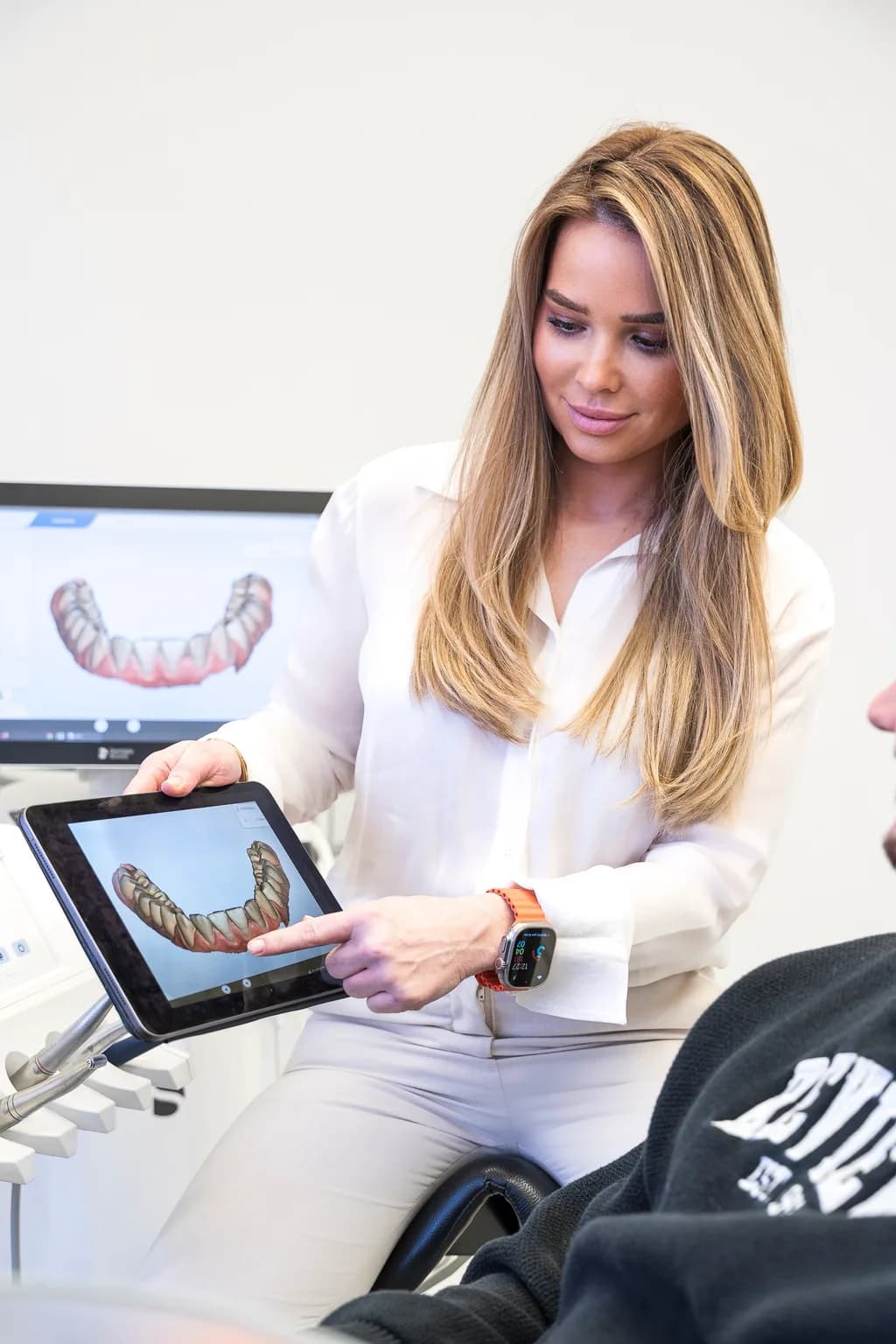
Digitale 3D-Implantatplanung auf Bildschirm — DVT-Aufnahme des Kiefers
Präzise 3D-Planung — so finden wir die optimale Lösung für Ihre Situation.

What Does a Dental Implant Really Cost?

Cost is, understandably, the decisive argument against implants for many patients. But the right question is not: "What does an implant cost?" — it is: "What will the right decision cost me over the next 20 years?"

Cost overview by type of restoration

  • Single-tooth implant (including crown): €1,800–3,500 — depending on the implant system, crown type and any necessary bone grafting
  • Implant-supported bridge (2 implants + bridge): €3,500–7,000
  • All-on-4 fixed full arch (per jaw): €12,000–25,000 — complete restoration with 4–6 implants
  • Bone grafting (if required): €500–1,500 additionally, depending on extent

A detailed breakdown by implant type, material and scope of treatment is available on our Implantology page.

Statutory insurance subsidy — what does the insurer pay?

Statutory health insurance (GKV) provides a fixed subsidy determined by the dental findings — that is, by how many teeth are missing and where. Crucially: the subsidy is the same regardless of whether you choose an implant, a bridge or a denture. The insurer pays the same amount it would pay for standard care (typically a bridge or denture). With a complete bonus booklet — maintained consistently for five years — you receive 20–30 % more subsidy. The bonus booklet is always worth keeping, and we will help you keep it up to date.

The lifecycle comparison — the honest calculation

An implant may cost €2,500 today. A bridge costs €1,200. At first glance, the bridge seems cheaper. But let's continue the calculation: the bridge lasts 10–15 years, then it must be replaced — another €1,200. Added to that are potential follow-up costs for the ground-down neighboring teeth, which have been weakened and will sooner or later require treatment. An implant, on the other hand, lasts — with good care — 25–30+ years without replacement. Calculated over 25 years, the implant is frequently the less expensive option. And the bone preservation it provides is virtually priceless: without an implant, the jawbone in the gap resorbs, which gradually changes the facial profile and makes future implants more difficult.

Privately insured? Private health insurance often covers more

Private health insurers reimburse, depending on the policy, up to 100 % of implant costs including bone grafting and prosthetic restoration. We are happy to prepare a detailed treatment and cost plan that you can submit to your insurer.

Financing available

Implants are an investment — and we know that not everyone can cover the cost all at once. On request, we offer installment payment plans and individual financing solutions. Please speak to us openly — we will find a solution together.

The Path to an Implant — 5 Steps

Many patients put off the decision to get an implant because they imagine the procedure to be more complicated than it actually is. The truth: the process is manageable and easy to plan — and we are by your side at every step.

  1. Initial consultation & 3D planning
    A free first appointment: we examine your jaw, create a digital volume tomogram (DVT / cone beam CT) if needed, and discuss all options together. At the end you will know exactly what is possible, what it costs and what the timeline looks like. No obligation.
  2. Preparatory treatment if required
    Sometimes preparation is necessary before implant placement: bone grafting when jaw volume is insufficient, treatment of existing periodontitis, or tooth extraction. These steps are not obstacles — they are part of a well-considered plan.
  3. Implant placement
    The procedure itself takes 30–60 minutes depending on complexity and is performed under local anaesthesia. Most patients report that the procedure was more comfortable than expected — comparable to a tooth extraction, often even less demanding.
  4. Osseointegration
    The implant fuses with the jawbone over 3–6 months (osseointegration). During this period you will wear a temporary restoration so that the gap is covered aesthetically and functionally. Regular check-ups ensure that everything is proceeding as planned.
  5. Final crown
    After successful osseointegration, an individual ceramic crown is fabricated and attached to the implant. The result: a tooth indistinguishable from the real thing — one that can last a lifetime.

The complete detailed treatment process — including clinical steps, material information and answers to all specialist questions — is available on our Implantology page.

Implantationsinstrumente — Implantat-Driver, Drehmomentschlüssel und Einheilkappen auf sterilem Tablett
Präzisionsinstrumente für eine sichere und schonende Implantation.

Common Concerns — Answered Honestly

Many patients come to their first consultation with questions and concerns — and that is exactly as it should be. Here are the most common ones we encounter:

"Will it hurt?"

This is the question we hear most often. The answer: No — not during the procedure. Implant placement is carried out under local anaesthesia, so you will feel nothing. Most patients report that the procedure was less uncomfortable than a routine tooth extraction. After the procedure there may be temporary swelling and mild pain, which are well managed with standard pain relievers. Anyone who is still anxious about the procedure can take advantage of our gentle sedation options: Dental anxiety treatment, Twilight sedation.

"Am I too old for implants?"

No. There is no upper age limit for dental implants. What matters is not chronological age but overall health and jawbone quality. We have successfully placed implants in patients in their eighties. As long as the cardiovascular system is stable and no serious contraindications are present, an implant is possible — and worthwhile, because older patients too benefit from stable chewing function and quality of life.

"I smoke — is that a problem?"

Smoking increases the risk of delayed osseointegration and peri-implantitis (inflammation around the implant). It is not an absolute contraindication, but it is a relevant risk factor. We recommend abstaining from smoking at least during the osseointegration phase to significantly improve the prospects for success. We will advise you honestly about your individual risk.

"I have diabetes"

Well-controlled diabetes is not a contraindication for dental implants. Studies confirm that patients with controlled diabetes achieve implant success rates comparable to non-diabetic patients. Close coordination with the treating internist or GP and particularly careful aftercare are important. Please speak to us — we plan the treatment in conjunction with your other physicians.

"My bone is too thin"

This is a common concern — but not a reason to give up. Modern bone augmentation management makes it possible to place implants even when bone volume is reduced. In the upper jaw, a sinus lift is often used to augment the maxillary sinus. For horizontal or vertical bone defects, proven regenerative procedures are available: Bone grafting before implants. 3D diagnostics show us precisely what is possible.

"I am afraid of the procedure"

Dental anxiety is very common — and no reason to forgo good treatment. Our practice specialises in treating anxious patients. In addition to empathetic communication and a calm treatment environment, we offer various sedation options: Nitrous oxide sedation for light relaxation, twilight sedation for deeper relaxation, or general anaesthesia for patients who wish to sleep through the entire procedure. No patient needs to be afraid — we will find the right solution for you.

Longevity & Care

Dental implants are among the most long-lasting restorations in dentistry — but their longevity is not guaranteed automatically. It depends to a great extent on how well the implant is maintained and how regularly you attend follow-up appointments.

What do the figures say?

Scientific long-term studies confirm: over 95 % of all implants are still in function after 10 years. With good home care and regular professional cleaning, many implants last 25 to 30 years and beyond — sometimes for a lifetime. The crown (the visible part) may need to be renewed occasionally (every 15–20 years); the implant itself remains permanently in the bone.

Care — simpler than you think

An implant is maintained much like a natural tooth — one of its greatest advantages. What you should do daily:

  • Brush twice daily with a soft-bristle toothbrush — paying careful attention to the junction between the implant and the gum
  • Use interdental brushes daily — the single most important step in preventing peri-implantitis. Standard dental floss is less suitable; small interdental brushes clean the tight spaces around the implant more effectively
  • Professional dental cleaning (PDC) twice a year — specifically for implants, using implant-compatible instruments and polishing pastes. More on Professional Dental Cleaning

The risk: peri-implantitis

Peri-implantitis is the most common cause of implant loss after the osseointegration phase. It is in some ways the counterpart to periodontitis around a natural tooth: a bacterial infection of the tissue and bone surrounding the implant. Peri-implantitis is largely preventable through consistent home care and regular professional cleaning. Patients who attend check-ups regularly give us the opportunity to detect early signs and intervene before an infection becomes established.

Our aftercare protocol

For all implant patients we recommend a structured recall programme: twice a year a combined session comprising a dental examination, measurement of implant pocket depths and professional cleaning. This protocol is your most important tool for a long implant life.

Implantatpflege — Interdentalbürsten, weiche Zahnbürste, Zahnspiegel und Implantatmodell
Langlebig mit der richtigen Pflege — Interdentalbürsten sind der Schlüssel.

Next Step — Free Initial Consultation

You have informed yourself — and perhaps have the feeling that an implant or another tooth replacement solution might be right for you. What now?

The next step is simple: a free initial consultation at our practice. Here is what to expect:

  • Thorough examination — We assess your clinical findings and evaluate the condition of the jawbone, adjacent teeth and gums.
  • Radiological diagnostics — Where needed, we take a digital X-ray or a 3D cone beam CT (DVT) that shows the precise bone situation and forms the basis for planning.
  • Joint discussion — We explain all options, answer your questions and address your concerns. No jargon, no pressure.
  • Treatment and cost plan — You receive an official cost estimate that you can submit to your statutory or private health insurer.

No obligation, no pressure. The decision is yours — we simply provide the information you need to make it with confidence.

Contact us:

  • Phone: 089 95760618
  • Address: Oberföhringer Straße 183a, 81925 München-Oberföhring

We look forward to helping you.

Kosten im Überblick

Single-tooth implant (including crown)

€1,800–3,500

Depending on implant system and crown type

Implant-supported bridge

€3,500–7,000

2 implants + bridge restoration

All-on-4 fixed full arch (per jaw)

€12,000–25,000

Complete restoration with 4–6 implants

Bone grafting (if required)

€500–1,500

Additional cost depending on extent

Statutory health insurance (GKV) pays a fixed subsidy determined by the dental findings — regardless of whether you choose an implant, a bridge or a denture. With a complete bonus booklet you receive 20–30 % more subsidy.

Private health insurers cover up to 100 % of implant costs including bone grafting and prosthetic restoration, depending on the policy.

Installment payment plans and individual financing solutions available. Please speak to us — we will find a solution.

Risiken und Sicherheit

Dental implants are among the safest and most thoroughly researched procedures in dentistry. The success rate is over 95 % after 10 years.

Implant failure (unsuccessful osseointegration)

Rare (2–5 %)

Careful planning, smoke-free osseointegration phase, regular check-ups

Peri-implantitis (inflammation around the implant)

Possible with inadequate care

Regular professional cleaning, interdental brushes, aftercare programme

Post-operative swelling and pain

Common, temporary (a few days)

Cooling, pain relief medication, rest

Through 3D-guided planning, navigated implant placement and a structured aftercare programme, we minimise the risk of complications to an absolute minimum.

Häufige Fragen

From a purely clinical standpoint, an implant is the superior solution: it preserves the jawbone, leaves the adjacent teeth untouched and offers a longevity of 25–30+ years. A bridge is sensible, however, when the neighboring teeth already require restoration anyway, or when a faster, more cost-effective solution is the priority. The right answer depends on your individual situation — we are happy to advise you in a personal consultation.
At our practice in Munich-Oberföhring, the cost of a single-tooth implant including the crown is between €1,800 and €3,500, depending on the implant system, crown type and whether bone grafting is required. For more extensive restorations (implant-supported bridges, All-on-4), costs are higher. We are happy to prepare a transparent treatment and cost plan before treatment begins.
Statutory health insurance (GKV) pays a fixed subsidy determined by the dental findings — regardless of whether you choose an implant, a bridge or a denture. The subsidy corresponds to the amount the insurer would pay for standard care (typically a bridge or denture). With a complete bonus booklet you receive 20–30 % more subsidy. Private health insurers cover up to 100 % of implant costs depending on the policy.
Studies confirm a success rate of over 95 % after 10 years. With good care and regular professional dental cleaning, many implants last 25 to 30 years or longer — sometimes for a lifetime. The crown may need to be renewed after 15–20 years; the titanium implant itself remains permanently in the bone. Consistent oral hygiene and the twice-yearly recall programme are the key factors.
There is no upper age limit for dental implants. What matters is not chronological age but overall health and jawbone quality. We have successfully placed implants in patients in their eighties. As long as no serious medical contraindications are present, an implant is possible — and particularly valuable for older patients, as it preserves chewing function and quality of life in the long term.
Yes — but only after successful periodontal treatment. Active periodontitis is a contraindication for implants, because the same bacteria that attack the natural periodontium also endanger implants (peri-implantitis). We first treat the periodontitis, establish a stable situation, and then plan the implant restoration. The long-term outcome is then just as good as in periodontally healthy patients.
An untreated gap is not a neutral option: without the pressure stimulation provided by a tooth or implant, the jawbone in the gap resorbs within months — this process is irreversible and can make future implants more difficult or impossible. Additionally, the adjacent teeth tip into the gap, the opposing tooth over-erupts (elongates), and the bite can shift. The longer a gap exists, the more complex the subsequent treatment becomes.
That depends on how many teeth are missing and what type of restoration is planned. A single missing tooth typically requires one implant. A three-unit bridge can be supported by two implants. A complete jaw restoration (All-on-4 or All-on-6) is possible with four to six strategically positioned implants. 3D planning with a cone beam CT shows us the bone situation and allows precise planning of the optimal number and position of implants.
Dental implants are among the safest and most thoroughly researched procedures in dentistry — the success rate is over 95 % after 10 years. The most common risk is peri-implantitis (inflammation around the implant), which is largely preventable through consistent care and regular professional cleaning. Implant failure due to unsuccessful osseointegration occurs in 2–5 % of cases. Through 3D-guided planning and navigated implant placement, we minimise risks to an absolute minimum.
An immediate implant is placed directly into the fresh socket immediately after tooth extraction — this saves time and protects the bone. The staged protocol waits for the extraction site to heal (approximately 6–8 weeks). Which approach is appropriate depends on bone quality, the initial situation and any existing infection. Not every case is suitable for an immediate implant — we establish this during 3D diagnostics.
Yes — ceramic implants (zirconia) are a metal-free alternative for patients with titanium sensitivity or a wish for a completely metal-free restoration. They are biocompatible, aesthetically excellent and have shown comparable success rates to titanium implants in long-term studies — although the evidence base is less extensive. Titanium implants remain the gold standard; however, we offer both options and advise you individually.
In the first few days after implant placement we recommend soft foods and protecting the implant site. You will receive a temporary restoration (crown or denture) so that the gap is covered. Once the initial healing period has passed (approximately 1–2 weeks), you can eat normally again — you should simply avoid chewing hard foods directly on the implant site during the osseointegration months. After complete osseointegration and placement of the final crown, there are no restrictions whatsoever.

Qualifikationen und Zertifikate

2012

State examination in dentistry

Heinrich-Heine-Universität Düsseldorf

2014

Curriculum in Implantology

Deutsche Gesellschaft für Implantologie (DGI)

2018

Certification in 3D implant planning

Straumann

2014

Member of the German Society of Implantology (DGI)

DGI

Bereit für Ihr strahlendes Lächeln?

Vereinbaren Sie jetzt Ihr kostenloses Beratungsgespräch. Wir freuen uns auf Sie.

Verwandte Leistungen

Ready for your
Dental Implants?

Schedule your consultation appointment today and let our expertise convince you. We look forward to helping you achieve a healthy and radiant smile.

Treatment Overview:

Treatment Duration:
Sessions:
Investment:
Specialist: Dentist Dickel

Contact & Directions

Dental Practice Christina Dickel
Oberföhringer Straße 183a, 81925 München

Opening Hours

Mon:08:00-19:00
Tue:08:00-19:00
Wed:08:00-19:00
Thu:08:00-19:00
Fri:08:00-13:00
13+
Years Experience
4.9
★★★★★ Rating
100%
Satisfaction

Implants vs. Bridge vs. Denture — The Honest Comparison

To make an informed decision, you need clear facts. The table below compares the three main options according to the criteria our patients ask about most often — without glossing anything over:

Criterion Dental Implant Dental Bridge Denture
Longevity 15–30+ years 10–15 years 5–10 years
Bone preservation Yes — implant stimulates the bone No — bone resorption in the gap Accelerates resorption
Adjacent teeth Left untouched Must be ground down Clasps place load on anchor teeth
Aesthetics Excellent — indistinguishable from a natural tooth Good Visibly a prosthetic replacement
Chewing sensation Natural — full chewing function Good Restricted
Maintenance Like your own teeth — brush + interdental brush Superfloss required under the bridge Remove and clean separately
Treatment duration 3–6 months (including osseointegration) 2–3 weeks 2–4 weeks
Cost €1,800–3,500 €800–2,500 €500–1,500

What this table shows: implants lead in virtually every qualitative criterion — longevity, bone preservation, aesthetics, chewing sensation. They are the only tooth replacement that truly replicates the natural tooth because they take over the same biomechanical function: transferring chewing forces into the jawbone, thereby preventing bone resorption.

However: implants are not always the right answer. If a neighboring tooth already requires extensive treatment, a bridge may be the more sensible choice. If a patient is not a candidate for implants due to underlying health conditions or insufficient bone volume, a high-quality denture still offers very good options. And for those with a limited budget, a bridge represents a very reasonable compromise.

The table is a starting point — your personal situation is what decides. At the initial consultation we will work out together which path makes the most sense for you.

Which Solution Fits Your Situation?

Every case of tooth loss is different — and the optimal solution depends on how many teeth are missing, where the gap is located, what your bone structure looks like, and what your expectations are. Here are the most common scenarios from our daily practice:

Single missing tooth

For a single missing tooth, a single-tooth implant is the first choice — it leaves the adjacent teeth untouched, preserves the bone and looks like a natural tooth. A bridge is a good alternative if the neighboring teeth already have large fillings or crowns, or if rapid treatment without a waiting period is a priority. For an otherwise healthy, small gap, however, the principle is: one implant placed — for decades. More on single-tooth replacement: Implantology | Dental Bridge.

Multiple missing teeth

When several adjacent teeth are missing, implant-supported bridges (2–3 implants supporting 4–6 replacement teeth) or a partial denture come into consideration. The implant-supported bridge offers a secure fit and complete bone preservation. The partial denture is less expensive and quicker, but carries the well-known limitations in stability and chewing comfort. This is where a detailed consultation with 3D diagnostics pays off, enabling precise planning of the optimal number and position of implants. More: Dental Prosthetics.

Complete edentulism — all teeth missing

In cases of complete tooth loss, there are today excellent options that go far beyond the conventional full denture:

More on your options: Implantology | Dental Prosthetics.

Loose or poorly fitting denture

One of the most frequent requests at our practice: the existing denture no longer stays in place — it is loose, causes discomfort or slips during eating. The solution: 2–4 implants for denture retention (bar or locator system). The existing denture can often be re-used; it is simply anchored to the implants. The result is a stable, comfortable restoration — without having to fabricate a completely new denture. More: Implantology.

What Does a Dental Implant Really Cost?

Cost is, understandably, the decisive argument against implants for many patients. But the right question is not: "What does an implant cost?" — it is: "What will the right decision cost me over the next 20 years?"

Cost overview by type of restoration

A detailed breakdown by implant type, material and scope of treatment is available on our Implantology page.

Statutory insurance subsidy — what does the insurer pay?

Statutory health insurance (GKV) provides a fixed subsidy determined by the dental findings — that is, by how many teeth are missing and where. Crucially: the subsidy is the same regardless of whether you choose an implant, a bridge or a denture. The insurer pays the same amount it would pay for standard care (typically a bridge or denture). With a complete bonus booklet — maintained consistently for five years — you receive 20–30 % more subsidy. The bonus booklet is always worth keeping, and we will help you keep it up to date.

The lifecycle comparison — the honest calculation

An implant may cost €2,500 today. A bridge costs €1,200. At first glance, the bridge seems cheaper. But let's continue the calculation: the bridge lasts 10–15 years, then it must be replaced — another €1,200. Added to that are potential follow-up costs for the ground-down neighboring teeth, which have been weakened and will sooner or later require treatment. An implant, on the other hand, lasts — with good care — 25–30+ years without replacement. Calculated over 25 years, the implant is frequently the less expensive option. And the bone preservation it provides is virtually priceless: without an implant, the jawbone in the gap resorbs, which gradually changes the facial profile and makes future implants more difficult.

Privately insured? Private health insurance often covers more

Private health insurers reimburse, depending on the policy, up to 100 % of implant costs including bone grafting and prosthetic restoration. We are happy to prepare a detailed treatment and cost plan that you can submit to your insurer.

Financing available

Implants are an investment — and we know that not everyone can cover the cost all at once. On request, we offer installment payment plans and individual financing solutions. Please speak to us openly — we will find a solution together.

The Path to an Implant — 5 Steps

Many patients put off the decision to get an implant because they imagine the procedure to be more complicated than it actually is. The truth: the process is manageable and easy to plan — and we are by your side at every step.

  1. Initial consultation & 3D planning
    A free first appointment: we examine your jaw, create a digital volume tomogram (DVT / cone beam CT) if needed, and discuss all options together. At the end you will know exactly what is possible, what it costs and what the timeline looks like. No obligation.
  2. Preparatory treatment if required
    Sometimes preparation is necessary before implant placement: bone grafting when jaw volume is insufficient, treatment of existing periodontitis, or tooth extraction. These steps are not obstacles — they are part of a well-considered plan.
  3. Implant placement
    The procedure itself takes 30–60 minutes depending on complexity and is performed under local anaesthesia. Most patients report that the procedure was more comfortable than expected — comparable to a tooth extraction, often even less demanding.
  4. Osseointegration
    The implant fuses with the jawbone over 3–6 months (osseointegration). During this period you will wear a temporary restoration so that the gap is covered aesthetically and functionally. Regular check-ups ensure that everything is proceeding as planned.
  5. Final crown
    After successful osseointegration, an individual ceramic crown is fabricated and attached to the implant. The result: a tooth indistinguishable from the real thing — one that can last a lifetime.

The complete detailed treatment process — including clinical steps, material information and answers to all specialist questions — is available on our Implantology page.

Common Concerns — Answered Honestly

Many patients come to their first consultation with questions and concerns — and that is exactly as it should be. Here are the most common ones we encounter:

"Will it hurt?"

This is the question we hear most often. The answer: No — not during the procedure. Implant placement is carried out under local anaesthesia, so you will feel nothing. Most patients report that the procedure was less uncomfortable than a routine tooth extraction. After the procedure there may be temporary swelling and mild pain, which are well managed with standard pain relievers. Anyone who is still anxious about the procedure can take advantage of our gentle sedation options: Dental anxiety treatment, Twilight sedation.

"Am I too old for implants?"

No. There is no upper age limit for dental implants. What matters is not chronological age but overall health and jawbone quality. We have successfully placed implants in patients in their eighties. As long as the cardiovascular system is stable and no serious contraindications are present, an implant is possible — and worthwhile, because older patients too benefit from stable chewing function and quality of life.

"I smoke — is that a problem?"

Smoking increases the risk of delayed osseointegration and peri-implantitis (inflammation around the implant). It is not an absolute contraindication, but it is a relevant risk factor. We recommend abstaining from smoking at least during the osseointegration phase to significantly improve the prospects for success. We will advise you honestly about your individual risk.

"I have diabetes"

Well-controlled diabetes is not a contraindication for dental implants. Studies confirm that patients with controlled diabetes achieve implant success rates comparable to non-diabetic patients. Close coordination with the treating internist or GP and particularly careful aftercare are important. Please speak to us — we plan the treatment in conjunction with your other physicians.

"My bone is too thin"

This is a common concern — but not a reason to give up. Modern bone augmentation management makes it possible to place implants even when bone volume is reduced. In the upper jaw, a sinus lift is often used to augment the maxillary sinus. For horizontal or vertical bone defects, proven regenerative procedures are available: Bone grafting before implants. 3D diagnostics show us precisely what is possible.

"I am afraid of the procedure"

Dental anxiety is very common — and no reason to forgo good treatment. Our practice specialises in treating anxious patients. In addition to empathetic communication and a calm treatment environment, we offer various sedation options: Nitrous oxide sedation for light relaxation, twilight sedation for deeper relaxation, or general anaesthesia for patients who wish to sleep through the entire procedure. No patient needs to be afraid — we will find the right solution for you.

Longevity & Care

Dental implants are among the most long-lasting restorations in dentistry — but their longevity is not guaranteed automatically. It depends to a great extent on how well the implant is maintained and how regularly you attend follow-up appointments.

What do the figures say?

Scientific long-term studies confirm: over 95 % of all implants are still in function after 10 years. With good home care and regular professional cleaning, many implants last 25 to 30 years and beyond — sometimes for a lifetime. The crown (the visible part) may need to be renewed occasionally (every 15–20 years); the implant itself remains permanently in the bone.

Care — simpler than you think

An implant is maintained much like a natural tooth — one of its greatest advantages. What you should do daily:

The risk: peri-implantitis

Peri-implantitis is the most common cause of implant loss after the osseointegration phase. It is in some ways the counterpart to periodontitis around a natural tooth: a bacterial infection of the tissue and bone surrounding the implant. Peri-implantitis is largely preventable through consistent home care and regular professional cleaning. Patients who attend check-ups regularly give us the opportunity to detect early signs and intervene before an infection becomes established.

Our aftercare protocol

For all implant patients we recommend a structured recall programme: twice a year a combined session comprising a dental examination, measurement of implant pocket depths and professional cleaning. This protocol is your most important tool for a long implant life.

Next Step — Free Initial Consultation

You have informed yourself — and perhaps have the feeling that an implant or another tooth replacement solution might be right for you. What now?

The next step is simple: a free initial consultation at our practice. Here is what to expect:

No obligation, no pressure. The decision is yours — we simply provide the information you need to make it with confidence.

Contact us:

We look forward to helping you.

Which is better — implant or bridge?
From a purely clinical standpoint, an implant is the superior solution: it preserves the jawbone, leaves the adjacent teeth untouched and offers a longevity of 25–30+ years. A bridge is sensible, however, when the neighboring teeth already require restoration anyway, or when a faster, more cost-effective solution is the priority. The right answer depends on your individual situation — we are happy to advise you in a personal consultation.
How much does a dental implant cost in Munich?
At our practice in Munich-Oberföhring, the cost of a single-tooth implant including the crown is between €1,800 and €3,500, depending on the implant system, crown type and whether bone grafting is required. For more extensive restorations (implant-supported bridges, All-on-4), costs are higher. We are happy to prepare a transparent treatment and cost plan before treatment begins.
Does health insurance cover dental implants?
Statutory health insurance (GKV) pays a fixed subsidy determined by the dental findings — regardless of whether you choose an implant, a bridge or a denture. The subsidy corresponds to the amount the insurer would pay for standard care (typically a bridge or denture). With a complete bonus booklet you receive 20–30 % more subsidy. Private health insurers cover up to 100 % of implant costs depending on the policy.
How long does a dental implant last?
Studies confirm a success rate of over 95 % after 10 years. With good care and regular professional dental cleaning, many implants last 25 to 30 years or longer — sometimes for a lifetime. The crown may need to be renewed after 15–20 years; the titanium implant itself remains permanently in the bone. Consistent oral hygiene and the twice-yearly recall programme are the key factors.
Am I too old for a dental implant?
There is no upper age limit for dental implants. What matters is not chronological age but overall health and jawbone quality. We have successfully placed implants in patients in their eighties. As long as no serious medical contraindications are present, an implant is possible — and particularly valuable for older patients, as it preserves chewing function and quality of life in the long term.
Can I get implants if I have periodontitis?
Yes — but only after successful periodontal treatment. Active periodontitis is a contraindication for implants, because the same bacteria that attack the natural periodontium also endanger implants (peri-implantitis). We first treat the periodontitis, establish a stable situation, and then plan the implant restoration. The long-term outcome is then just as good as in periodontally healthy patients.
What happens if you leave a gap untreated?
An untreated gap is not a neutral option: without the pressure stimulation provided by a tooth or implant, the jawbone in the gap resorbs within months — this process is irreversible and can make future implants more difficult or impossible. Additionally, the adjacent teeth tip into the gap, the opposing tooth over-erupts (elongates), and the bite can shift. The longer a gap exists, the more complex the subsequent treatment becomes.
How many implants will I need?
That depends on how many teeth are missing and what type of restoration is planned. A single missing tooth typically requires one implant. A three-unit bridge can be supported by two implants. A complete jaw restoration (All-on-4 or All-on-6) is possible with four to six strategically positioned implants. 3D planning with a cone beam CT shows us the bone situation and allows precise planning of the optimal number and position of implants.
What are the risks of dental implants?
Dental implants are among the safest and most thoroughly researched procedures in dentistry — the success rate is over 95 % after 10 years. The most common risk is peri-implantitis (inflammation around the implant), which is largely preventable through consistent care and regular professional cleaning. Implant failure due to unsuccessful osseointegration occurs in 2–5 % of cases. Through 3D-guided planning and navigated implant placement, we minimise risks to an absolute minimum.
Immediate implant or staged protocol — which is better?
An immediate implant is placed directly into the fresh socket immediately after tooth extraction — this saves time and protects the bone. The staged protocol waits for the extraction site to heal (approximately 6–8 weeks). Which approach is appropriate depends on bone quality, the initial situation and any existing infection. Not every case is suitable for an immediate implant — we establish this during 3D diagnostics.
Is there a metal-free alternative (ceramic implant)?
Yes — ceramic implants (zirconia) are a metal-free alternative for patients with titanium sensitivity or a wish for a completely metal-free restoration. They are biocompatible, aesthetically excellent and have shown comparable success rates to titanium implants in long-term studies — although the evidence base is less extensive. Titanium implants remain the gold standard; however, we offer both options and advise you individually.
Can I eat normally during the osseointegration phase?
In the first few days after implant placement we recommend soft foods and protecting the implant site. You will receive a temporary restoration (crown or denture) so that the gap is covered. Once the initial healing period has passed (approximately 1–2 weeks), you can eat normally again — you should simply avoid chewing hard foods directly on the implant site during the osseointegration months. After complete osseointegration and placement of the final crown, there are no restrictions whatsoever.