
Contents
Fixed teeth in one day: from a toothless jaw to a fixed bridge
With the All-on-4 concept you leave the practice on the day of surgery with fixed teeth — no palate plate, no denture adhesive, no weeks with a removable temporary. We place four implants per jaw and screw a provisional bridge onto them the same day. Once the implants have healed in, a final, particularly durable bridge replaces the provisional one.
The concept is designed for people who are already toothless, whose remaining teeth can no longer be saved, or who struggle with their full denture: it moves, rubs, causes sore spots, or makes eating and speaking hard work. Denture wearers with advanced bone loss benefit in particular, because the implants are planned so that extensive bone grafting is often unnecessary.
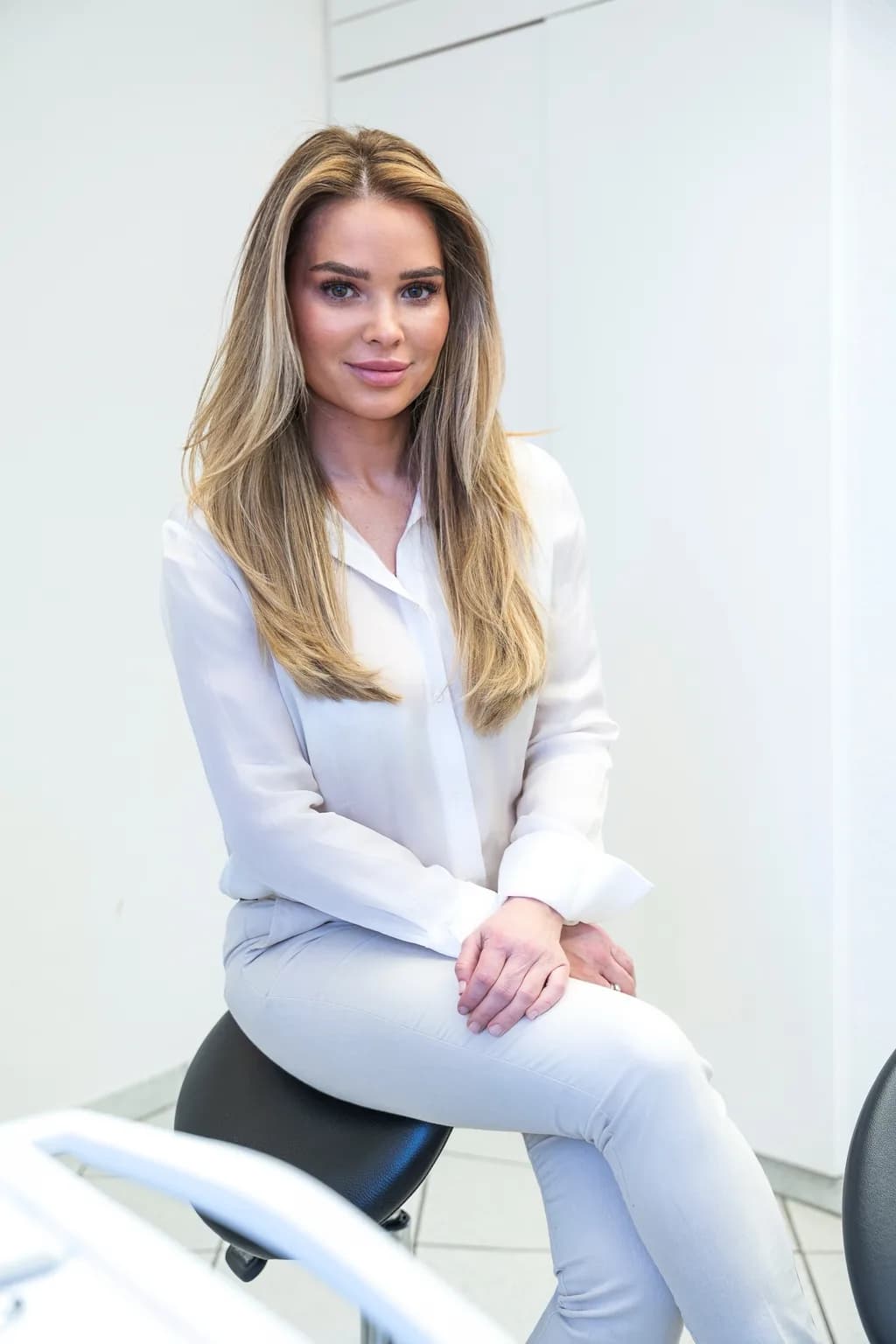
Dentist Christina Dickel plans and performs every step herself at our practice in Munich-Oberföhring — from 3D diagnostics to aftercare. If you would rather sleep through the procedure, that is possible: we treat under twilight sedation or general anaesthesia with a specialist anaesthetist on request.

How does All-on-4 work?
The concept was developed in the 1990s by the Portuguese dentist Paulo Maló and is now one of the most thoroughly studied approaches for the toothless jaw. Its core is the particular position of the implants:
- Two front implants stand upright in the jawbone, where the bone is usually still strongest.
- Two back implants are placed at an angle of up to about 45 degrees. In the upper jaw they avoid the maxillary sinus, in the lower jaw the nerve; they make better use of existing bone and support the bridge further back.
- One continuous bridge splints all four implants rigidly together. This splinting distributes chewing forces and is why the implants can be loaded immediately.
If there is enough bone for more implants, or if forces are particularly high, for example with heavy teeth grinding, we plan five or six implants per jaw (often called "All-on-6"). The principle stays the same; the bridge is simply supported more broadly. Which variant suits you is decided by the 3D scan, not by a fixed scheme.
Good to know: "fixed teeth in one day" requires the implants to sit firmly in the bone right away (primary stability). We check this for every implant during surgery. In the rare cases where the bone is too soft for that, you first receive a removable temporary and the fixed bridge follows after healing. If the diagnostics suggest this beforehand, we tell you honestly.

Who are fixed teeth in one day suitable for?
You are a good candidate if one of these applies to you:
- You have no teeth in your upper or lower jaw and wear a full denture you are unhappy with.
- Your remaining teeth are loosened by periodontitis or so badly damaged that saving them no longer makes sense.
- Your jawbone has shrunk, and conventional implants would only be possible with extensive bone grafting.
- You want as few procedures as possible and no months-long phase without fixed teeth.
When we look more closely
Some factors do not rule out All-on-4 in principle but increase the risk. We discuss them openly and, where needed, coordinate with your GP or specialist:
- Smoking reduces blood flow and increases the risk of healing problems and later inflammation around the implant. Pausing before and after surgery, or stopping altogether, clearly improves your chances.
- Diabetes is not a reason to exclude you if your blood sugar is well controlled. Poorly controlled diabetes slows wound healing.
- Bisphosphonates or denosumab (medication for osteoporosis or bone metastases) can increase the risk of jaw osteonecrosis. The drug, dose and duration matter; an individual assessment is essential.
- Radiotherapy to the head and neck, untreated periodontitis and severely limited oral hygiene must be taken into account before planning.
- Extreme bone loss in the upper jaw: in individual cases there is not enough bone even for angled implants. Alternatives such as a sinus lift or special implant types may then be considered, which we discuss with you or refer to specialised colleagues.
For a first assessment in two minutes, try our All-on-4 suitability check.
The process: from consultation to the final bridge
From the first consultation to the finished bridge usually takes four to seven months. You have fixed teeth from the day of surgery onwards.
1. Consultation and 3D diagnostics
At the first appointment we examine your mouth, discuss your wishes and medical history, and take a three-dimensional X-ray (CBCT). It shows bone height and width, and the position of the maxillary sinus and the lower jaw nerve. On this basis we decide whether All-on-4 is possible, how many implants make sense and whether immediate loading is realistic.
2. Planning and preparation
We plan the implant positions digitally and, together with the dental technician, define tooth shape, shade and smile line. You receive a treatment and cost plan (Heil- und Kostenplan) to submit to your health insurer. If you would like sedation or general anaesthesia, you have a consultation with the anaesthetist.
3. The day of surgery
- Anaesthesia: local, with nitrous oxide, twilight sedation or general anaesthesia on request.
- Removal of teeth that cannot be saved and thorough cleaning of inflamed areas.
- Placement of the four (or six) implants according to the digital plan, with a surgical guide where useful.
- Fitting the connecting parts (abutments) that compensate for the angle of the back implants, and suturing the gums.
- Impression or digital scan of the implant positions. While you rest, the lab adapts the provisional bridge.
- Fitting the fixed provisional bridge: it is screwed onto the implants and stays fixed from now on.
Expect to spend the whole day at the practice. After sedation or general anaesthesia you must not drive and need someone to accompany you home.
4. Healing and check-ups
Swelling and a feeling of tension are normal in the first days; painkillers and cooling help. We see you the next day and after about a week; stitches come out after seven to fourteen days. Over the following weeks the implants fuse firmly with the bone (osseointegration).
5. The final bridge
After three to six months of healing we make the final bridge. By then the gums have also settled after the extractions, so the new bridge fits precisely. You try in shape and shade beforehand, and we implement any changes before it is finished.
Provisional and final bridge: what is the difference?
The bridge you receive on the day of surgery is already fixed and looks natural, but it is deliberately simpler: it is made of acrylic and usually has slightly fewer teeth at the back, so the freshly placed implants are not overloaded when you chew.
The final bridge is designed for years of use. It consists of a rigid framework, usually titanium or zirconia, with teeth made of ceramic or high-quality composite. Which material suits you depends on, among other things, how hard you bite, whether you grind your teeth and how the opposing jaw is restored. The final bridge is also screwed in: you cannot remove it yourself, but we can take it off for check-ups and repairs.

Treatment under twilight sedation or general anaesthesia
Many people who choose fixed teeth in one day have avoided the dentist for a long time, often out of fear. The procedure takes several hours, so we offer three levels:
- Nitrous oxide: relaxed but awake and responsive. Better suited to shorter stages.
- Twilight sedation: you sleep lightly, breathe on your own and barely remember the treatment afterwards.
- General anaesthesia: you are completely unaware. A specialist anaesthetist monitors you throughout the procedure at our practice.
For the several-hour operation most patients choose twilight sedation or general anaesthesia. If anxiety plays a big role for you, our page for anxious patients explains how we approach the first conversation and the treatment day.
After surgery: eating, care, everyday life
The first weeks
- Soft diet: for the first six to eight weeks, eat foods you can mash with your tongue or a fork: soups, scrambled eggs, fish, mashed potatoes, cooked vegetables, yoghurt. Hard, chewy or crunchy foods (bread crust, nuts, steak) wait until healing is complete.
- Cooling during the first 48 hours, with breaks; keep your head slightly raised when sleeping.
- No smoking, at least until the wounds have healed, ideally for good.
- Oral hygiene from day one, gently with a soft brush and the rinse we give you.
Long-term care
Implants do not get caries, but they can become inflamed (peri-implantitis) if plaque builds up under the bridge. The most important care therefore happens at home: brushing, interdental brushes or superfloss under the bridge and, if you like, a water flosser. Add regular check-ups with professional cleaning at the practice, usually two to four times a year. When needed, we remove the bridge and clean the implants thoroughly.
All-on-4, implant-retained denture or full denture compared
| All-on-4 (fixed bridge) | Implant-retained denture (removable) | Full denture | |
|---|---|---|---|
| Retention | screwed in, fixed | clicks onto 2–4 implants (e.g. locators, bar, telescopes) | suction, adhesive often needed |
| Palate in the upper jaw | free | usually free or reduced | covered by a palate plate |
| Removal | only by the dentist | daily, by yourself | daily, by yourself |
| Chewing feel | close to natural teeth | much better than a full denture | limited, especially in the lower jaw |
| Bone loss | slowed around the implants | slowed around the implants | continues |
| Time to fixed teeth | on the day of surgery (provisional) | after healing, usually a few months | a few weeks |
| Cleaning | in the mouth, with brushes under the bridge | outside the mouth, easy | outside the mouth, easy |
| Procedure | implant surgery, often without bone grafting | smaller implant surgery | none |
No solution is best for everyone. People who value the feel of fixed teeth and do not want a plate on the palate are usually happiest with All-on-4. People who prefer to take their teeth out and clean them themselves, or prefer a smaller procedure, are well served by an implant-retained denture. You can read more about removable options on our full dentures page.

Immediate implant: not the same as All-on-4
The terms are often mixed up. An immediate implant replaces a single tooth: the tooth is removed and the implant is placed into the fresh socket in the same session. Depending on the situation it receives a provisional crown straight away, or it first heals in protected. It requires an infection-free socket with enough bone, especially on the outer wall.
All-on-4, by contrast, restores an entire jaw: four implants carry a complete bridge. Both approaches shorten the time without teeth, but they suit very different starting points. We clarify which one is right for you at the consultation. For an overview of all implant solutions, see implant dentistry.
What does German health insurance cover?
Implant-supported restorations such as All-on-4 are not part of the standard care (Regelversorgung) of German statutory health insurance. Statutory patients still receive something: the insurer pays a findings-based fixed subsidy (Festzuschuss). For a toothless jaw it is calculated from the standard care, i.e. a full denture, and is paid even if you choose a more elaborate solution.
- 60 percent of the standard care as the base amount
- 70 percent if your bonus booklet (Bonusheft) documents five years of regular check-ups
- 75 percent with ten years of uninterrupted check-ups
- up to 100 percent of the standard care for patients on low incomes (hardship rule)
Statutory insurance covers the implants themselves only in narrowly defined exceptional cases, for example after tumour surgery. Private health insurance and supplementary dental insurance reimburse a large share depending on the policy. Our guide to the fixed subsidy explains the details. We prepare your personal treatment and cost plan after the 3D diagnostics so you can submit it to your insurer before treatment.
Fixed teeth in Munich-Oberföhring
Our practice is in Munich-Oberföhring, easy to reach from Bogenhausen, Johanneskirchen, Englschalking and eastern Munich. Dentist Christina Dickel specialises in implant dentistry (curriculum of the German Society of Implantology, DGI) and carries out the entire treatment herself: 3D diagnostics and planning, surgery, provisional and final restoration, and aftercare.
At the first consultation we take time for your questions, look at the X-rays together and tell you openly whether fixed teeth in one day are the right path for you or whether another solution fits better. For background reading, see our guides to dental implants and jawbone loss.
Risks and safety
All-on-4 is an established, well-studied procedure. As with any surgery there are risks. Most are temporary and treatable.
Swelling, bruising, wound pain
Common in the first days
Cooling, painkillers, head raised; usually subsides after three to seven days.
Implant fails to integrate
Rare
Careful planning, checking primary stability, no smoking; an affected implant can usually be replaced.
Fracture or loosening of the provisional bridge
Occasional
Soft diet during healing; repair at the practice.
Inflammation around the implant (peri-implantitis)
Occasional, mainly long-term
Thorough cleaning under the bridge, regular professional cleaning, not smoking.
Numbness of the lip or chin (lower jaw)
Rare
3D planning showing the course of the nerve; usually temporary.
Sinus involvement (upper jaw)
Rare
Planning the angled implants to pass the sinus.
We minimise risks through 3D diagnostics with CBCT, digital implant planning, surgical guides where useful, sterile surgical conditions, honest assessment of risk factors before treatment and close check-ups during healing.
Qualifications and certificates
2014
Curriculum in Implant Dentistry
German Society of Implantology (DGI)
2015
Curriculum in Aesthetic Dentistry
German Society of Aesthetic Dentistry (DGÄZ)
2019
Curriculum in Functional Diagnostics
Dr. Seeher, Munich-Nymphenburg
2012
State Examination in Dentistry
Heinrich Heine University Düsseldorf
Frequently asked questions
Ready to take your first step?
Book an appointment for a personal consultation at our practice in Munich Oberföhring.