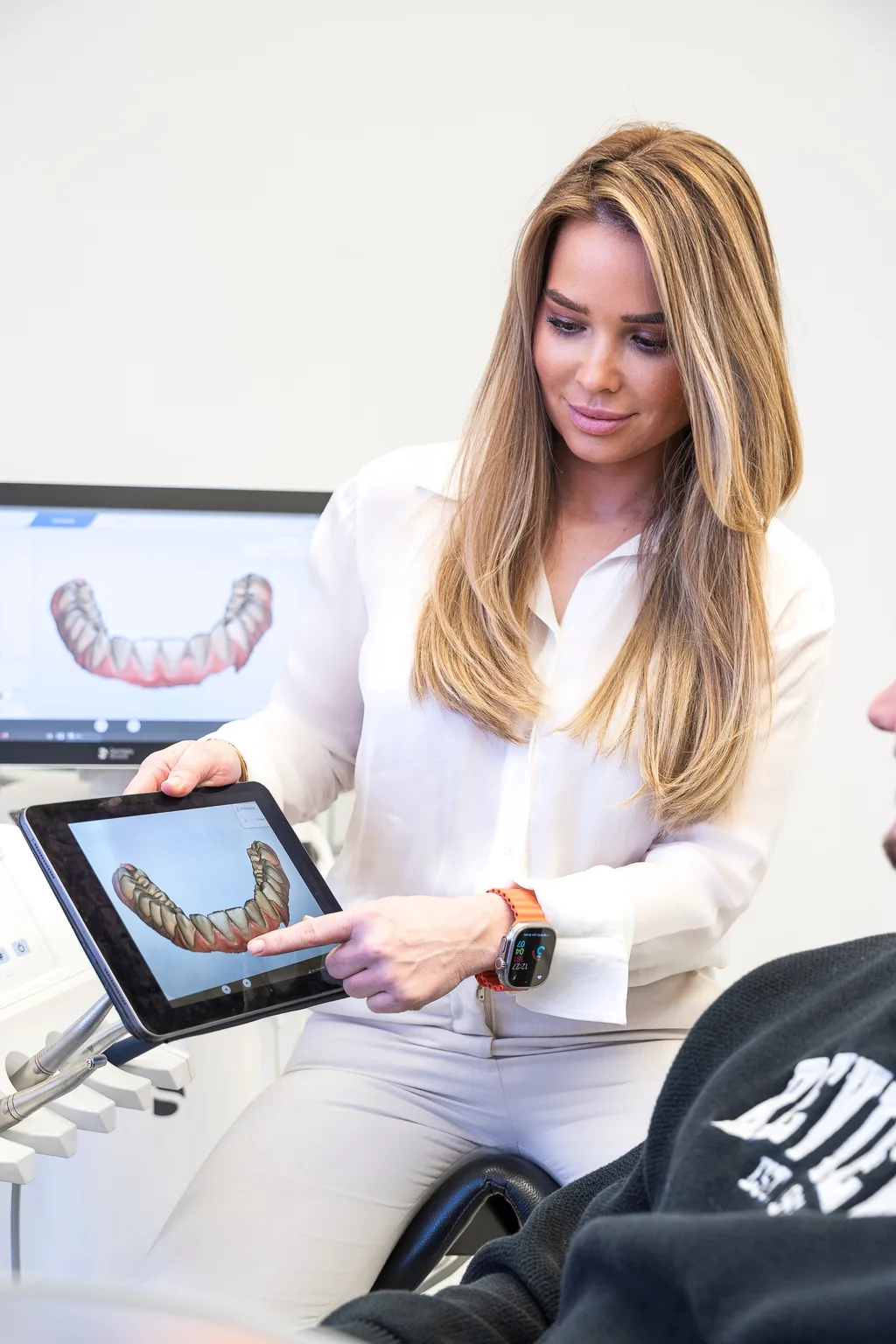
A composite filling is completed in a single appointment in the vast majority of cases — typically in 30 to 60 minutes. No temporary restoration, no second visit, no laboratory waiting time.
Inhaltsverzeichnis
Dental Filling — What to Expect
Almost everyone needs a filling at some point. If you feel apprehensive about the appointment, that is entirely understandable — and entirely unnecessary. A modern composite filling is one of the most routine, safest and most comfortable procedures in dentistry. In 30 to 60 minutes, completely pain-free under local anaesthesia, you leave our practice with a reconstructed, aesthetically natural-looking tooth.
What is composite? Composite is a resin-ceramic blend — a mixture of synthetic resin (Bis-GMA) and fine ceramic filler particles. The material is tooth-coloured, biocompatible and bonds chemically and mechanically to both enamel and dentine through the adhesive technique. The result: an invisible filling that is firmly integrated into the natural tooth structure.
Modern composites are the first choice when it comes to replacing tooth substance lost through decay or fracture. They are mouldable, layerable and can be precisely adapted to the shape of the tooth — and once cured with blue light (polymerisation lamp) they are hard, durable and highly polishable.
Do you feel anxious about treatment? We are experienced in caring for nervous patients and explain every step in advance. To learn more about why a filling becomes necessary in the first place, see our overview of caries treatment. Book your appointment now on 089 95760618.

Step by Step: How the Treatment Works
A composite filling is completed in a single appointment in the vast majority of cases — typically in 30 to 60 minutes. No temporary restoration, no second visit, no laboratory waiting time.

Anaesthesia
Before anything is done to the tooth, it is completely numbed with a local anaesthetic. We use modern articaine — a highly effective, well-tolerated local anaesthetic. You will feel no pain throughout the entire procedure — at most a slight pressure or the vibration of an instrument. For particularly sensitive areas we can apply a topical numbing gel beforehand, so that even the injection itself is barely noticeable.
Decay Removal
Once the tooth is numb, we remove the decayed tissue using fine rotary instruments. Our principle: as little as necessary, as much as required. We remove only the bacterially infected, damaged tissue — healthy tooth substance is left untouched. This minimally invasive approach is not a marketing promise but evidence-based tooth conservation: the more natural structure that is preserved, the more stable and long-lasting the tooth will be.
Conditioning (Adhesive Technique)
Composite does not adhere to the tooth on its own — the surface must be prepared. First, a mild acid gel is applied (etching), which microscopically roughens the enamel. This is followed by a liquid bonding agent (adhesive), which flows into the roughened structure and cures in place. The result is a durable micromechanical and chemical bond between the tooth and the filling material.
Layer Build-Up (SDA Technique)
The composite is not placed all at once but built up in several thin layers. After each layer, curing takes place using a blue LED polymerisation lamp (approx. 20–40 seconds). This incremental layering technique (SDA — Selective Directional Adhesion) reduces polymerisation shrinkage, minimises internal stress and ensures optimal material properties. Layer by layer, a stable, homogeneous filling volume is created.
Fine Shaping & Polishing
After the build-up, the filling is checked against the bite using articulating paper — no high point, no occlusal interference. Fine finishing and polishing instruments are then used to shape and smooth the filling so that it integrates seamlessly with the natural tooth form. The result: a mirror-smooth, tooth-coloured surface that is virtually indistinguishable from real enamel.
Modern Composites: Why Tooth-Coloured Is Better
For decades, amalgam was the standard filling material in the posterior region. That has fundamentally changed — for good reasons.
Amalgam: Why We No Longer Use It
Amalgam contains approximately 50% mercury — a heavy metal that can be released in trace amounts from the filling. While the health assessment is complex, the EU has largely banned amalgam since 2025. There is a further drawback: amalgam does not bond to the tooth but is mechanically wedged in. This means that more healthy tooth substance often has to be removed than the defect actually requires. And of course: the silver-grey appearance is visible — even when laughing.
Glass Ionomer: For Specific Situations
Glass ionomer cement is a fluoride-releasing material that is useful in certain situations: as a base layer, for temporary restorations or for deciduous teeth in the anterior region. It is easy to work with, releases fluoride continuously, but has lower mechanical strength than composite. For permanent restorations on adult teeth it is rarely the first choice.
Composite: The Modern Gold Standard
Composite combines the best of both worlds: it is tooth-coloured and aesthetically inconspicuous, bonds adhesively to the tooth (no unnecessary loss of substance), is metal-free and biocompatible, and achieves a service life of 7–10 years with modern layering technique — in many cases considerably longer. For large defects in the posterior region, ceramic inlays offer even greater longevity — we are happy to discuss the best option with you on a case-by-case basis.

How Long Will My Filling Last?
A well-placed composite filling lasts on average 7 to 10 years — with good care and regular check-ups often considerably longer; 15 years and more are achievable. Durability depends on several factors:
- Size and position: Small fillings in areas of low stress last longer than large restorations on heavily loaded molar teeth.
- Bite force and bruxism: Patients who clench or grind their teeth at night place disproportionate stress on fillings. An occlusal splint can protect against this.
- Oral hygiene: Regular, thorough brushing and interdental cleaning significantly extend the lifespan — secondary caries at the filling margin is one of the most common reasons for replacement.
- Diet: Frequent consumption of acidic or intensely staining foods (red wine, coffee, tea) can discolour or slightly roughen composite over time.
Signs that a filling should be replaced: discolouration or cloudiness of the material, rough edges detectable with the tongue, sensitivity to cold or sweet foods, a high-point sensation when biting, or visible marginal leakage. Not every one of these changes requires immediate replacement — regular check-up appointments and a professional dental cleaning every 6 to 12 months help to identify the right moment.
Costs and Insurance Coverage
The cost question around dental fillings is confusing for many patients. Here is a clear overview.
Statutory insurance coverage for back teeth: The statutory health insurer (GKV) covers the cost of an amalgam filling as the so-called standard care in the posterior region. Amalgam is officially considered adequate treatment. If you choose a tooth-coloured composite filling instead, you pay the difference between the GKV reimbursement and the actual cost yourself — this is the so-called co-payment agreement. The amount of the co-payment depends on the number of tooth surfaces involved.
Front teeth: On the anterior teeth (incisors, canines), tooth-coloured composite fillings are fully covered by statutory insurance — GKV patients pay nothing.
Fixed subsidy system: The GKV pays a fixed subsidy for each type of care, based on the least expensive medically adequate option. If you have kept your dental bonus booklet up to date (annual check-up for 5 consecutive years), your fixed subsidy increases by 20%; after 10 years it increases by 30%.
Private health insurance: PKV patients are generally fully reimbursed for composite fillings. The same applies to those entitled to civil service allowance (Beihilfe).
Filling or Inlay — Which Is Better for Me?
We hear this question regularly — and the answer is not a blanket one, but depends on the clinical situation.
When Is a Filling Sufficient?
For small to medium defects, a direct composite filling is the ideal solution: it is completed in a single appointment, is more cost-effective, and with the correct technique is very durable. As long as sufficient healthy tooth structure remains to support the filling and the cavity is not too extensive, composite is a fully adequate clinical choice.
When Is an Inlay Better?
For larger defects that involve multiple cusps of the tooth, or defects that require precise reconstruction of the chewing surface, ceramic inlays offer superior properties: the inlay is fabricated individually in the laboratory, can therefore be fitted more precisely, has a better marginal seal and higher compressive strength. A service life of 15–20+ years is realistic. The decision therefore depends on defect size, position, occlusal load and your personal priorities — we will advise you transparently.

After Treatment: Tips for the First Few Days
After a filling procedure there are a few things to bear in mind — most are straightforward and resolve on their own within a few days.
- First 2 hours — do not eat: The anaesthetic is still active. Do not eat until you have full sensation back — you could inadvertently bite your cheek or lip without realising it.
- First 24 hours: Avoid very hot or very cold foods and drinks, as well as intensely staining foods (red wine, coffee, turmeric). Composite can be slightly more susceptible to staining in the first few hours after polishing.
- Mild sensitivity for a few days: It is completely normal for the tooth to be somewhat more sensitive to cold or pressure for 2–5 days after a filling. This post-operative hypersensitivity resolves without any further measures.
When should you call us?
- Persistent or worsening pain lasting more than one week
- The bite feels wrong — a high point when closing your teeth together
- A piece of the filling breaks off
- Strong sensitivity to warmth (not cold) lasting more than 30 seconds
In any of these cases, please call us on 089 95760618 — we will find a prompt appointment for you.

Your Appointment for a Tooth-Coloured Filling
Do you need a filling — or would you like to know whether your existing fillings are still in good condition? Book your appointment with Dr. Christina Dickel in Munich-Oberföhring today.
What to expect:
- Pain-free treatment thanks to modern local anaesthesia
- Tooth-coloured, aesthetic result — an invisible filling
- State-of-the-art composites and layering technique (SDA) for long-lasting results
- Transparent cost information before treatment begins
- Evening appointments Mon–Thu until 7 pm — also for working patients
Call: 089 95760618 — or book conveniently online. We look forward to seeing you.
Kosten im Überblick
| Leistung | Preisrahmen | Hinweis |
|---|---|---|
| Single-surface (small filling) | €30–80 | One surface, typical for early-stage decay |
| Two-surface (medium filling) | €60–130 | Two surfaces, the most common type |
| Three-surface (large filling) | €90–180 | Three surfaces, borderline case for an inlay |
| Build-up filling (pre-crown) | €80–200 | Core build-up as a foundation for crown restoration |
Single-surface (small filling)
€30–80
One surface, typical for early-stage decay
Two-surface (medium filling)
€60–130
Two surfaces, the most common type
Three-surface (large filling)
€90–180
Three surfaces, borderline case for an inlay
Build-up filling (pre-crown)
€80–200
Core build-up as a foundation for crown restoration
The statutory health insurer (GKV) covers the cost of an amalgam filling as standard care in the posterior region. For a tooth-coloured composite filling you pay the difference yourself. For front teeth, composite is fully covered by statutory insurance.
Private health insurers (PKV) generally reimburse composite fillings in full. Civil servants entitled to Beihilfe also receive full reimbursement.
For more extensive treatments we offer instalment payments. Please do not hesitate to ask us.
Risiken und Sicherheit
Composite fillings are among the safest and most routine procedures in dentistry. Complications are rare.
Post-operative sensitivity
Common (mild, temporary)
Correct layering technique and adhesive protocol
Allergic reaction to composite
Very rare
Alternative materials available
Secondary caries (at the filling margin)
Rare
Precise marginal adaptation and regular check-ups
Filling fracture
Rare
Size-appropriate restoration, bite adjustment
Discolouration over time
Occasional
Polishing at check-up appointments; replacement possible
Through incremental layering technique (SDA), rubber dam isolation when indicated, high-quality composites and careful polishing, we minimise the risk of complications.
Häufige Fragen
No. With modern local anaesthesia (articaine), the procedure is completely pain-free. We numb the tooth fully before we begin. During treatment you may feel slight pressure or the vibration of an instrument — but no pain. After the anaesthetic wears off, the tooth may be mildly sensitive for 2–5 days; this is normal and resolves on its own.
A simple composite filling typically takes 30 to 60 minutes — depending on the size of the defect and the number of surfaces involved. Larger restorations may take 60–75 minutes. Unlike ceramic inlays, a composite filling is always completed in a single sitting — no temporary restoration, no waiting time.
Wait until the anaesthetic has fully worn off — usually 1 to 2 hours. Do not eat beforehand, as you could inadvertently bite your numb cheek or lip. For the first 24 hours we recommend avoiding very hot, very cold or intensely staining foods. After that there are no restrictions.
The assessment of amalgam is complex: it contains approximately 50% mercury, which can be released in very small amounts as vapour. International health authorities long classified amalgam as safe, but the EU has progressively restricted its use for precautionary reasons and due to environmental concerns. From 2025, amalgam is largely banned in the EU. We have not used amalgam for years — exclusively tooth-coloured, metal-free materials.
The GKV covers the so-called standard care — what is dentally adequate, not the best possible option. In the posterior region, amalgam has traditionally been considered standard care. For a higher-quality aesthetic composite filling, GKV patients pay the difference themselves. For front teeth, however, composite is fully covered by insurance, as there is no aesthetically acceptable alternative there.
In principle yes — but with important caveats: intact amalgam fillings that are causing no problems should not be replaced unnecessarily. Removal temporarily releases more mercury than simply wearing the filling. However, if amalgam fillings are leaking, need replacing anyway, or you wish to have them replaced for aesthetic reasons, we are very happy to do this — using special protective measures (rubber dam, high-volume suction, rinsing). Book a consultation on 089 95760618.
Typical signs include: discolouration or cloudiness of the composite, rough or sharp edges you can feel with your tongue, sensitivity to cold or sweet foods, a high-point sensation when biting, visible cracks or chipping. Not every one of these changes requires immediate replacement. At regular check-up appointments we assess the integrity of your fillings and detect problems before they worsen.
A filling or inlay is adequate as long as sufficient healthy tooth substance remains to support the restoration and distribute chewing forces onto the tooth. When more than 50% of the crown surface is destroyed, after a root canal treatment, in the case of a major fracture, or when the tooth is serving as a bridge abutment, a crown is the more stable solution. In borderline cases, a ceramic inlay can avoid the need for a crown — we advise you individually.
Yes, composite fillings are suitable for children's teeth and are used in both deciduous and permanent teeth. They are metal-free, aesthetic and bond adhesively to the tooth. For very young children or particularly anxious patients, glass ionomer can be a simpler alternative in certain situations. When cooperation is uncertain, we discuss all options with the parents, including sedation.
Private costs for composite fillings are based on the GOZ (scale of fees for dentists) and the number of surfaces involved. A single-surface filling typically costs €30–80, a two-surface filling €60–130, a three-surface filling €90–180. Private health insurance patients are generally fully reimbursed. As a GKV patient you pay the difference above the amalgam standard care rate. We always provide a transparent cost plan before treatment.
Qualifikationen und Zertifikate
2013
Dental degree (Approbation)
LMU Munich
2016
Certification in minimally invasive dentistry
German Society for Conservative Dentistry (DGZ)
2019
Advanced training in modern composite techniques
Moderne Zahntechnik Akademie
2016
Member of the German Society for Conservative Dentistry (DGZ)
DGZ
Verwandte Leistungen
More Treatment Options
Similar Treatments
Ready for your
Composite Filling?
Schedule your consultation appointment today and let our expertise convince you. We look forward to helping you achieve a healthy and radiant smile.
Treatment Overview:
Treatment Duration:
Sessions:
Investment:
Contact & Directions
Dental Practice Christina Dickel
Oberföhringer Straße 183a, 81925 München
Opening Hours
Mon:08:00-19:00
Tue:08:00-19:00
Wed:08:00-19:00
Thu:08:00-19:00
Fri:08:00-13:00
13+
Years Experience
4.9
★★★★★ Rating
100%
Satisfaction